Remarketing Audience Google Ads for Roofers: A Setup Guide
A homeowner searches for a roofer after work, compares a few companies, checks your replacement page, then closes the tab. You’ve paid to bring that person to your site, but the quote form is still empty. A well-built Google Ads remarketing audience gives you a measured way to follow up while the homeowner is still considering the job.
The trick is not to show the same ad to every visitor. For a roofing company serving a regional market, overly narrow lists can be too small to deliver, while aggressive tracking can undermine customer trust. Build audiences around useful signs of intent, keep the message relevant, and measure enquiries that could become jobs.
Table of Contents
- Remarketing Audiences Roofers Should Build First
- Privacy and Consent Rules for NZ Roofing Audiences
- How to Build Your Audiences in Google Ads, Step by Step
- Three Roofing Scenarios That Show the Audiences in Action
- Why Your Audience Stops Working and How to Fix It
- Which Audience to Switch On This Week
Remarketing Audiences Roofers Should Build First
Start with six audiences, each with a clear purpose. Use the general visitor list to provide reach, then separate higher-intent visitors so their follow-up ads match what they were looking for. Google Ads guidance for audience measurement defines conversion rate as conversions divided by trackable ad interactions, a useful reminder to track outcomes rather than count ad views as success. Google Ads’ conversion measurement guidance
| Audience | Built from | Lookback window | Ad message |
|---|---|---|---|
| All website visitors | Any page view from any traffic source | 30 days | Service area reminder and free inspection offer |
| Replacement and repair page visitors | Visits to replacement, repair or leak pages | 30 days | Replacement quote or repair booking |
| Quote-form starters | Started but did not submit the enquiry form | 7 days | Quick prompt to finish the quote |
| Engaged visitors | Two or more pages viewed or over 60 seconds on site | 90 days | Reviews and project examples for a longer decision |
| Commercial and new-build visitors | Visits to commercial or new-build pages | 90 days | Commercial capability and project references |
| Confirmed leads and customers | Converted enquiries and booked jobs | Ongoing exclusion | Suppressed from acquisition ads |
All website visitors is the general pool for 30-day reach. It can include someone who came from a Google search, an organic result, a blog post, or a social post. The service-specific lists then let you tailor the follow-up: someone who read about leak repairs should see a repair booking prompt, not a generic ad about commercial capacity.
Keep quote-form starters on a short window because their enquiry is unfinished and a quick reminder is more useful than a message months later. Engaged visitors and commercial prospects get longer windows, giving people time to compare options or make plans. If a visitor starts a form and submits it, make sure they leave the starter list and enter the appropriate lead workflow instead.
Exclude confirmed leads and customers from acquisition ads on an ongoing basis. Otherwise, a homeowner who has booked an inspection may keep seeing “get a quote” ads, wasting spend and making your follow-up look careless. A list is healthy when it grows steadily and each segment has a distinct message. If an audience is too small to serve, broaden it rather than adding more filters.
A relevant landing page helps carry the same promise from ad to enquiry. Make sure the page answers the service-specific question the ad raises, whether that’s a roof replacement, repair, or commercial project. This guide to roofing Google Ads landing pages can help you check whether the page is doing that job. To keep repeat impressions useful rather than irritating, use Exerta’s guide to reducing ad fatigue when planning how often your ads appear and how their messages change.
Privacy and Consent Rules for NZ Roofing Audiences
In a small regional market, a tightly filtered audience can become too narrow to serve. Keep the distinction clear: a page visit may help define an audience, while a name, phone number, or other identifying detail requires careful handling.
| Data source | Usable for remarketing? | Requirement |
|---|---|---|
| Website page visits through tag or cookie | Yes | Disclose the technology and explain opt-out options |
| Quote-form submissions as list membership | Yes | Use the form event, not personal details in the audience |
| Uploaded customer email or phone lists | Only with consent | Use eligible first-party data through Customer Match |
| Precise location data | Only with consent | Get explicit consent before sending precise location information |
| Personal details combined with cookies | No | Google’s personalised advertising policy prohibits this |
| Another client’s remarketing list | No | Do not use a list for an unaffiliated client |
New Zealand’s Privacy Act 2020 applies when tracking information can identify a person. Information Privacy Principle 10 restricts using personal information for a materially different purpose from the one it was collected for. If information gathered for analytics or account management will also support targeted advertising, explain that use and establish an appropriate basis. The New Zealand privacy law comparison guide outlines this framework and related rules for personalised advertising.
A quote-form event can define an audience without adding the person’s name or phone number to it. Google prohibits uploading personally identifiable information, combining it with cookies or pseudonymous remarketing data, and using one client’s list for an unaffiliated client. Check Google’s personalised advertising policy before activating a list or combining audience filters.
Make the notice clear
Your privacy notice should say that remarketing technology is used, explain that it can show ads based on past website visits, and tell visitors how to opt out through Google’s ad settings. Clear notice helps people understand what their visit data is used for.
For Customer Match, use only eligible first-party records collected with consent. Encryption protects the file during matching, but it does not make an ineligible contact list acceptable. Don’t upload detailed property addresses or send precise location information without consent.
Practical check: If a data source could identify a homeowner, document its purpose and consent basis before using it. Clients retain full ownership of their Google Ads accounts and data at all times.
How to Build Your Audiences in Google Ads, Step by Step
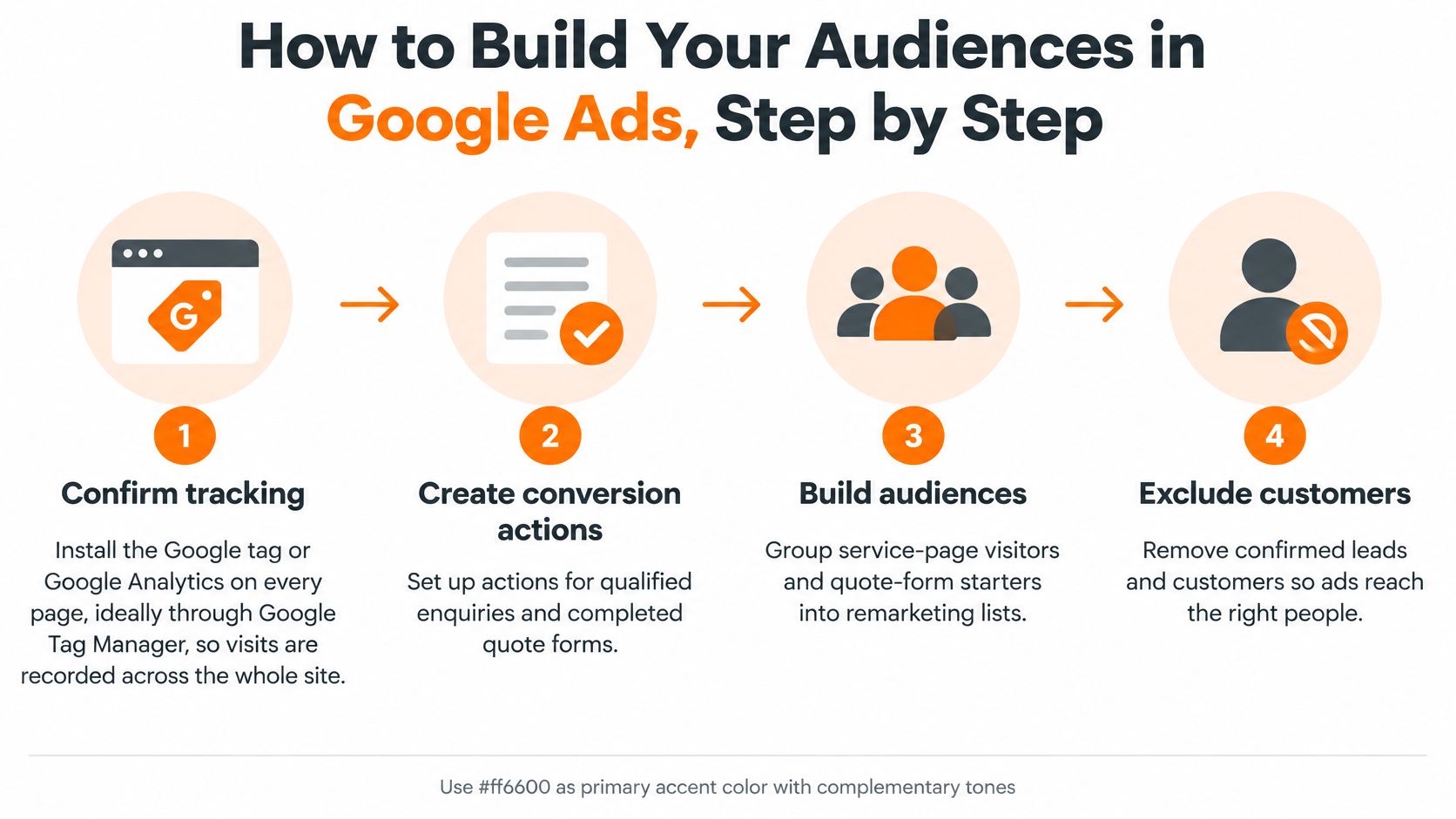
Use this sequence to build a remarketing system that can distinguish a casual page view from a real roofing opportunity.
-
Confirm tracking across the site. Check that the Google tag or Google Analytics is installed on every page, ideally through Google Tag Manager. If the tag misses a service page or the form confirmation, your audiences and conversion reports won’t reflect the full journey.
-
Create conversion actions for qualified calls and completed quote forms. Decide which action is primary for each enquiry, so one homeowner who calls and submits a form isn’t counted twice as two new leads. If phone calls are a major source of work, record their outcomes in a way that lets you separate qualified enquiries from irrelevant calls.
-
Build page-based visitor lists in Audience Manager. Create lists using page rules, such as URLs containing “replacement”, “repair”, “gutters” or “commercial”. Page visits are useful signals because they let you show a relevant message without putting personal details into the audience.
-
Set each membership duration to match the audience. Use 30 days for general visitors and replacement or repair visitors, 7 days for quote-form starters, and 90 days for engaged and commercial visitors. A longer window gives people more time to consider a substantial project, while a short form-starter window keeps the prompt timely.
-
Create a form-starter list and exclude submitters. Use a form-start event to identify people who began an enquiry but didn’t finish, then remove anyone who submits the form from that list. Test the event yourself so a successful submission doesn’t continue to trigger an unfinished-form message.
-
Create an exclusion list for confirmed leads and customers. Add eligible, consented lead or customer records through an appropriate first-party process, and apply the exclusion to every acquisition campaign. Keep exclusions current as enquiries become booked jobs or completed work.
-
Add remarketing after the search campaign is in place. A keyword-based search campaign catches active demand; remarketing gives you a way to reconnect with visitors who didn’t enquire on their first visit. Bluelight starts new Google Ads accounts with search and then adds remarketing as the second campaign type.
-
Use Search audiences carefully and keep visual campaigns separate. For Search, add remarketing lists for search ads (RLSA), first in observation mode so you can see how past visitors and quote starters search. Add bid adjustments only when a list is large enough to serve, and keep Display and YouTube remarketing separate so each audience can receive its own message.
-
Check list size and reporting after launch. If a segment is too small to serve, widen it by combining related service pages or extending its window rather than stacking on more filters. A working setup has lists growing steadily, exclusions in place, and calls and forms attributed to the right conversion actions.
Three Roofing Scenarios That Show the Audiences in Action
Consider a two-person re-roofing company in Hamilton. A homeowner visits the re-roofing page at night, reads about the process, and leaves without enquiring. The all website visitors list can bring that person back into reach with a service-area reminder and a free inspection offer, while the replacement-page list can show a more specific quote message.
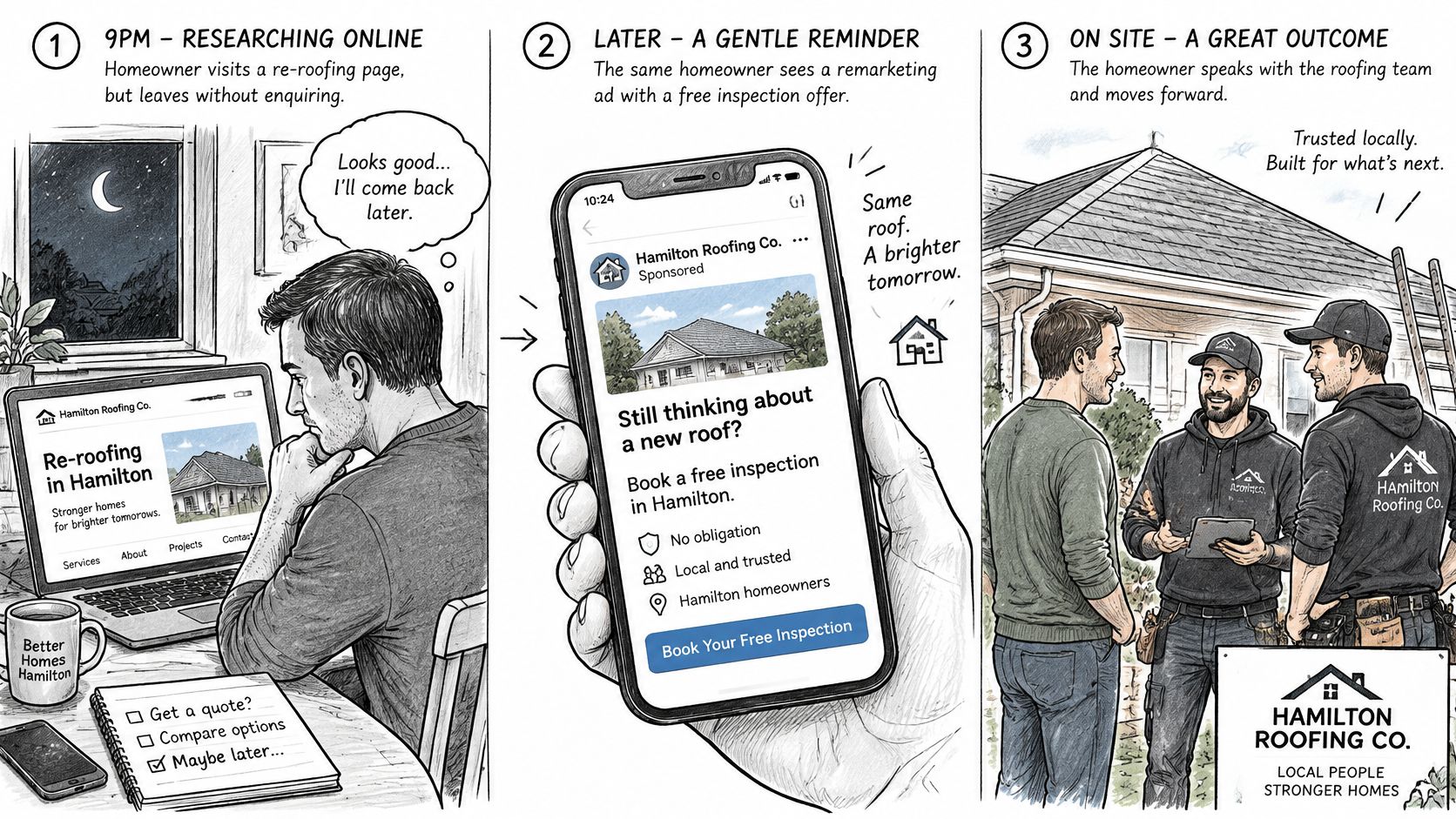
Next, someone starts the quote form but stops halfway. The quote-form starters list can show a brief prompt to finish the enquiry while the visit is still recent. Don’t use an ad that assumes the homeowner has already booked or pressures them to act. A simple reminder is more appropriate, and the form itself should be easy to complete on a phone.
Past enquiries need a different treatment. The company should capture consent and lead source, then classify each enquiry in its CRM as qualified, booked, sold, lost or invalid. Only eligible, consented records should be used for customer-list matching. Keep open estimates, lost quotes, past customers and maintenance opportunities in separate lists, and suppress sold customers from acquisition campaigns.
The ad message should reflect the status. An open-estimate follow-up can invite the homeowner to ask a question or book an inspection. A lost-quote audience, after an appropriate interval, could receive a maintenance-focused message rather than another push to accept the original estimate. Google’s AU/NZ guidance describes Customer Match as using consented first-party data, with uploaded files encrypted for matching, and supports its use across Search, Shopping, Gmail, YouTube and Discovery campaigns. See Google’s AU/NZ guide to durable audience solutions before setting up that workflow.
Most people don’t say yes the first time. Remarketing lets you stay in the conversation instead of getting forgotten.
The company should judge the system by qualified-lead rate, cost per qualified lead, estimate-to-sale rate and incremental revenue, not by cheap form submissions alone. Keep the sequences simple: capture the right information, classify the enquiry, use only eligible records, and ensure the ad matches the person’s current relationship with the business.
Here’s a short visual walkthrough of the homeowner journey and follow-up sequence.
Each audience gets one relevant message. A homeowner who has already bought should never see the acquisition offer again.
Why Your Audience Stops Working and How to Fix It
A remarketing audience can be too narrow to serve, especially in a small regional roofing market. For example, visitors to one service page from a single suburb may not provide enough eligible people for ads to show consistently. Google also restricts combinations of geographic and other filters that make audiences overly narrow. Check Google’s remarketing audience policy before adding another location or behaviour rule.
| Symptom | Likely cause | Fix |
|---|---|---|
| Audience too small to serve | Too many filters, such as one suburb plus one service | Widen to a regional or service-level list |
| Ads stop showing | Membership window too short or list too small | Extend to 90 days and combine related service pages |
| Clicks rise but calls do not | Converters not excluded or call conversion not tracked | Exclude converters and check call tracking |
| Duplicate enquiries counted | Phone and form events both recorded as conversions | Use one primary conversion per enquiry |
| Returning users look most valuable | High-intent selection bias | Run a holdout or geo-split test before scaling |
New Zealanders are increasingly concerned about how their personal information is collected and want clear notices and meaningful control over its use. Explain what tracking does, obtain consent where required, and avoid building audiences from layers of highly specific targeting. A broader regional or service-level audience can give a campaign more room to serve without relying on intrusive targeting.
Diagnose before changing bids
If ads stop serving, check the list size and whether its membership window fits the roofing decision cycle. If clicks rise but calls do not, confirm that leads are excluded and call tracking works before changing the budget. A click alone does not show that someone is a qualified job opportunity.
Returning visitors may convert more often because they were already considering a roofer before seeing a remarketing ad. Where practical, use a holdout group or geo-split test to compare people who see remarketing with a similar group who do not. Avoid scaling on a handful of conversions or a simple before-and-after comparison.
Use this Google Ads conversion tracking guide to check whether calls and forms are recorded correctly. In a regional market, widen the audience to a regional or service-level list before adding filters, then assess the change using qualified enquiries and booked inspections, not clicks.
Which Audience to Switch On This Week
A 30-day service-page audience and a 7-day quote-form-starter audience give a roofing campaign two useful starting points. Exclude confirmed leads and customers from both. The first list can provide broader reach; the second focuses on people who started an enquiry but did not complete it.
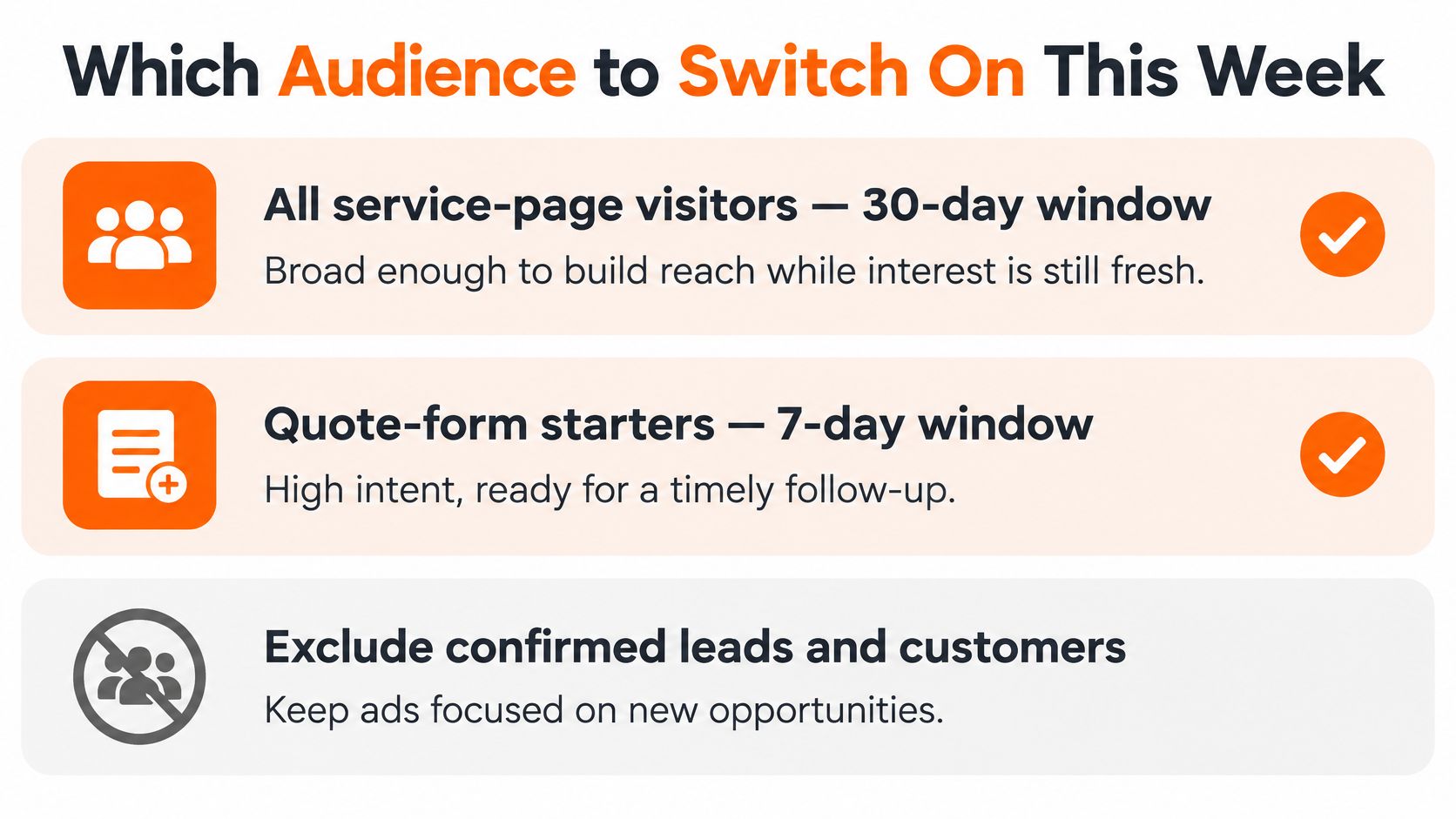
In a small regional market, even a sensible audience can be too narrow to serve consistently. Start with these two lists, then check whether they are growing and ads are receiving impressions. If a list is too small, widen it to include more relevant service-page visitors before adding filters. Keep consent expectations in view: New Zealanders increasingly expect more control over how their personal information is collected and used.
Search remains a practical starting point for reaching people actively looking for roofing work. New Zealand’s advertising market reached NZ$4.115 billion in total revenue in the 12 months ending 31 December 2025. Digital advertising generated NZ$2.967 billion, while search advertising accounted for NZ$1.44 billion, up 12% year over year. These market-level figures do not represent Google-only or remarketing spend. The New Zealand advertising market figures reported by Scoop provide context, but your calls, qualified enquiries and booked jobs should guide your budget.
Data quality matters as tracking changes. The 2025 IAB New Zealand Digital Advertising Forecast says first-party data is increasingly important for addressing tracking gaps and supporting optimisation. Build audiences from visitors who have given appropriate consent, and use clear notices about data collection.
Run the two audiences for 30 days. Compare cost per qualified enquiry, booked inspection rate and estimate-to-sale rate with Search. Check list growth, exclusions and qualified calls before changing the setup. A smaller consented audience can be more useful than a larger list if its leads can be connected to outcomes.
Bluelight advises roofing companies to start with Search and remarketing before testing other campaign types. Keep the first test simple: use relevant ads, confirm lead tracking works, and assess results by qualified outcomes rather than impressions.
Bluelight offers a free 30-minute ad account review covering what’s working, where budget is leaking, and the two or three changes most likely to improve results. For a roofing-focused review of remarketing audiences and conversion tracking, visit Bluelight.
Related service Google Ads for Roofers