Conversion Rate Optimisation for Roofers: Win More Jobs
You’re paying for roofing clicks, but the diary still has gaps. A homeowner taps your roof repair advert, lands on a homepage full of general company information, and leaves without calling. You bought the visit, but you didn’t get a chance to quote.
The answer isn’t automatically more advertising. Conversion rate optimization means improving what happens after the click, then checking whether those changes produce jobs you can book. For a roofing business, a page that generates fewer enquiries can be the better page if more of them become worthwhile inspections and signed work.
Table of Contents
- How Conversion Rate Optimization Works for Roofers
- Metrics Worth Tracking Before You Change Anything
- How to Turn Enquiries Into Testable Hypotheses
- How to Run a Landing Page A/B Test That Gives a Trustworthy Answer
- Landing Page Changes That Lift Qualified Enquiries
- Compliance-Safe Wording for Roofing Pages
- Start Your First Landing Page Test This Month
How Conversion Rate Optimization Works for Roofers
Conversion rate optimisation is the work of getting more existing visitors to take a useful next step. That might be a connected phone call, a quote request or an inspection booking. It isn’t just making buttons brighter or removing every question from a form.
Think of your marketing as water passing through connected pipes. You pour traffic into the top, but visitors can disappear between the advert, landing page, enquiry, inspection and signed job. Increasing traffic before finding those leaks can mean paying for more of the same waste.
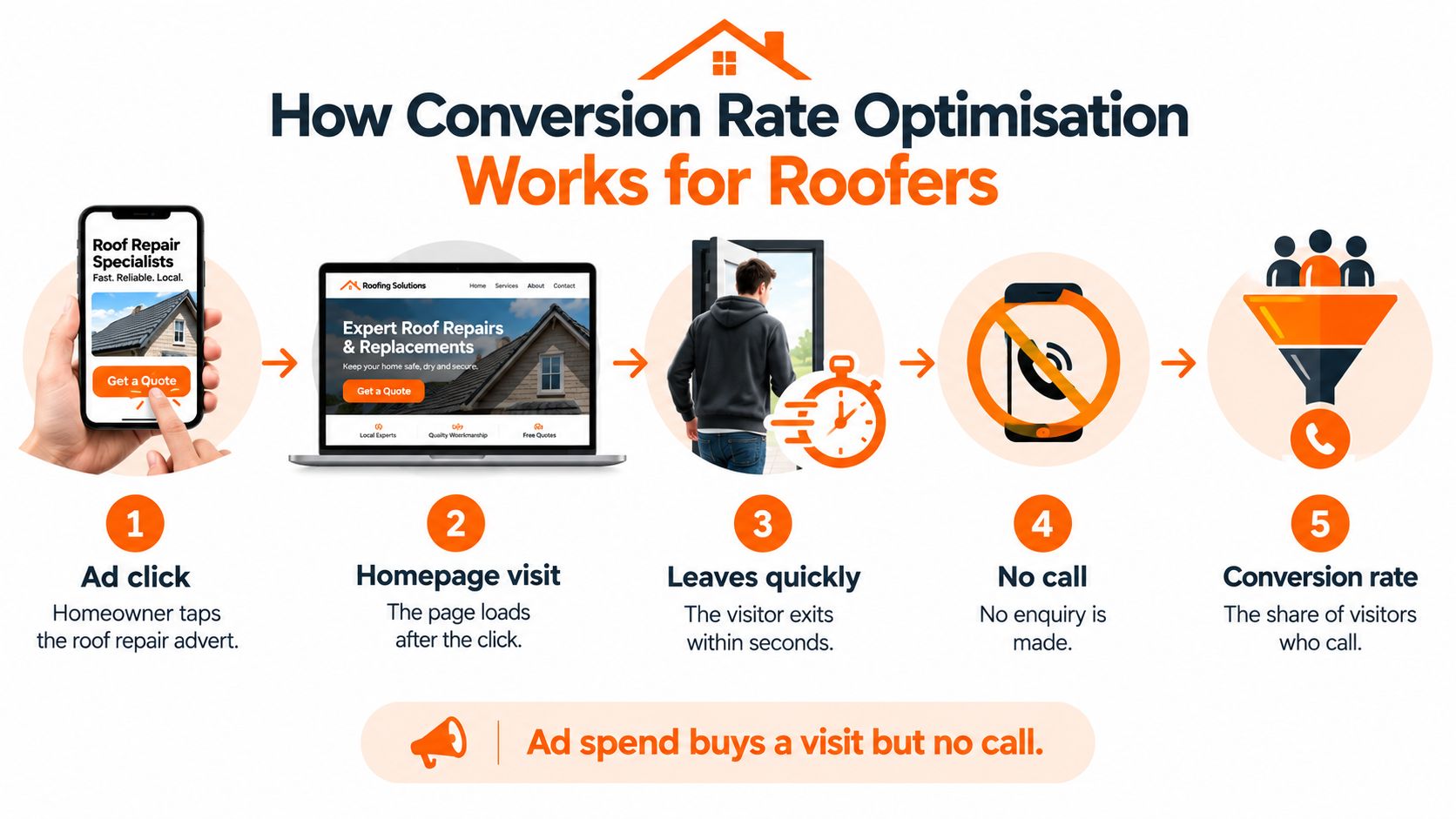
Calculate the action you actually want
The basic calculation is:
Conversion rate = conversions ÷ landing page visits × 100
For a hypothetical example, say 400 visits produce 12 enquiries. That’s a 3 per cent conversion rate. If the same traffic produces 16 enquiries, the rate becomes 4 per cent, giving you a third more enquiries without additional ad spend.
Those figures explain the arithmetic, not a roofing industry benchmark. Whether the improvement helps your business still rests on the quality of those extra enquiries and your ability to turn them into profitable work.
A roofing job doesn’t need to sell online for this measurement to work. Record the initial contact digitally, then connect it to the inspection, quote and eventual outcome in your customer records.
Give each search a relevant destination
Only 53% of businesses had a website in InternetNZ’s 2025 .nz consumers and businesses research, unchanged from its 2022 survey. That’s a business-wide finding, not a roofing-specific figure, but it highlights the opportunity to provide useful information through a dedicated site.
A homeowner searching for metal roof repairs shouldn’t have to work through commercial roofing, gutters and company history before finding help. Send that visitor to a page with the right service, relevant local projects and a clear enquiry route.
If your existing website makes campaign pages difficult to publish, a dedicated tool such as Landra’s landing page builder is an option to assess. Check tracking integration, mobile layout and editing control before choosing a platform.
Map your own funnel before changing the design:
- Ad click: Which roofing search brought the visitor?
- Page visit: Did the destination match that search?
- Call or form: Did the homeowner make contact?
- Booked inspection: Was the enquiry suitable and scheduled?
- Signed job: Did the quote become work?
Metrics Worth Tracking Before You Change Anything
Landing page metrics and how to calculate them
| Metric | How to calculate | What it tells you |
|---|---|---|
| Visit-to-call rate | Calls divided by landing page visits, times 100 | Whether the page’s main action is working |
| Form completion rate | Submitted forms divided by form starts, times 100 | Where friction sits inside the form |
| Qualified enquiry rate | Enquiries in your service area and job type divided by total enquiries, times 100 | Whether the page attracts buyers you can serve |
| Inspection booked rate | Inspections booked divided by qualified enquiries, times 100 | Whether the offer convinces serious buyers |
| Cost per qualified enquiry | Ad spend divided by qualified enquiries | The real cost of a serviceable lead |
| Won job rate | Jobs won divided by quotes sent, times 100 | Whether quotes close into paid work |
| Mobile conversion rate | Mobile conversions divided by mobile visits, times 100 | Whether phone visitors can act easily |
Establish a clean baseline before editing the page. I’d reserve two to four weeks for checking tracking and collecting an initial comparison period, extending that window when enquiries are sparse. That’s a practical starting point, not a guarantee that you’ve collected enough evidence.
Use consistent definitions. A phone-button tap isn’t necessarily a connected call, and a form submission isn’t automatically a new customer. Exclude spam, supplier calls and duplicate submissions from your lead totals.
Define qualified before counting it
At minimum, a qualified enquiry must concern a job type you perform in an area you serve. Add other criteria only when they reflect genuine operating constraints, such as whether you accept small repair work or handle commercial properties.
Form fills can flatter a weak page. A vague offer might attract plenty of enquiries while leaving your estimator to explain that you don’t cover the suburb or provide the requested service.
Commercial rule: Judge the page by serviceable opportunities, not how busy it makes your inbox.
Inspection bookings also need context. If suitable customers can’t get an appointment because your estimator is unavailable, changing the headline won’t solve the bottleneck. Likewise, won job rate reflects quoting, pricing and follow-up as well as the original landing page.
Keep reporting manageable
Use a lead sheet or CRM to store source, service, suburb, qualification, inspection status and quote outcome. Bluelight’s explanation of conversion tracking provides useful context for connecting website actions with advertising measurement.
For teams managing several campaigns or regions, AdCrunch’s guidance can help you optimize multi-account advertising workflows without losing sight of the underlying performance measures.
Choose one primary metric per page, with two supporting metrics, and review them in the same weekly slot. Qualified inspections per visit is a useful primary measure; cost per qualified enquiry and won job rate can show whether the improvement holds commercially.
How to Turn Enquiries Into Testable Hypotheses
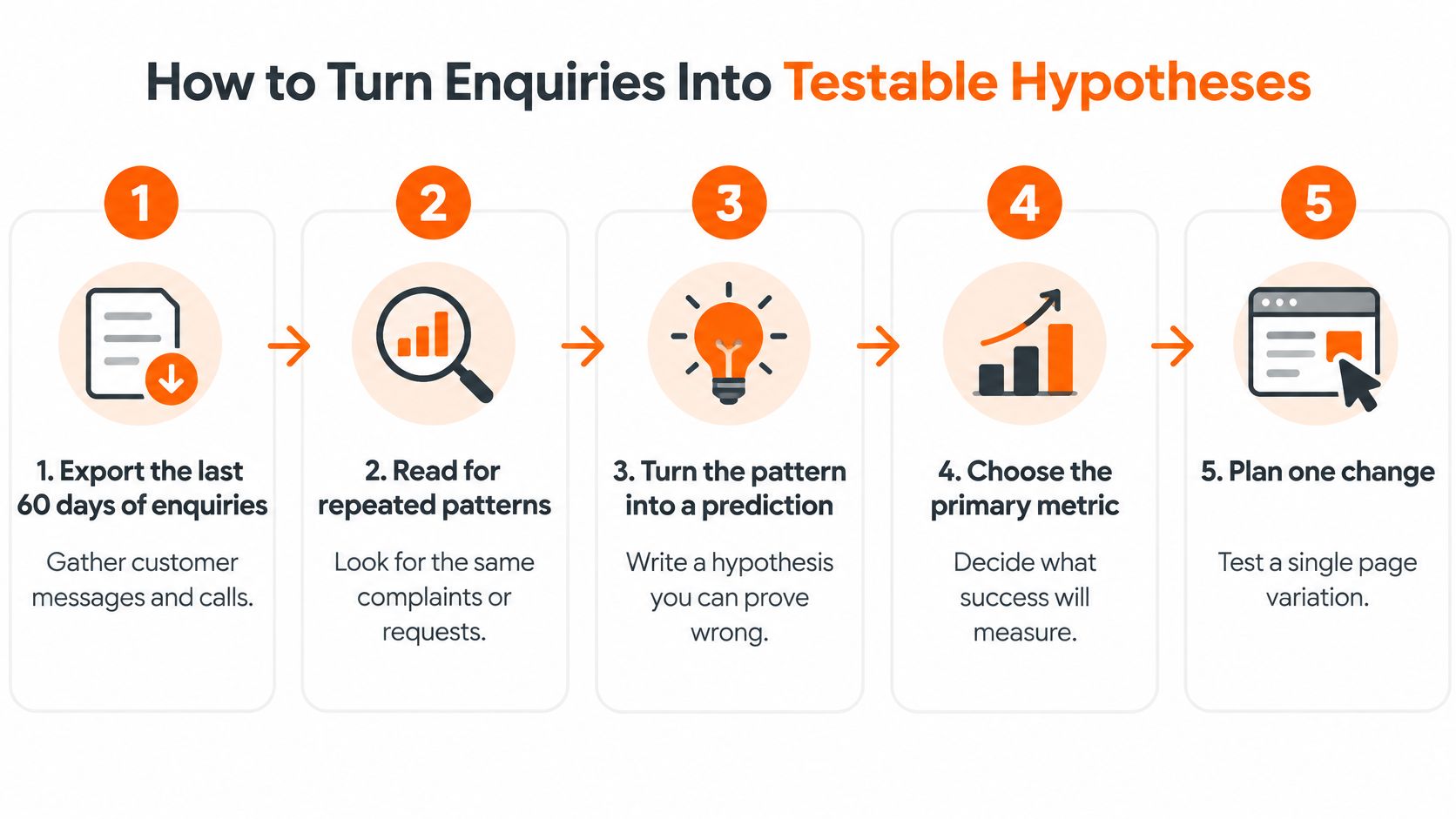
A hypothesis is a prediction you can prove wrong. It names a problem, proposes a change and specifies the outcome you expect. Start with customer questions rather than a designer’s preference for a different layout.
Convenience was the leading reason for buying online, cited by 68% of New Zealand respondents, in the 2024 Australian and New Zealand Ecommerce Report published by IAB New Zealand, which surveyed 1,000 shoppers in each country in July 2024. For roofing pages, the useful application is to make the next step understandable and manageable, not to pretend a roof replacement is an online checkout.
Extract patterns from real enquiries
-
Export the last 60 days of enquiries. Gather forms, call outcomes and estimator notes in a spreadsheet. Keep the original source and landing page where available.
-
Listen to 20 recorded calls, where recording and access are appropriate, or review equivalent call notes. Tag objections such as price, timing, service area, DIY attempt and wrong job type. Include missed calls and unsuccessful conversations, not just customers who booked.
-
Count repeated objections. Separate what customers explicitly said from what you inferred. Someone asking about your coverage is evidence of uncertainty about location, not proof that your prices are too high.
-
Turn a pattern into an if-then-because prediction. For example, if the page displays served suburbs beside the form and asks visitors to select their suburb, then out-of-area submissions should fall because homeowners can check eligibility before contacting you. Measure qualified inspections per visit alongside total submissions.
-
Rank hypotheses by frequency multiplied by likely revenue impact. A recurring issue that blocks replacement enquiries deserves more attention than a rare question about a service you scarcely provide. Record your reasoning rather than inventing precise revenue forecasts.
-
Pick one hypothesis for the next test. Keep the others in a backlog with the evidence that prompted them.
Include hesitation, not just complaints
Customers may ask who receives their details, whether an inspection commits them to anything, or whether you’ll call during working hours. Treat those questions as candidates for clearer identity, privacy and process wording.
Don’t automatically answer price objections with discounts. A homeowner comparing quotes may need to understand material specifications, preparation, access costs or exclusions before they can compare fairly.
For each hypothesis, write down what would make you reject it. If the change increases submissions but reduces suitable inspection bookings, it hasn’t delivered the intended outcome.
A hypothesis without a measurable outcome is an opinion.
How to Run a Landing Page A/B Test That Gives a Trustworthy Answer
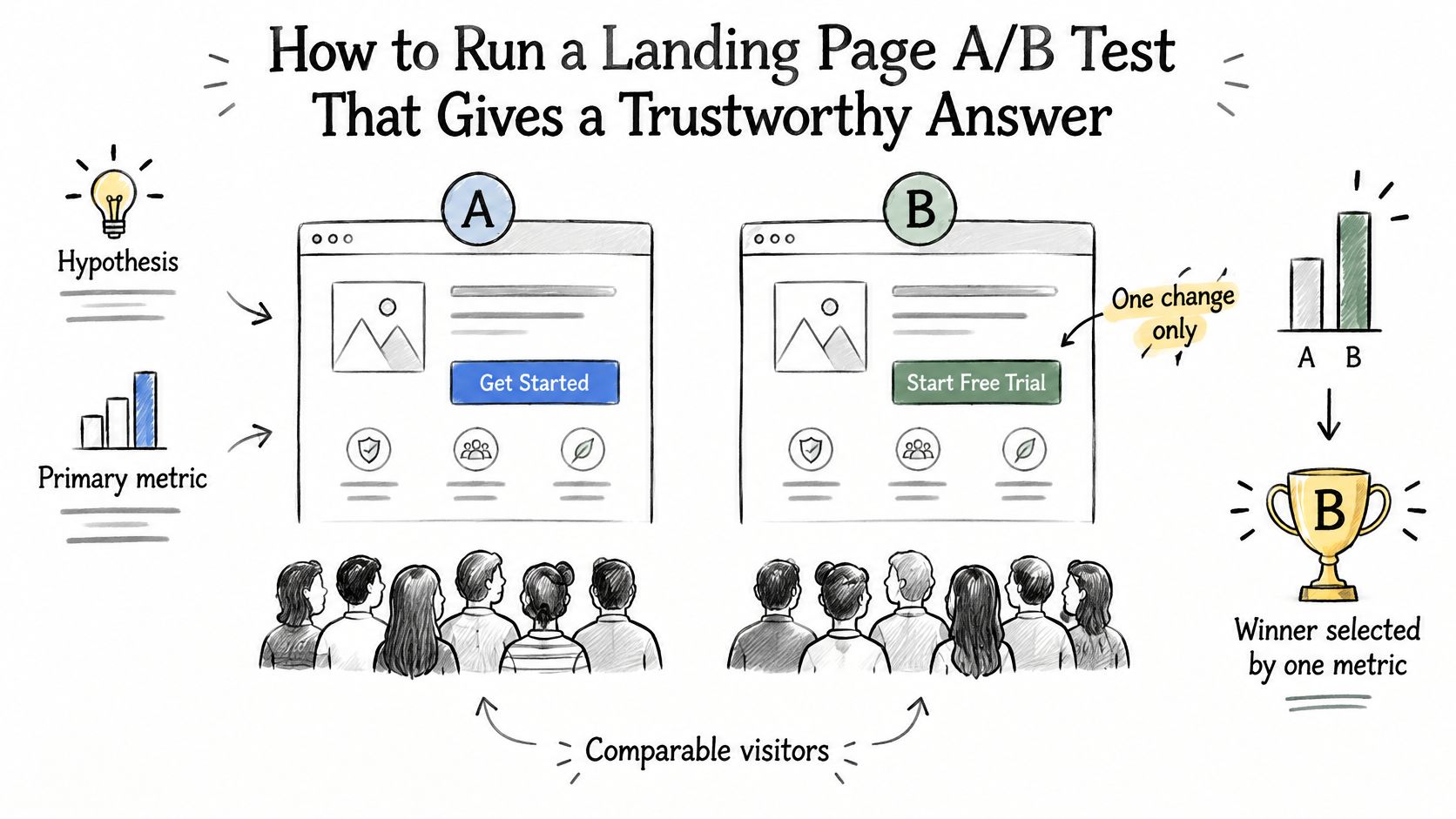
Change one element at a time when you need to identify what caused a result. An A/B test shows comparable visitors different page versions concurrently, then compares the chosen outcome. Replacing the headline, form, imagery and offer together tests a package, not the contribution of each element.
Figr’s A/B testing best practices offers a useful planning reference. Your own test still needs a commercial outcome and a stopping rule that suits your traffic.
Write the rules before launch
- Record the hypothesis and primary metric. Specify the eligible traffic and how you’ll identify qualified enquiries.
- Change the headline, form length, call button or proof block. Leave unrelated elements alone.
- Split traffic evenly using an experiment or website testing tool. Preserve comparable targeting and keep returning visitors on a consistent version.
- Set the stopping rule in advance. A planning rule of thumb is at least 100 conversions per version, but that isn’t a statistical guarantee. Required sample size also reflects baseline performance and the improvement you want to detect.
- Run for at least two full weeks to include weekday and weekend behaviour. Treat this as a minimum operating window, not proof of certainty.
- Check mobile and desktop separately, including whether either version has a technical fault.
- Record the result, including losses. Save the dates, page versions, traffic conditions and downstream lead outcomes.
A useful candidate could be a scope-assessment FAQ beside a reroofing enquiry form. The Roofing Association of New Zealand submission to the Commerce Commission explains that some reroofing is exempt from building consent under Schedule 1 of the Building Act, while relevant products must still meet New Zealand Building Code performance requirements. Test whether a clear assessment process encourages suitable inspection requests, not whether an oversimplified promise attracts more clicks.
Common testing mistakes, why they mislead and how to fix them
| Mistake | Why it misleads | Fix |
|---|---|---|
| Ending a test after two days | Early swings look like winners | Run to the planned sample size |
| Changing ads and page together | You cannot tell which change worked | Change one variable per test |
| Counting form fills as wins | Junk enquiries inflate the numbers | Track qualified rate and inspections booked |
| Averaging mobile and desktop | Mobile losses hide in the average | Report results by device |
Take a different approach with low volume
Say a version receives 12 enquiries a month. Reaching 100 enquiries for that version would take roughly eight and a third months at the same pace. Waiting that long may be impractical for a small roofer.
Instead, test a substantial, evidence-led change for a full month with a qualified-enquiry target written down. Treat the result as directional, acknowledge changes in weather and demand, and don’t label a small difference conclusive.
An inconclusive test isn’t permission to declare your preferred design the winner.
If neither version wins, keep the original, log the lesson and choose another hypothesis.
Landing Page Changes That Lift Qualified Enquiries
Landing page elements, weak versus stronger versions
| Element | Weak version | Stronger version |
|---|---|---|
| Headline | Quality roofing services | Re-roofs and repairs in named suburbs |
| Main action | Contact link in the footer | Click-to-call button above the fold with a short form |
| Form fields | Name, email, phone, address, budget, message | Suburb, roof type, job type, preferred contact |
| Proof | Claims such as best in town | Named local projects with photos, suburb and job type |
| Service area | Not mentioned | Served suburbs listed clearly |
| After submitting | Blank confirmation page | What happens next and when to expect a call |
A roofing page should help the right homeowner act and let unsuitable prospects recognise the mismatch. These stronger versions are test candidates, not promises that every page will improve.
A job-and-location headline lets the visitor check relevance immediately. Name actual suburbs you serve and the work you want, rather than suggesting you handle every roofing problem across an entire region.
Make the contact route usable
Put the call option and short form in the initial screen area where the layout allows it. On phones, place the call button within comfortable thumb reach, and check that a persistent button doesn’t cover form controls or privacy text.
Ask for suburb, roof type, job type and preferred contact, then reveal the relevant phone or email field. Give homeowners an unsure option for roof material so they don’t have to guess or abandon the enquiry.
A little qualification can be useful friction. Requiring a full street address and detailed project description before any conversation may be unnecessary, while asking repair versus replacement can help route the request to the right person.
Replace reassurance with evidence
Local project proof should identify the suburb, roof type and work completed, with permission to publish the details and photos. Show what the homeowner can evaluate, such as replacement scope or a relevant finished roof, rather than relying on generic praise.
MBIE’s New Zealand Consumer Survey 2022 report found that 64% of consumers remained concerned about the security of their payment and personal information. That makes a visible business name and concise explanation of how enquiry details will be used sensible elements to test.
- Identify the recipient: Make clear which roofing business receives the request.
- Explain the purpose: Say that contact information will be used to discuss the roofing job, if that matches your actual practice.
- Set the next step: Describe who will respond and what information they’ll confirm.
- Keep promises realistic: State that you’ll contact the homeowner within one working day only if your team can consistently do it.
The confirmation page should acknowledge receipt without implying an inspection is already booked. Keep contact details accessible if the homeowner needs to correct something.
For a wider layout assessment, use the same criteria when evaluating roofing website design. Attractive presentation helps, but it doesn’t replace clear scope, credible proof and a contact route that works.
Compliance-Safe Wording for Roofing Pages
Consent wording should describe an assessment, not promise an outcome before you know the job. Whether consent is needed turns on the proposed scope and circumstances, so a blanket statement that reroofing never needs consent is unsuitable landing-page copy.
The useful distinction is between an exemption from the consent process and the performance obligations that still apply. Don’t let a short marketing headline collapse those separate questions into a claim your estimator later has to correct.
Use scope-based wording
Keep the initial explanation plain: your team needs details of the existing roof and proposed work before confirming the appropriate next steps. Don’t present an enquiry form as a legal determination.
Build a short FAQ around the questions a homeowner needs answered:
- Does my reroof need consent? Explain that you’ll assess the proposed scope rather than promise an exemption.
- What about roofing materials? Distinguish product performance requirements from the consent question.
- What if the work isn’t exempt? Explain that the consent pathway must be confirmed before proceeding, without implying your business provides services it doesn’t offer.
Ask about existing roof material, approximate roof age and planned changes when those details help assess the enquiry. Include an unknown option, and use conditional questions rather than making every visitor complete a technical questionnaire.
The shortest possible form may not be the best form. A homeowner proposing substantial changes needs a different conversation from someone reporting an isolated leak.
Check every claim before publishing
Apply a simple pre-publication check:
- Can I show the claim? Keep evidence for project details, warranties, qualifications and stated service coverage.
- Can I test the change? Identify the actual wording or page element being changed.
- Can I measure the outcome? Choose a result that distinguishes suitable enquiries from general interest.
If an answer is no, rewrite the claim or improve the measurement before publishing. Have someone with responsibility for the roofing scope check technical wording, rather than leaving compliance language entirely to the marketer.
Make the page specific about your process, cautious about unknown scope and accurate about what you can deliver.
Start Your First Landing Page Test This Month
Start with the paid landing page receiving the most relevant traffic. You don’t need a complete website rebuild to begin learning.
Use this monthly schedule to organise the work.
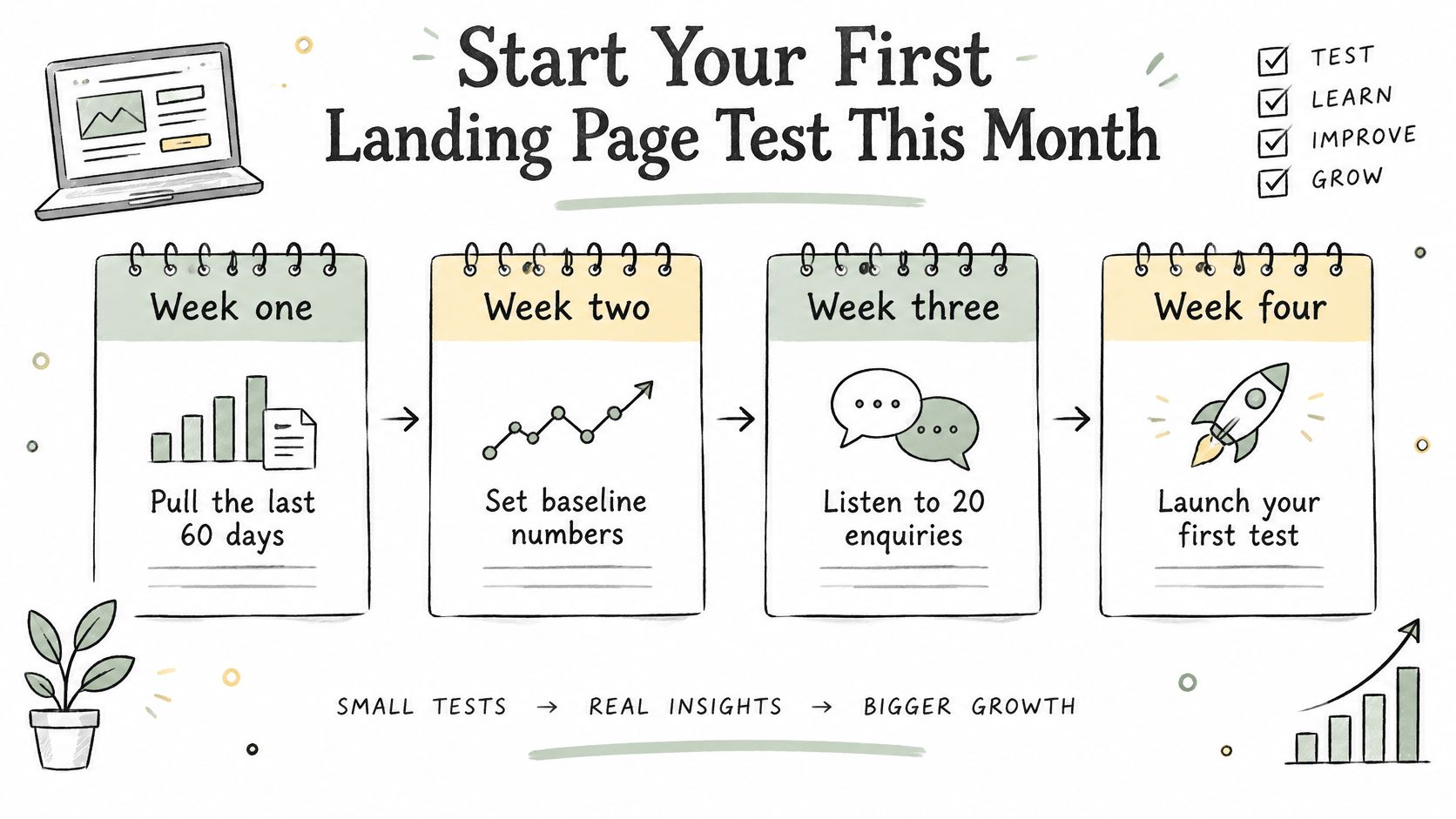
- Week one: Pull the last 60 days of enquiries, check source attribution and establish baseline measures. Mark missing outcomes rather than guessing.
- Week two: Review 20 calls or equivalent notes, tag objections and write three hypotheses.
- Week three: Launch one test on the priority page, with its primary metric and stopping rule recorded.
- Week four: Review device performance and qualified enquiry rate. Keep, roll back or continue collecting evidence when the planned stopping point hasn’t been reached.
Bluelight tracks every enquiry with call tracking and optimises the ad account every month. Source attribution makes the baseline useful because you can connect enquiries to the advertising that generated them, rather than treating all phone activity as paid-search success.
Keep that connection between advertising and outcomes in view as you plan the work.
Bluelight offers a free 30-minute ad account review covering what’s working, what’s leaking budget, and the two or three moves that would change numbers fastest. Monthly reporting shows what was spent, how many leads came in, what each lead cost and what was changed, so you can judge progress against documented actions.
Bluelight works exclusively with roofing companies, connecting Google Ads, landing-page improvements and enquiry tracking to help owners identify worthwhile opportunities. Visit Bluelight this week to book your free ad account review and identify a practical first test aimed at qualified, bookable jobs.
Related service Google Ads for Roofers