What Is Conversion Tracking and Why Roofers Need It
Conversion tracking is the system that connects a digital interaction, like an ad click, website visit, phone call, or completed enquiry, to a defined business outcome. For a roofer, the conversion should be a quote-ready enquiry or booked inspection, not just any submission.
If you’ve ever opened your ad dashboard and seen healthy activity while the office still feels quiet, you already know the problem. The numbers move, the phones ring, but too many of those enquiries are dead ends, and the work diary stays thin.
Table of Contents
- The Lead Problem Every Roofer Recognises
- What Conversion Tracking Actually Means
- Why Raw Lead Counts Mislead Roofing Owners
- The Three Tracking Methods Roofers Must Get Right
- The NZ Privacy Layer Most Tracking Guides Skip
- Building a Weekly Reconciliation Habit
- Qualifying Leads the Way an Estimator Would
The Lead Problem Every Roofer Recognises
A roofing owner does not need another dashboard full of activity. You need to know which enquiries can turn into real work, which ones are just noise, and which campaigns deserve more budget next month. That gap between “we got leads” and “we got jobs” is where many roofing accounts lose money.
The pattern is familiar. The dashboard shows a healthy pile of conversions, the admin team has a stack of voicemails, and the estimator starts sorting the mess. Some callers are outside the service area. Some only wanted a price to compare with a mate’s quote. Some clicked by accident on mobile, then hung up before saying anything useful.
A tracked enquiry is not the same thing as a profitable lead. A DIY researcher asking about underlay, a landlord chasing the cheapest patch-up, and a homeowner with a full re-roof can all look similar if you count them as one conversion. Roofing firms need measurement that separates signal from noise, not just a tally of form fills.
The test is in the estimator’s pile. One week can bring 40 raw leads, but only 6 are worth booking, and maybe 2 turn into paid jobs. That is the difference between activity and revenue. A campaign that floods the inbox with poor-fit enquiries may look busy and still leave the work diary thin.
Practical rule: if a reported conversion cannot be traced to a booked inspection, a qualified quote, or a job won, it is just a marketing event, not proof of demand.
A roofer also has to read the local context properly. In New Zealand, mobile search behaviour matters because so many enquiries start on a phone, often while the customer is standing beside the problem roof. Privacy rules and building consent questions can shape what people are willing to submit, and generic lead forms often miss that nuance. If the form asks the wrong thing, or asks too much too early, the lead looks real in the platform but goes nowhere in the office.
If you want a practical example of why that distinction matters, this guide on Google Ads conversion rate for roofers covers the point from a campaign perspective. The useful habit is simple, count the work that can be won, not the noise that only looks busy.
What Conversion Tracking Actually Means
Think of conversion tracking as the cash register for your ads. A click is someone walking into the shop, but a conversion is the moment that visit becomes something your business can count as a real outcome. For a roofing company, that outcome is usually a serviceable enquiry, a booked inspection, or a won job.
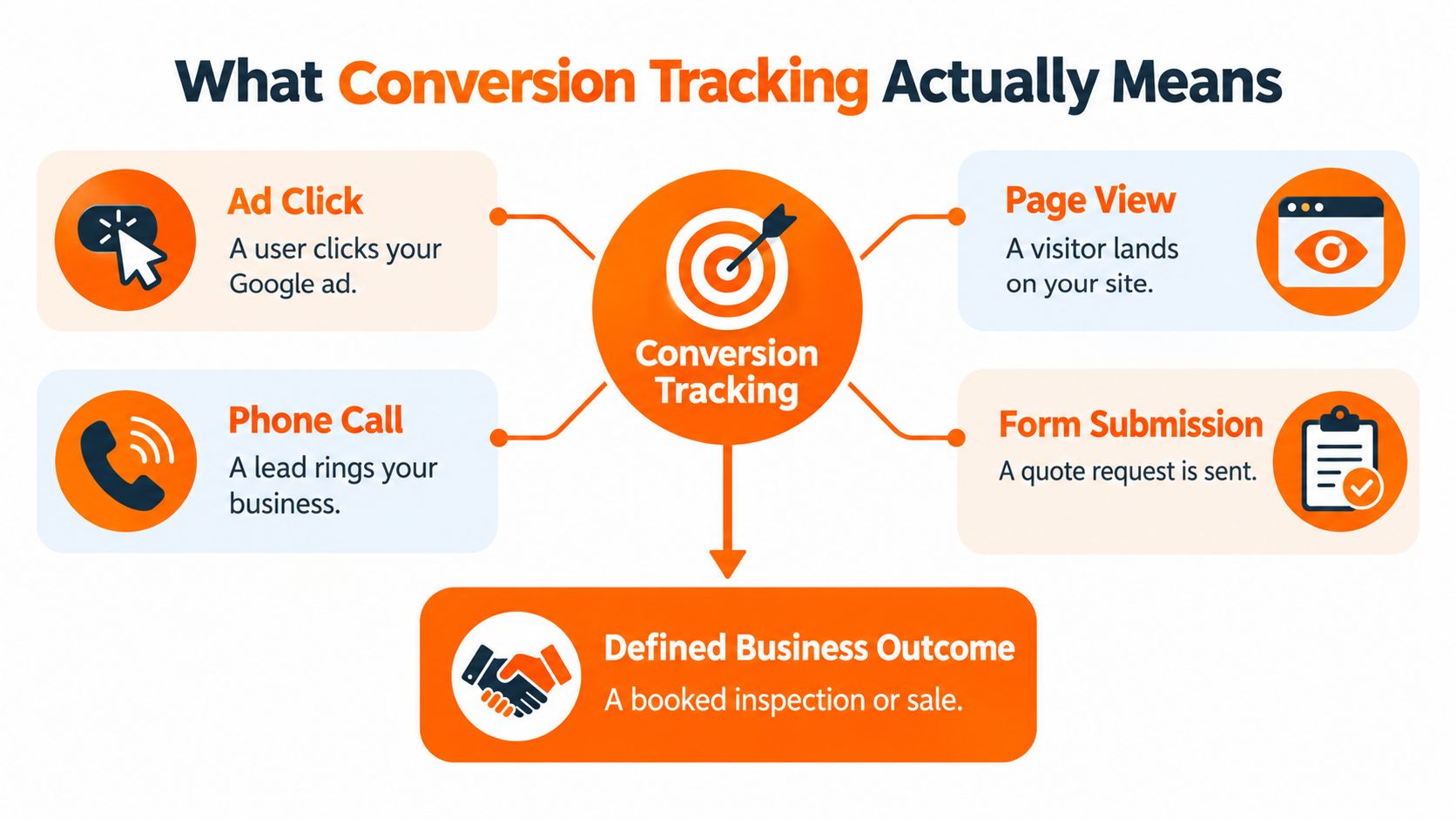
The four layers that actually matter
The first layer is the ad click, because that tells you which campaign or keyword brought the person in. The second is the landing-page engagement, where you learn whether they stayed long enough to read, click, or look around. The third is the lead action, such as a phone call or form submission. The fourth is the downstream sales status, which is where value shows up.
That chain matters because one event by itself says very little. A form submission could be a valid quote request, or it could be an out-of-area message that gets declined the same day. A phone call could be a roofing job, or it could be a wrong number. Without consistent definitions across those layers, you end up deciding budget based on incomplete data.
A roofing account should treat each tracked event like a receipt. The ad platform records the click, the website records the action, the office records the lead, and the CRM records whether that lead was worth anything. That’s the difference between knowing what happened and guessing what probably happened.
If you want a deeper walk-through on how to track website leads in a clean way, this practical conversion tracking guide is a useful reference point. The takeaway is that reporting only matters when it helps you choose the next dollar with confidence.
Why Raw Lead Counts Mislead Roofing Owners
A roofing account can look busy and still be underperforming. Raw lead counts reward volume, not fit. A campaign that produces fewer enquiries can still be the better buy if those enquiries match your service area, job mix, and crew capacity.
The trade-off shows up fast in real accounts. Campaign A might deliver a cheaper form fill, but most of those leads are patch jobs, out-of-area requests, or people who are not ready to book. Campaign B may cost more per lead, yet it brings in homeowners asking for full replacements, commercial enquiries, or bookings that move straight to inspection. For roofers, paying a bit more for the right lead is usually better than chasing cheap volume that keeps the office busy and the estimators short on real work.
A 30-second call and a genuine roofing conversation are not the same event. A small repair, a full replacement, and a suburb outside your service area also should not be counted the same way. If you roll them together, the spreadsheet says the campaign is working even when the diary is full of dead ends.
A better standard is to measure what the business can verify later. If a conversion cannot be checked against the office record or the job system, it is too easy for the numbers to look good while revenue stays flat.
For roofers, the useful question is whether the enquiry moved toward real work. A helpful guide to improving Google Ads conversion rate for roofing campaigns starts with that mindset. The stage matters, but so does the quality behind it.
A simple way to judge the trade-off
| Campaign example | Raw lead cost | Lead quality | What it means |
|---|---|---|---|
| Campaign A | Lower | Few leads fit your work | Cheap traffic, weak follow-through |
| Campaign B | Higher | More leads become inspections or quotes | Better value despite the higher cost |
That is the kind of comparison roofing owners need. A lower cost per lead means very little if the office spends time sorting through poor fits. A higher cost per lead can still produce stronger return if the enquiries are local, serviceable, and likely to become booked work.
The Three Tracking Methods Roofers Must Get Right
Watertight tracking comes from three parts working together, not from a single tag. Forms capture intent, calls capture the people who’d rather ring than type, and offline imports teach the ad platform which enquiries turned into real jobs. Miss one of those pieces, and your reports start lying by omission.
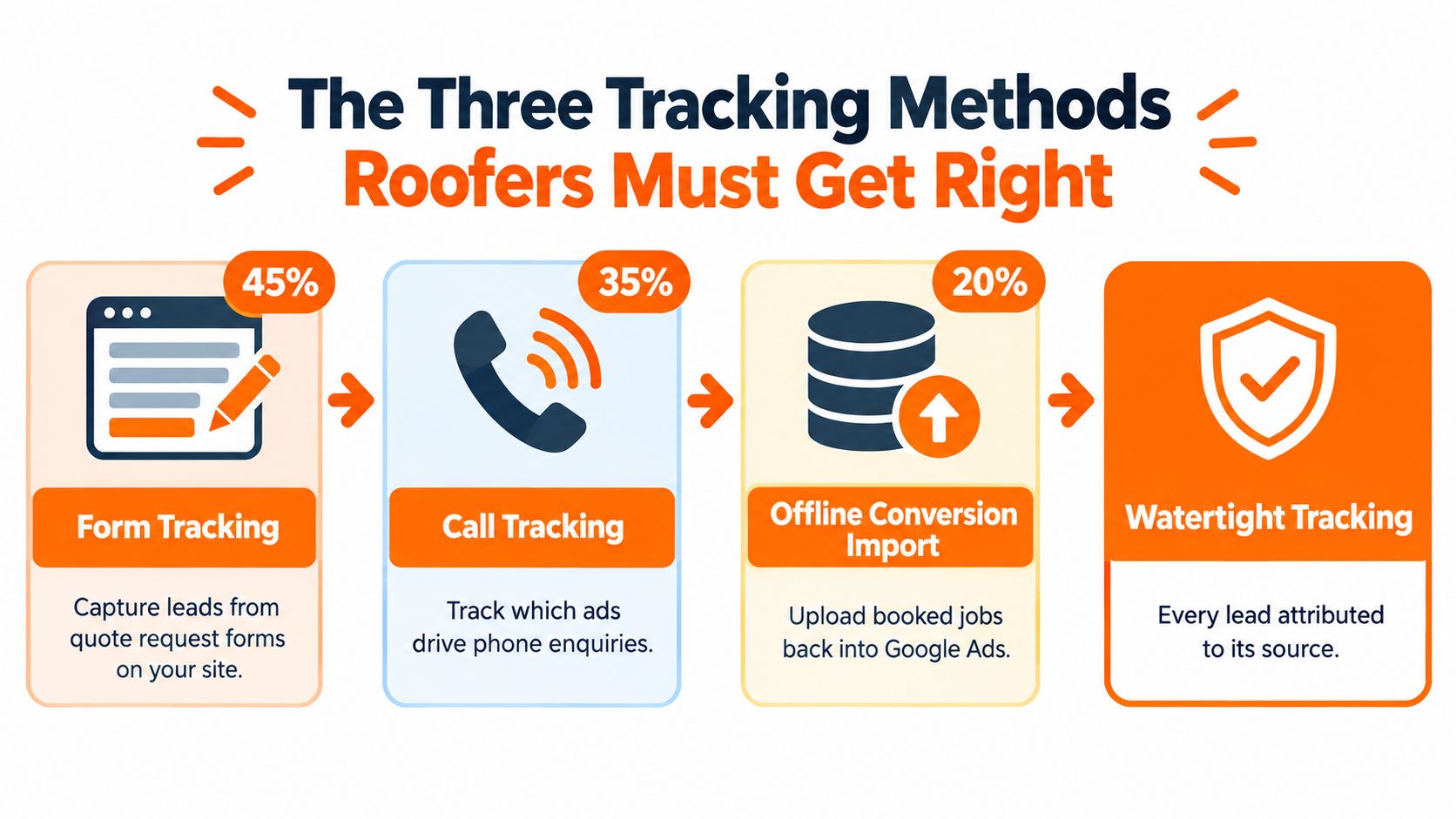
Forms need clean source preservation
A form tag should fire only when the submission is completed. The thank-you page or confirmation event matters because it gives the system a clean finish line, and the source parameters need to survive any redirects so the original ad click still reads correctly when the lead is reviewed later. If you lose that trail, your team ends up guessing where the lead came from.
Calls need more than a phone number
Dynamic number insertion lets the site display a tracking number tied to the ad session, which helps link the call back to the right campaign. On mobile, a click-to-call action can be the entire conversion path. On desktop, the caller may first browse, then ring later, so call count alone isn’t enough. Call duration matters more than volume because it helps separate accidental taps from real enquiries.
If you’re comparing systems, this roundup on call tracking software is a decent starting point, and this independent list of call tracking options can help you look past surface features. In roofing, the right setup is the one that keeps source data intact and matches calls back to the campaign that earned them.
Offline imports close the loop
An offline conversion import is the step where you send later-stage outcomes back into the ad platform. For roofing, that should usually mean stages like booked inspection, quoted job, and won job. This teaches the platform that some enquiries are worth more than others, so it stops optimising only for easy form fills.
A hail-storm enquiry is a good example. The person rings the same day, the office books an inspection, the estimator quotes the work, and once the roof replacement is won, that outcome gets uploaded back into the account. That’s how the platform learns what real value looks like instead of guessing from the first contact alone.
The point of all three methods is consistency. A form, a call, and a later job record should all tell the same story, otherwise the platform optimises for the wrong kind of work.
The NZ Privacy Layer Most Tracking Guides Skip
In New Zealand, conversion tracking isn’t just a technical build. It sits inside the Privacy Act 2020 and the 13 Information Privacy Principles, which means lead data has to be collected and used with care, not as an open-ended data grab. The government’s web-privacy guidance also expects you to collect no more data than necessary and tell users what’s collected, why it’s collected, how it will be used, and how they can review or correct it. New Zealand’s privacy guidance for websites makes that boundary very clear.
More data is not always better measurement
A hashed email or phone number is not automatically anonymous. If the data can still relate to an identifiable person, it can remain personal information, which means the business still has privacy obligations. That matters for quote forms, CRM records, and any setup that sends customer details back into an ad platform.
The safer default is minimum-necessary data. For a roofing business, that usually means tracking the few events that separate serviceable enquiries from noise, then being clear in the privacy notice about what happens to the information. If the notice doesn’t mention how the data is used for measurement or follow-up, the setup is weaker than it looks.
Practical rule: build the privacy review into campaign setup, not after the leads start coming in.
This also matters because the legal environment keeps moving. The Privacy Amendment Bill’s IPP3A notification obligations for indirectly collected personal information are scheduled to apply from 1 May 2026, so a sloppy measurement plan can age badly fast. More identifiers won’t fix a bad system, and in some cases they just increase compliance exposure without improving the quality of the optimisation.
For roofers, the best practice is simple. Use the smallest dataset that still lets you tell a quote-ready roof enquiry from an irrelevant one. Keep the notice understandable, protect access to lead records, and make sure the purpose of tracking is defensible before the campaign goes live.
Building a Weekly Reconciliation Habit
Tracking only works if someone checks it against reality. A weekly reconciliation habit keeps the dashboards honest, because the office, the call logs, and the CRM all get compared against the ad platform instead of being treated as separate truth sources. You catch the small failures that distort budgeting.
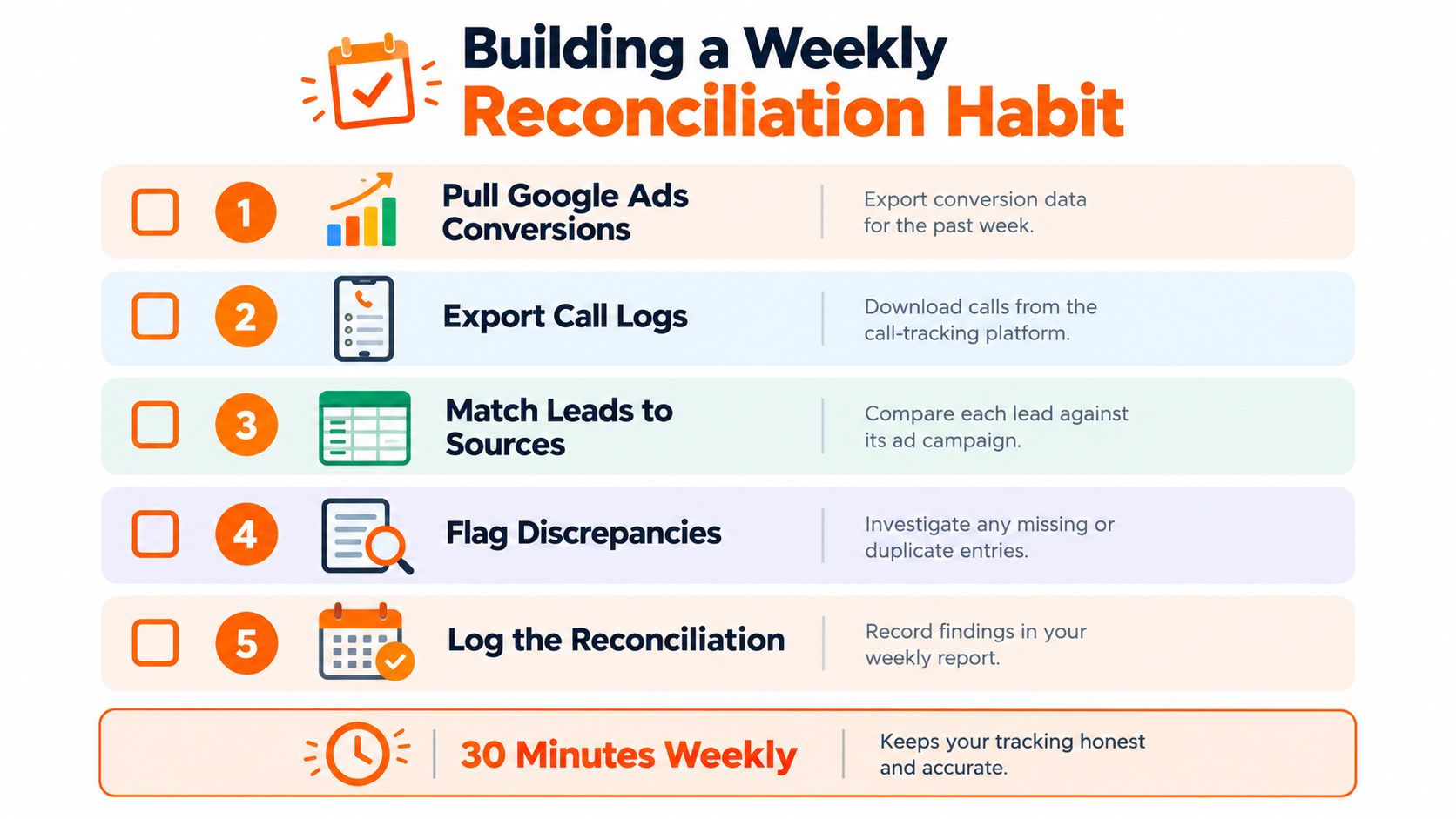
A roofer-friendly reconciliation routine
Pull the Google Ads conversions first, then export the call logs from the tracking platform. Match both against the CRM stages for contacted, inspected, quoted, and won, and flag anything that doesn’t line up by device, campaign, or consent status. That’s how you find the campaigns that look healthy on paper but underperform once the office gets involved.
The two failure modes I see most often are boring, but expensive. Calls never make it into the CRM because someone at reception forgot to log them, or forms come in after hours and nobody follows up quickly enough. Both problems make the same campaign look weaker than it is.
Check the handoff, not just the click.
A single reporting view should show cost per raw lead, cost per qualified lead, cost per booked inspection, and cost per won job by service type and region. That lets you compare like with like. A replacement lead in one area isn’t the same as a small repair in another, and your budget shouldn’t treat them as if they are.
If you want the setup handled inside a roofing-specific ad system, Bluelight is one option that builds call tracking, form tracking, and lead attribution into its Google Ads work for roofers. The value of the weekly reconciliation is that it shows whether the system is catching the leads that matter.
Qualifying Leads the Way an Estimator Would
Roofers already know how to qualify work. The estimator asks about the existing roof material, the proposed material, whether it’s a repair or replacement, the property type, the approximate age, the suburb, and whether any structural changes are likely. Those are not just sales questions, they’re the same data points that make a lead usable.
The Building Performance guidance on exempt building work is a good example of why those fields matter. Comparable repair or replacement work can often be carried out without a building consent when comparable materials are used in the same position, but the exemption doesn’t cover every kind of replacement, and the guidance gives examples that show how material and structural changes change the classification. Building Performance guidance on exempt building work makes that distinction explicit.
The form should mirror the sales call
If the form captures the same information an estimator needs on the phone, reporting gets a lot cleaner. A straightforward re-roof can be separated from a project that may need engineering input or building-consent guidance, and campaign reporting can stop pretending those two jobs have the same value. That’s the bridge between marketing measurement and operational reality.
A strong roofing CRM record should end where the ad click began and the job ended. The path should show the campaign, service type, location, qualification status, quoted value, and final outcome. When those pieces line up, the office knows which enquiries deserve follow-up and which ones were never going to become profitable work.
Good tracking doesn’t just count interest, it helps the estimator spend time on the right roofs.
That’s the answer to what is conversion tracking for a roofing company. It’s not a vanity report, and it’s not just analytics. It’s a quality-control system that shows whether your marketing is producing the kind of jobs you want to win.
If you want your roofing ads to report the truth, not just the activity, talk to Bluelight about conversion tracking, call attribution, and landing pages built for quote-ready enquiries. Visit Bluelight and see how a roofing-specific setup can help your numbers line up with the work your team books.
Related service Google Ads for Roofers