10 Call Tracking Software Options for Roofing Companies
A homeowner finds your roofing ad, calls straight away, books a repair, and your report still gives the credit to the wrong keyword or nothing at all. That gap is exactly what call tracking software is meant to close. For roofing companies, the job is simple, tie the call to the ad, the keyword, the landing page, and the booked job, then keep the bill from creeping up once numbers and minutes are counted. The list below starts with smaller setups and moves up to enterprise platforms, with NZ and AU fit called out where it matters. If you want a broader view of the market, the call tracking software rankings are a useful companion.
New Zealand roofers also have the usual local reality to deal with. Mobile and internet use made phone enquiries a measurable marketing channel years ago, and that still shapes how attribution needs to work in practice. The Ministry of Business, Innovation and Employment review reported 5.3 million mobile connections in 2013/14, about 118 mobile connections per 100 people, with mobile connections up 8% in that financial year, while fixed-line retail revenue fell from NZ$2.77 billion to NZ$2.68 billion and mobile retail revenue reached NZ$2.49 billion (MBIE telecommunications review). If a roof repair lead comes in by phone, your tracking has to catch the whole path, not just the website visit.
Table of Contents
- 1. WildJar
- 2. Nimbata
- 3. CallRail
- 4. WhatConverts
- 5. CallTrackingMetrics
- 6. Jet Interactive
- 7. Delacon
- 8. Infinity
- 9. Ringba
- 10. Invoca
- Top 10 Call Tracking Software Comparison
- Choosing the Right Tool for Your Roofing Business
1. WildJar
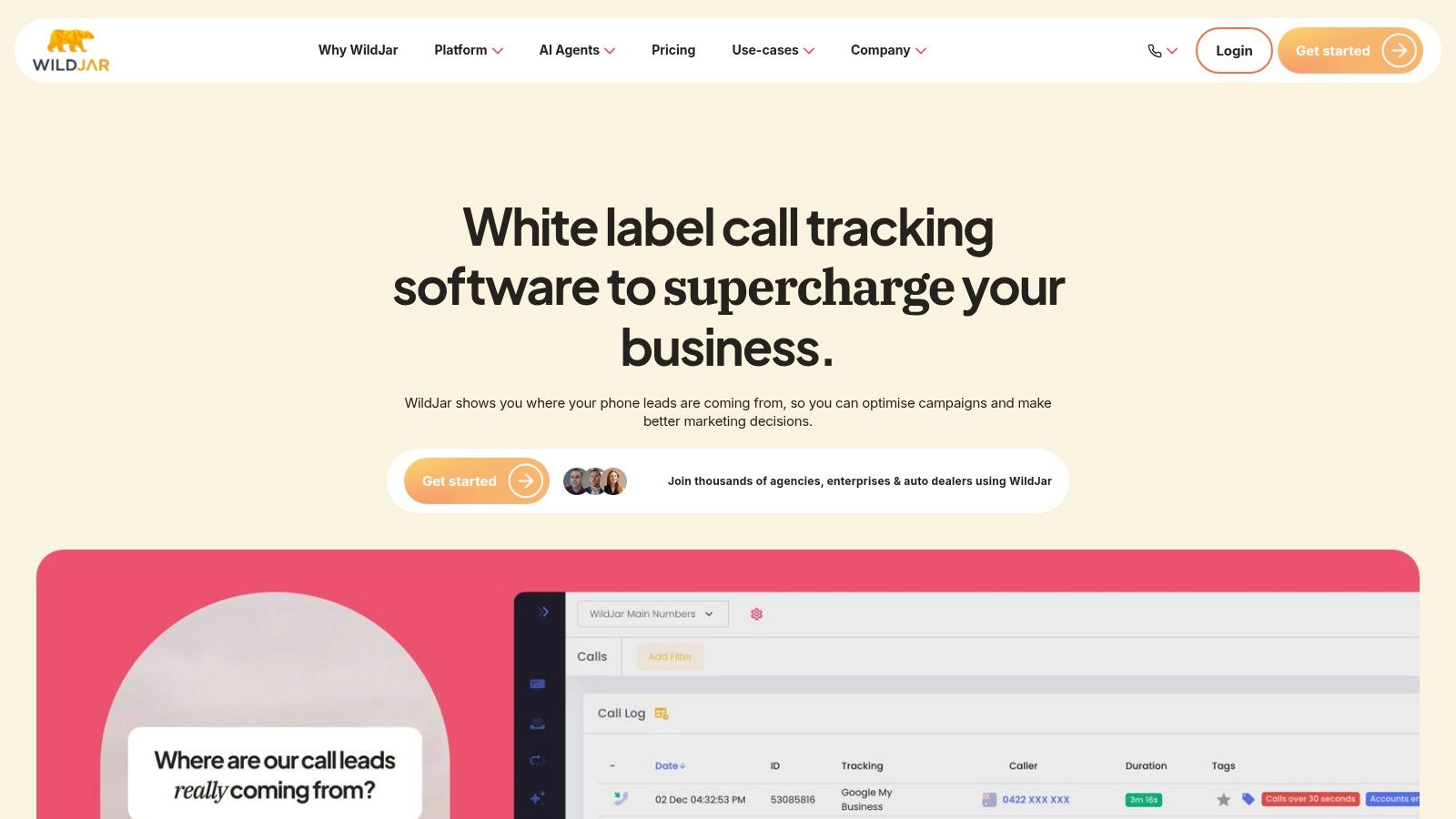
WildJar is the cleanest starting point for ANZ roofers who want local support without a messy setup. It feels built for agencies and trades businesses that need dynamic number insertion, call recording, and AI transcription without turning implementation into a project. The fit is especially strong if you’re running roofing campaigns in New Zealand or Australia and want the system to feed Google Ads with conversion data instead of leaving calls stranded in a dashboard.
Why it works for roofing
The main advantage is local practicality. WildJar’s ANZ focus makes it easier to think in terms of real service areas, real phone numbers, and a real Google Ads workflow rather than a generic global setup. The trade-off is that some usage tiers can pick up minute overages, and higher-tier pricing isn’t always fully self-serve, so you may need to speak to sales before you know the exact bundle.
Practical rule: if the vendor can’t clearly explain what a tracked number costs, what minutes cost, and how Google Ads receives the qualified call, the platform is too vague for a roofing owner.
For a roofing company, that matters more than flashy extras. You want to know whether a call from a leak repair or re-roof enquiry maps back to the keyword that triggered it, and whether your team can review the call later without hunting through three systems. WildJar’s website is the right place to confirm current ANZ bundles and coverage, because this kind of tool only pays off when the number plan and the reporting plan line up.
2. Nimbata
Nimbata is the better fit when you want affordability and flexibility before you want enterprise polish. It offers static and dynamic tracking, source and keyword attribution, and call recording, with number inventory across many countries, including New Zealand. That makes it a sensible option for smaller roofing firms that want to test call tracking without committing to a heavy platform from day one.
The trade-off that matters
Its strongest point is transparency. You can usually see the logic of the pricing more easily than with some larger suites, which is useful when you’re trying to work out the true cost of tracking a handful of jobs a week. The limitation is that it doesn’t try to be everything at once, so if you want a deep stack of enterprise features, it can feel lighter than some competitors.
For a roofer, that can be a plus. Most smaller teams don’t need a complex system, they need to know which enquiry came from Google Ads, which came from organic search, and which came from repeat or referral traffic. Nimbata’s website is worth checking if you want to see how its per-number and per-call structure would play out in your market.
Where it fits best
- Smaller markets: Useful if you don’t need a huge feature stack.
- Testing phase: Good when you want to prove call attribution before scaling.
- Simple reporting: Works when the sales team mainly needs source clarity, not a long list of extra workflows.
If you’re a roofing owner watching every line item, this is one of the more straightforward options to compare against your ad spend.
3. CallRail
CallRail is the familiar name most agencies have touched at some point, and there’s a reason for that. It covers DNI, call recording, forms, SMS tracking, softphone, and porting, so it can sit across more of the customer journey than basic call-only tools. For roofing companies, that matters because phone leads, form leads, and text responses often happen in the same week, sometimes from the same campaign.
The platform is also comfortable for agency workflows, which helps if you manage more than one location or more than one client account. Its documentation is extensive, and that reduces friction when you’re trying to get a roofing team live without teaching everyone a new system from scratch.
Good enough is not the same as cheap. CallRail often feels easy to start with, but usage costs can grow once call volume rises, so the invoice deserves the same attention as the dashboard.
For a roofing company, the downside is that the international setup, including New Zealand pricing, may need support enablement. That’s not a deal-breaker, but it does mean you shouldn’t assume the public pages tell you the whole story. The CallRail website is the starting point, and Bluelight’s note on call tracking benefits is useful if you want the agency-side view of why the data matters in roofing.
4. WhatConverts
WhatConverts is the strongest choice here if your priority is lead quality, not just call volume. It unifies calls, forms, and chats, which is important for roofing because a good month rarely comes from phone calls alone. When a tool can push qualified-lead and revenue signals back to Google Ads, it’s doing the job an owner cares about, not just counting rings.
Why roofers usually like it
It gives you a cleaner view of which campaigns bring in enquiries that are worth quoting. That matters when you’re trying to compare search traffic against form submissions, or when a keyword gets plenty of calls but very few booked inspections. The reporting focus is strong, and for smaller agencies or in-house teams it can be easier to use than a tool that was built mainly for call centre operations.
The main caution is simple. You need to verify New Zealand number inventory with support, and the cost of numbers and minutes varies by country. That’s exactly the kind of detail that decides whether a tracking platform is practical for a local roofing business or just looks good in a demo.
A roofing owner should care less about raw call counts and more about whether the call became a quote opportunity. That’s the gap this platform is built to close. The WhatConverts site is where you can confirm the current workflow, and Bluelight’s piece on Google Ads conversion rate fits naturally with the lead-quality mindset behind this kind of setup.
What to check before buying
- Google Ads hand-off: Make sure qualified calls can be sent back as conversion signals.
- Source taxonomy: Confirm calls, forms, and chats share the same lead definitions.
- New Zealand numbers: Don’t assume inventory, check it directly.
- Qualified lead rules: Ask how the platform separates real roofing enquiries from spam or price shoppers.
5. CallTrackingMetrics
CallTrackingMetrics is the platform that comes up when a team wants more moving parts. It connects calls, forms, SMS, and chat to the ad, campaign, and keyword, and it adds softphone, routing, and a wide integration library. For roofing businesses with more complex lead flow, that can be useful, especially if different crews handle different service types or regions.
The upside is obvious, you get a strong full-funnel layer and a system that can grow with you. The downside is that usage fees and softphone connections can add up, and pricing by country can feel fragmented. That makes it less friendly if you just want a clean quote and one monthly number to explain to the owner.
Best use case in roofing
Use it when you need to route calls by service area or team, then push the right outcomes back into Google Ads and the CRM. It’s also a better fit when you’ve got an agency managing several accounts and want a repeatable process across clients.
If your team mainly wants a simple “this keyword brought the job” answer, it can feel heavier than needed. If you want multi-channel attribution plus operational routing, it earns its place. The CallTrackingMetrics website is the best place to confirm NZ number rates before you build a model around it.
Practical rule: for a roofer, routing matters only if the data ends up in the CRM. If the call is tracked but the booked estimate never gets linked back, the setup is incomplete.
6. Jet Interactive
Jet Interactive sits closer to telco than to lightweight SaaS, which is exactly why some multi-location roofing firms like it. It combines call tracking and cloud telephony, with DNI, number pools, routing, AI call summaries, and direct integrations with GA4, Google Ads, Microsoft Ads, and Meta. If you care about line-item transparency, it’s one of the easier platforms to read from an invoice perspective.
That makes it appealing for roofing operators who want both reliability and ad-platform reporting in one place. It can also suit businesses with more than one office or crew, where routing needs to be as tidy as attribution.
The main caution is the obvious one. It’s AU-based, so you need to confirm what that means for NZ numbers and rates before you commit. The Jet Interactive website is where to check current coverage and pricing, because telco-style tools tend to be precise about the details that matter.
A roofing-owner view
If your campaigns are split by city, region, or service line, Jet Interactive can be a solid middle ground between basic call tracking and heavy enterprise tooling. If your needs are simple, it may be more platform than you need. But if your business already thinks in terms of routing, reporting, and multiple ad channels, it makes sense.
7. Delacon
Delacon is for operators who want enterprise-grade attribution in the ANZ market. It captures session data such as GCLID and keyword, and it connects tightly with Google Ads, Google Analytics, Salesforce, and SA360. For a roofing business that already has a more serious CRM and paid media operation, that level of integration can make lead tracking far more useful than a basic call log.
What it does well
The platform is built for scale, not just for pretty reports. Its speech analytics and call management features make it suitable when you need to understand quality, not just quantity, and when you need the ad data to flow cleanly into the rest of the stack. That matters if you’re trying to optimise toward booked estimates rather than only lower cost per call.
The cost structure is less friendly to small advertisers. It’s quoted pricing with monthly per-number and per-minute usage, so you need to be confident that the volume justifies the overhead. The Delacon NZ site is the right place to verify the current setup before comparing it against lighter options.
For larger roofing groups, Delacon makes sense when attribution needs to touch both marketing and CRM workflows. For a single-crew roofer with modest ad spend, it can be more platform than profit.
8. Infinity
Infinity is the paid-search specialist in this group. It focuses hard on automatic DNI for PPC, keyword and campaign attribution, and broad ad-platform and CRM integrations. Roofing companies that spend heavily on Google Ads and want a strong view of which paid clicks are turning into calls will find the setup familiar.
The useful part is that it still works with Google call assets and extensions using fixed numbers, so it doesn’t force you to rebuild every part of your account. That saves time when you already have ad structure in place and just need cleaner attribution.
Where it shines
Infinity is strongest when paid search is central to the business. If you’re running campaigns for multiple service areas and want enterprise-grade analytics, it can deliver a lot of depth. If you only need basic source tracking, it’s probably more platform than you need, and pricing by quote reflects that.
The Infinity website is the place to check current enterprise terms. For roofing owners, the key question is whether the extra analytics improve booking decisions or just add another dashboard for the team to ignore.
9. Ringba
Ringba is built for control. It’s API-driven, which is great if you want detailed routing, marketplaces, and transparent per-number pricing, especially in high-volume or performance-marketing environments. For roofing, that can be useful when you’re distributing calls by region, service type, or lead value.
The upside is cost discipline at scale. The platform can be a strong fit when call flow design matters as much as attribution, and when you want the system to behave more like an operational layer than a marketing widget. The trade-off is that it doesn’t always feel as polished out of the box for standard SMB marketing teams.
If you want something that your call centre or media-buyer side can shape very precisely, it’s a smart look. If you want a straightforward roofing dashboard with minimal setup, it may feel like too much machinery. The Ringba website is where to confirm New Zealand number availability and fees before you go further.
Straight answer for roofers
Ringba is better when you already know the routing logic you want. It is less attractive when your main ask is, “Which keyword made this roof repair call?”
10. Invoca
Invoca is the enterprise option for teams that want conversation intelligence layered on top of call attribution. It brings DNI, AI-powered QA, deep ad-tech and CRM integrations, and offline conversion flows. For national or multi-location roofing brands, that can be powerful, especially when governance and reporting need to be consistent across a large team.
The platform also includes VoIP termination options that can help reduce telecom fees, which matters more once call volume is large enough to notice. That’s the sort of detail enterprise buyers care about, because the cost of call tracking is never just the software licence.
Where it fits and where it doesn’t
Invoca is strong when you want very rich analytics and a mature enterprise ecosystem. It’s weak when a smaller roofing business wants a clean setup and a predictable bill. Pricing is by quote, so it isn’t a casual purchase.
The Invoca website is the place to look if your business already has a larger media and CRM stack. If you’re a smaller roofer, you’ll probably get more from simpler tools unless your lead volume justifies the overhead.
Practical rule: enterprise call tracking only makes sense when someone on the team will read the reports, act on them, and change bids or routing because of them.
Top 10 Call Tracking Software Comparison
| Product | Core features | UX & reliability | Pricing / Value | Target audience | Unique selling points |
|---|---|---|---|---|---|
| WildJar | DNI, AI transcription, call recording, Google Ads integration | ★★★★, ANZ support & straightforward setup | 💰 Mid, ANZ plans; minute overages | 👥 ANZ trades & agencies | ✨ AI transcripts, agency/whitelabel options |
| Nimbata | DNI/static tracking, call recording, source/keyword attribution | ★★★, simple, lightweight UI | 💰 Low, clear per‑number / per‑call pricing | 👥 Small roofers / local markets | ✨ Transparent per‑call pricing; easy to scale |
| CallRail | DNI, forms & SMS tracking, softphone, porting | ★★★★, familiar UI & docs | 💰 Mid, usage can grow with volume | 👥 SMBs & multi‑client agencies | ✨ Large knowledge base & agency workflows |
| WhatConverts | Instant numbers, DNI, keyword attribution, push to Google Ads | ★★★★, strong lead‑quality reporting | 💰 Low‑Mid, good SMB value | 👥 SMBs/agencies focused on lead quality | ✨ Unified calls/forms/chats + revenue signals |
| CallTrackingMetrics | DNI, multi‑channel attribution, routing, no‑code integrations | ★★★★★, scalable & agency‑friendly | 💰 Mid‑High, usage & agent fees apply | 👥 Agencies / growing enterprises | 🏆 Full‑funnel attribution & extensive integrations |
| Jet Interactive | DNI, number pools, AI call summaries, GA4 & ad pushes | ★★★★, telco‑grade reliability in ANZ | 💰 Mid, AU pricing (confirm NZ) | 👥 Multi‑location trades in ANZ | ✨ Telco reliability + direct ad platform integrations |
| Delacon | DNI + GCLID capture, speech analytics, deep CRM integrations | ★★★★★, enterprise ANZ focus | 💰 Quote, per‑number + per‑minute | 👥 Enterprises & large ANZ advertisers | 🏆 Speech analytics & session‑level attribution |
| Infinity | Auto DNI for PPC, campaign/keyword attribution, enterprise analytics | ★★★★★, proven for PPC at scale | 💰 Quote, enterprise tiered pricing | 👥 Enterprise PPC teams | 🏆 Strong PPC workflows & conversation analytics |
| Ringba | API‑driven routing, marketplaces, transparent per‑number pricing | ★★★, highly configurable for volume | 💰 Low‑Mid, cost‑effective at scale | 👥 Performance marketers / affiliates | ✨ Granular API routing; scales high‑volume calls |
| Invoca | DNI, AI QA/conversation intelligence, deep ad/CRM integrations | ★★★★★, enterprise governance & analytics | 💰 Quote, premium enterprise | 👥 Large, national brands | 🏆 Advanced conversation intelligence & governance |
Choosing the Right Tool for Your Roofing Business
Start with two or three tools that fit your call volume and market, then force each vendor to answer four questions clearly. Does it provide New Zealand or Australia numbers. What is the full cost per number and per minute. How does dynamic number insertion work on your website and call assets. How do call outcomes reach Google Ads and your CRM.
A roofing business doesn’t need the most features on paper, it needs the cleanest path from enquiry to booked job. If you’re a smaller operator, a tool like Nimbata or WildJar may be enough if the pricing is clear and the number coverage fits your market. If your agency or in-house team is already handling multiple channels, CallRail, WhatConverts, or CallTrackingMetrics can do more of the heavy lifting. If you’re running a larger stack, Delacon, Infinity, or Invoca may be justified, but only if the extra depth changes decisions.
The test I’d run is simple. Pick one service area and one ad group, then run the platform for two weeks and compare which calls tie most cleanly to booked roofing work. Watch for duplicate leads, spam, repeat callers, and unqualified price shoppers, because raw call counts can flatter a campaign that doesn’t really sell jobs. The right setup imports only qualified outcomes back into Google Ads and the CRM, so the team optimises to qualified roofing opportunities, not noise.
If you want call tracking built into the rest of the lead system from the start, Bluelight includes call tracking, form tracking, and lead attribution in its roofing-only Google Ads service, with details at Bluelight. That’s often the cleaner route for owners who’d rather have the tracking tied to the campaign work instead of managing another platform themselves.
Bluelight builds Google Ads systems for roofers that include call tracking, form tracking, and lead attribution, so you can see which enquiries turn into booked jobs. If you want a roofing-specific setup instead of stitching together separate tools, visit Bluelight and take a look at how the service is structured for roofing companies.
Related service Google Ads for Roofers