What Is Cost Per Click: A Roofer's Guide to Google Ads
Cost per click is what an advertiser pays Google each time someone clicks a search ad, and Bump Digital’s New Zealand cost guide places typical trades and local-service clicks in New Zealand at around NZ$2 to NZ$8.
You’re staring at your Google Ads bill while the crew’s calendar still has gaps. The account shows visitors arriving, but you need roof inspections and profitable work, not just traffic. To answer what is cost per click properly, follow the money from the first click through to the job you win. CPC is the opening number in a chain that ends at cost per booked job, so the question is never “how cheap was the click” but “what could that click realistically produce.”
Table of Contents
- What Cost Per Click Means for Your Roofing Ads
- How to Work Out What a Click Really Costs
- Typical Click Costs for Roofing Searches in New Zealand
- What Pushes Your Cost per Click Up or Down
- Why a Cheap Click Can Cost More Than an Expensive One
- Budget Your Clicks and Check Cost per Qualified Lead
What Cost Per Click Means for Your Roofing Ads
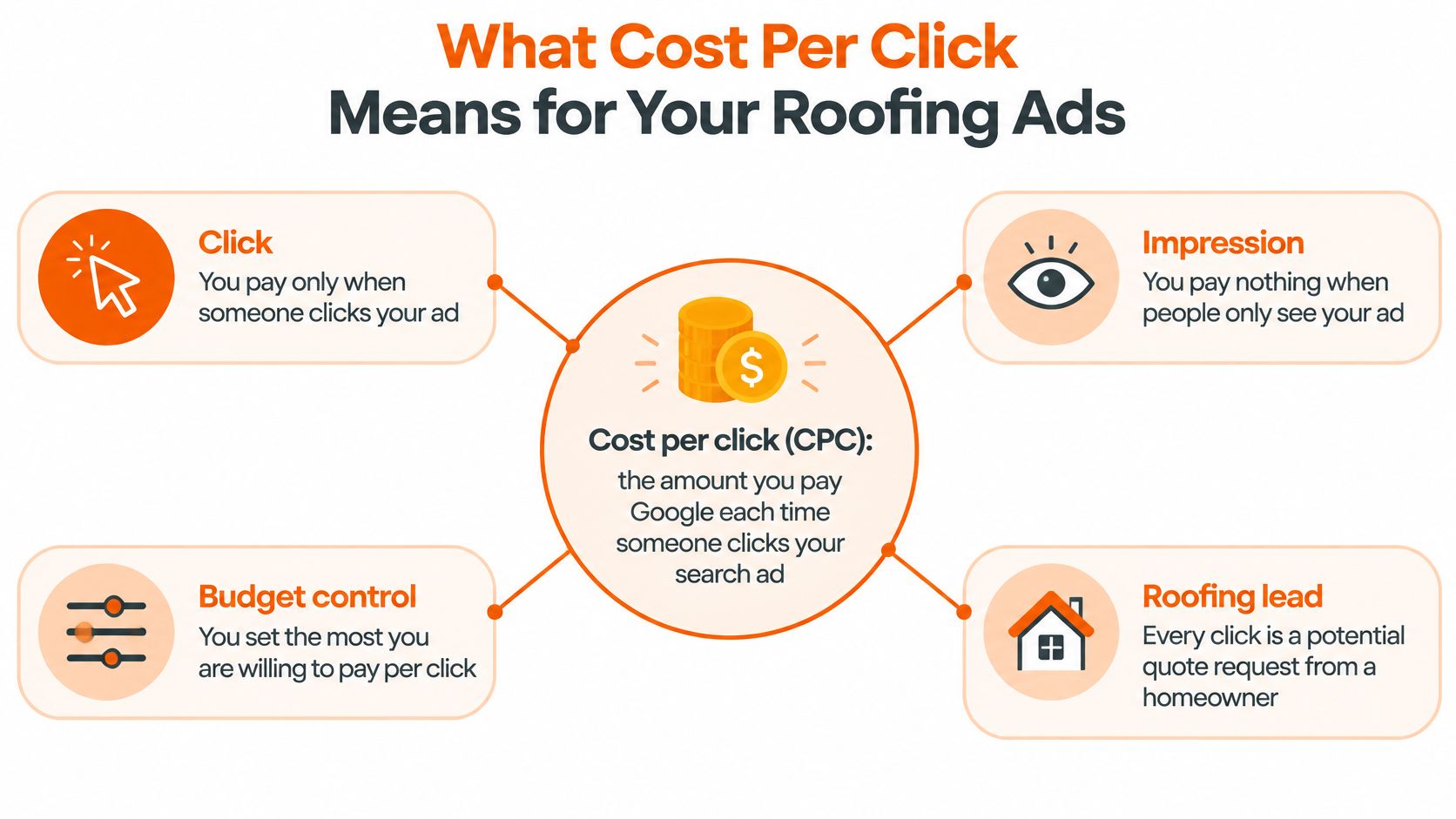
Cost per click (CPC) is the amount you pay for someone to click your Google Search ad; someone merely seeing it, called an impression, doesn’t trigger that click charge. 20 Minute Marketing’s New Zealand pricing guide illustrates the arithmetic: 100 clicks at NZ$5 cost NZ$500.
Say that’s your campaign, and none of those visitors books a job. Google has still delivered the chargeable action, a visit to your website, even though you haven’t received the business outcome you wanted.
A click is like a doorknock. You pay for the knock, but only some people will need a quote, have a suitable roof, and be ready to proceed.
A visitor isn’t yet a roofing lead
The homeowner might call immediately. They might compare your replacement service with another roofer, discover you don’t cover their suburb, or leave because they can’t find the service they need.
That distinction matters when you review performance. A click tells you that someone engaged with the ad, not that they’re qualified or likely to buy.
The diagram separates the chargeable interaction from the possible enquiry.
Follow the click beyond the website
Google uses a fresh auction for each eligible search, rather than a fixed roofing rate card. You can control your budget and bidding approach, but you can’t assume every visitor will cost the same amount.
Your reporting should follow this simple chain:
Click → Enquiry → Qualified lead → Booked job
A qualified lead is an enquiry that fits your service area and the work you want. CPC is the first cost in that chain, not the final cost of acquiring a roofing customer.
How to Work Out What a Click Really Costs
Average CPC = total ad spend ÷ total clicks. In a hypothetical account, spending NZ$600 across 120 clicks gives an average CPC of NZ$5.
Next, calculate your conversion rate, the share of visitors who complete a tracked action such as calling or submitting a quote form. Count genuine enquiries, not button clicks that never become contact.
Bump Digital’s New Zealand cost guide places local-service clicks at roughly NZ$2 to NZ$8 and demonstrates why the next steps matter: a NZ$6 CPC, 10% conversion rate, and 50% qualified share produce a NZ$60 raw enquiry but a NZ$120 qualified lead.
Cost per click to cost per qualified lead
These are worked scenarios, not promised campaign results. Use the rows as a lookup against your own conversion rate and lead quality.
| Average CPC (NZ$) | Conversion rate | Cost per raw enquiry (NZ$) | Qualified share | Cost per qualified lead (NZ$) |
|---|---|---|---|---|
| NZ$2 | 10% | NZ$20 | 50% | NZ$40 |
| NZ$6 | 10% | NZ$60 | 50% | NZ$120 |
| NZ$6 | 5% | NZ$120 | 50% | NZ$240 |
| NZ$10 | 10% | NZ$100 | 50% | NZ$200 |
| NZ$15 | 10% | NZ$150 | 50% | NZ$300 |
CPC is an average. Calculate it by service and suburb where you have enough activity, rather than allowing one account-wide figure to hide expensive, poorly qualified enquiries.
Use your own account numbers
- Choose a useful slice of the account. Pull spend and clicks for a service and suburb using the same reporting period.
- Check tracked enquiries. Use connected calls and completed forms to calculate conversion rate. Remove duplicate contacts when assessing lead volume.
- Calculate cost per enquiry. Divide CPC by conversion rate expressed as a decimal.
- Apply lead qualification. Divide cost per enquiry by the qualified share, also expressed as a decimal.
You multiply enquiry volume by qualified share to estimate how many qualified leads you have. You divide enquiry cost by qualified share to calculate what each qualified lead costs.
Practical rule: Fix unreliable tracking before making bid decisions. A low reported enquiry cost is meaningless if the account counts spam or duplicate calls as new prospects.
Typical Click Costs for Roofing Searches in New Zealand
A click’s price only means something once you know what the job behind it is worth. CPC is the first figure in your cost-per-job chain, so treat the ranges below as starting assumptions to replace with your own numbers.
| Search type | Typical CPC (NZ$ unless stated) | What pushes it higher or lower |
|---|---|---|
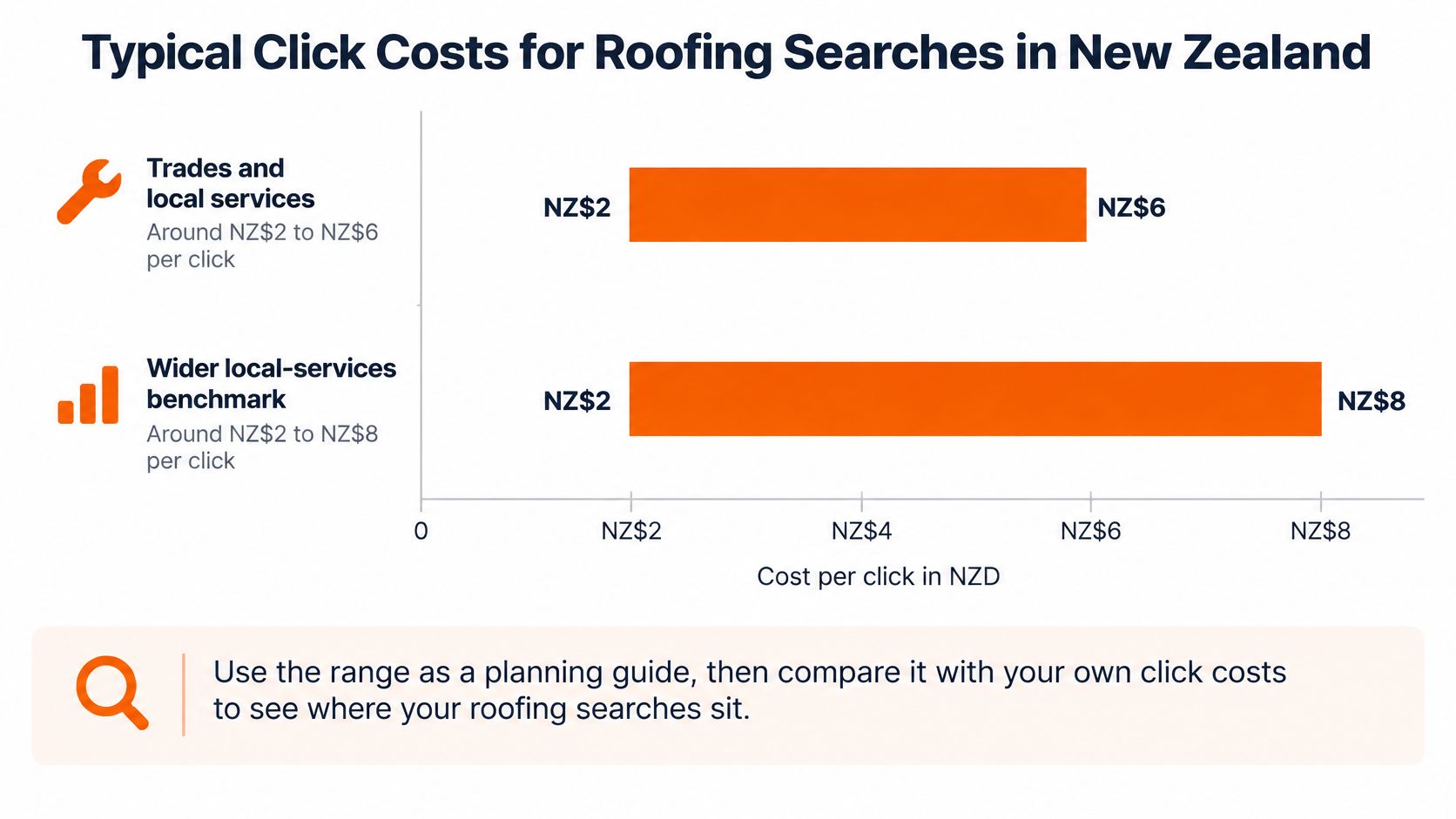
| Trades and local services, main benchmark | 2–6 | Local demand and competing advertisers |
| Local services, wider benchmark | 2–8 | Suburb, keyword choice and competitor activity |
| Roofing, plumbing, building and electrical | 5–15 | Auckland and Wellington toward the top, smaller centres lower |
| Roofing benchmark, US dollars | US$7.29 | Convert to NZD before budgeting |
The trades and local-service bands come from the New Zealand pricing guides discussed earlier. Lucid Leads’ New Zealand estimate puts trades and home services, including roofing, at roughly NZ$5 to NZ$15, with Auckland and Wellington tending towards the upper end.
AgencyAnalytics’ Google Ads cost dataset lists a New Zealand roofing benchmark of US$7.29 per click. That figure is quoted in US dollars, so convert it to NZD before using it in a budget.
Two accounts can sit at opposite ends of these bands and both be healthy. Where your click lands inside the spread depends on the suburb and the search, and the cheaper position only wins if it produces the same jobs.
Forecast the service and location together
Don’t treat these overlapping ranges as an official roofing price list. They describe different groups of searches, not guaranteed prices for your account.
Forecast roof repair Hamilton, reroof Auckland, and commercial roofing Christchurch separately. They represent different work, different locations, and different buying decisions, so an average across all three hides which campaign deserves more budget.
Google’s actual CPC documentation explains that search context, competition, and auction-time quality affect the price. Even closely related roofing searches can produce different costs.
The video below covers the same ground if you prefer to watch.
Keep ownership of the forecast rather than accepting a budget solely because an agency recommends it. Come Together Media on budget ownership is a useful companion when deciding how advertising fits your business finances.
Use the ranges to model a cautious scenario and a more competitive one. Replace those assumptions with your own click and enquiry figures once you have enough activity, and judge each click by the jobs it can realistically produce rather than the cents saved at the top of the chain.
What Pushes Your Cost per Click Up or Down
Google’s auction isn’t a contest where the biggest wallet wins. Your willingness to pay matters, but so does how useful your ad and website are to the person searching.
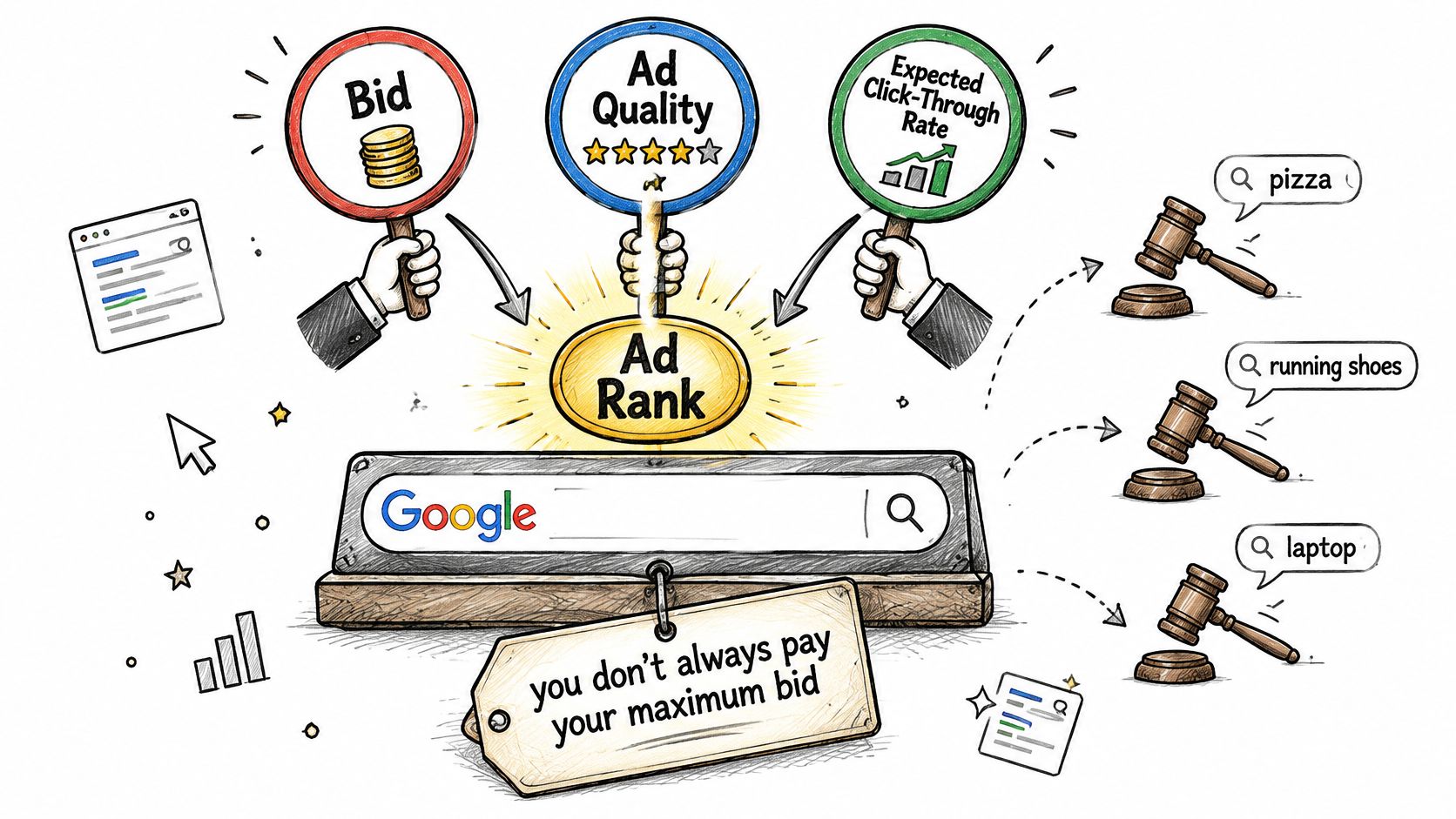
Google’s Ad Rank guidance explains that an advertiser with a more relevant ad can outrank a higher bidder and may pay less. Your actual CPC is generally the minimum needed to retain the position and associated ad-format benefits, not automatically your maximum bid.
How Google assesses your ad
Ad Rank determines whether and where your ad can appear. In plain terms, Google considers your bid alongside ad quality, expected click-through rate, landing-page experience, and the search context.
Expected click-through rate means how likely someone is to click. Landing-page experience concerns the page they reach after clicking, including how closely it answers their search.
The relationship between those inputs is shown below.
| Campaign approach | What the searcher receives |
|---|---|
| Metal roof replacement Auckland, matched to a replacement ad | A replacement-focused page explaining the service, coverage and quote process |
| Broad roofing search, matched to a general ad | A homepage where the visitor must find the relevant service themselves |
The specific approach gives Google and the homeowner a clearer match. It doesn’t guarantee a cheaper click, but it avoids paying for traffic while making visitors work out whether you can help.
Controls worth using
- Separate services. Keep repair, replacement, gutters, and commercial work in distinct keyword groups with appropriate ads.
- Exclude unsuitable searches. Use a negative keywords list to identify terms such as DIY and how-to searches that don’t fit paid roofing work.
- Constrain the service area. Target suburbs you can realistically serve, and review where enquiries originate.
- Match the promise. If the ad offers metal re-roofing, the destination page should explain that service rather than general building work.
Competitors can change their bids and schedules, so auction conditions can shift by day and time. Don’t assume a price movement means your manager changed something.
Track impression share, the share of eligible appearances your ads received, alongside CPC. Review lost impression share from rank and budget as well; then inspect bid competitiveness and relevance rather than assuming price alone caused missed visibility.
Why a Cheap Click Can Cost More Than an Expensive One
A NZ$9 click can beat a NZ$3 click when the visitors are more likely to book an inspection. Consider these hypothetical campaigns, which illustrate the calculation rather than predict a roofer’s results.
| Hypothetical campaign | Average CPC | Clicks per booked inspection | Ad cost per booked inspection |
|---|---|---|---|
| Campaign A | NZ$3 | 40 | NZ$120 |
| Campaign B | NZ$9 | 10 | NZ$90 |
Campaign B buys fewer visitors for the same spend, but reaches a booked inspection at a lower cost. That doesn’t yet prove it produces cheaper completed jobs, because you still need to account for quote acceptance.
Cheap traffic can create expensive office work
A price shopper asking for the cheapest possible quote still consumes phone time. An out-of-area homeowner can submit a perfectly valid form that your business can’t service.
Someone asking how much a tarp costs may need a retail product, not a roofing contractor. If those enquiries dominate, cheap traffic can leave your estimator busy without filling the installation calendar.
Judge the enquiry by whether you’d willingly send an estimator, not merely whether someone supplied a phone number.
For a roofing business, lead quality means the location is serviceable, the work fits your offering, and the decision-maker is realistically considering the job. Replacement, repair, and commercial enquiries may all qualify, but they shouldn’t automatically receive the same commercial value.
Connect marketing records to the job book
Use checks that the office can maintain without creating a second full-time job:
- Track calls and forms. Preserve the connection between the enquiry and its advertising source so you can investigate which searches brought suitable work.
- Tag quality after contact. Mark enquiries as suitable, outside the area, wrong service, duplicate, or not ready. Record a short reason when rejecting a lead.
- Record jobs won each month. Match accepted quotes to the original enquiry, allowing for the time between first contact and approval.
At Bluelight, we track every enquiry with call tracking and optimise the ad account every month. Our monthly reporting shows what was spent, how many leads came in, what each lead cost, and what was changed.
That gives you a basis for a commercial conversation. Instead of asking only whether CPC fell, ask whether the changes produced more suitable opportunities and whether your team converted those opportunities into worthwhile work.
Budget Your Clicks and Check Cost per Qualified Lead
Keep the money trail clear. With Bluelight, your ad budget is paid directly to Google, separate from the management fee, and you own the ad account and control the spend.
A useful budget connects available cash to realistic job outcomes. It shouldn’t start with the largest amount you can afford to spend, or with a promise to buy the cheapest visitors available.
Build the forecast from cash to jobs
-
Set your monthly advertising allowance including GST. Separate the cash leaving the bank from the media spend used in campaign calculations.
Google’s New Zealand tax guidance states that accounts with New Zealand business addresses carry 15% GST, so NZ$2,000 of pre-GST advertising becomes NZ$2,300 on the invoice. A GST-registered business may be able to claim the GST component, but plan cash flow for the full charge and ask your accountant how to record it.
-
Estimate clicks from the advertising amount before GST. Divide that media spend by your target CPC. Use a target drawn from the service and location you’re advertising, not an unrelated industry average.
-
Estimate enquiries. Multiply expected clicks by the landing page’s conversion rate. If tracking is new, use a clearly labelled planning assumption and update it when genuine enquiries arrive.
-
Estimate jobs. Multiply enquiries by the qualified share, then multiply qualified leads by your close rate, the share you win. Keep raw enquiries and qualified leads separate so unsuitable calls don’t inflate the forecast.
-
Test the cost against job margin. Divide advertising spend by estimated jobs, then assess management and website costs separately. Compare the acquisition cost with the gross margin left after delivering the roofing work, not the invoice value.
Keep advertising spend, management fees, and website costs on separate lines in your financial review. Otherwise, you can’t tell whether a change came from the auction, agency charges, or a website project.
Review the economics before changing bids
Pull the previous month’s report and calculate cost per qualified lead for each meaningful service and suburb grouping. Use the cost per lead guide to keep enquiry cost distinct from the cost of winning work.
Allow for your close rate when comparing a qualified lead with job margin. A lead cost sitting below the margin isn’t sufficient by itself, because not every suitable prospect accepts your quote.
Budget check: Keep bids steady when the cost per won job leaves enough margin for overheads and profit. Don’t raise them merely because individual clicks look cheap.
Where the economics don’t work, diagnose the cause before increasing spend. Pause searches producing DIY or out-of-area contacts, tighten replacement pages that attract visitors but don’t generate enquiries, and adjust bids by service rather than forcing the whole account towards one CPC.
Avoid judging a quiet service-and-suburb combination from a handful of visits. Use a longer reporting window where necessary, and distinguish a lack of evidence from evidence that the campaign is unprofitable.
Make the monthly action concrete: reconcile the advertising report with your enquiry log and accepted quotes before approving a budget change. That keeps your decisions tied to the jobs the clicks can realistically produce.
Bluelight offers a free 30-minute ad account review covering what’s working, what’s leaking budget, and the two or three moves that could change the numbers fastest. Visit Bluelight to request a review and assess your click costs against qualified enquiries and booked roofing work.
Related service Google Ads for Roofers