Google Ads for Small Business: A Roofer's Setup Guide
Three quotes went out last week and none have come back signed. The phone ran hot in April, the calendar for the next fortnight has gaps in it, and the roofer two suburbs over keeps turning up in the local Facebook group. You’ve heard Google Ads can fill the quiet weeks, but the account someone set up in an afternoon shows a few hundred dollars spent and a click count in the hundreds, and you can’t name a single roof that came from it.
That’s the only question worth asking. Google Ads for small business owners gets judged in the job book, not in a dashboard full of impressions. This guide works from the invoice forward: what a realistic monthly budget looks like once GST is added, which campaign types earn their place early, which searches to block before they chew through your budget, and how to tell a forty-dollar lead that becomes a re-roof from a forty-dollar lead that becomes a question about gutter cleaning.
Table of Contents
- How Much to Budget for Google Ads as a Roofer
- How Google Ads Reaches Roofing Customers
- Campaign Types to Start With
- Keywords to Bid On and Block
- Measure Lead Quality, Not Just Clicks
- DIY or Managed Services for Roofing Ads
- Set Up Your First Campaign This Month
How Much to Budget for Google Ads as a Roofer
| Monthly media budget (NZD) | GST at 15% (NZD) | Total invoice (NZD) | Typical use |
|---|---|---|---|
| 1,000 | 150 | 1,150 | Testing one suburb and one service |
| 2,000 | 300 | 2,300 | Two or three suburbs with repair and replacement terms |
| 3,000 | 450 | 3,450 | A wider service area with separate emergency and replacement campaigns |
The number you type into Google is not the number that leaves your bank account. Google’s billing guidance for New Zealand accounts states that all Google Ads sales to accounts with New Zealand business addresses are subject to 15% GST, with Google New Zealand Limited issuing the invoices. A campaign with NZD 2,000 in media spend creates NZD 300 in GST, making the invoice total NZD 2,300 before any other applicable charges. Budget the invoice, not the media line, or your cost per job will be wrong before the first click.
Billing mechanics catch people out too. The same guidance notes that prepaid accounts can receive one invoice when funds are added and another at month end, while postpaid accounts receive a single invoice at the end of the month. Two invoices in one month isn’t a double charge, it’s timing.
Reading the three tiers
NZD 1,000 a month is roughly thirty-three dollars a day, and it should be treated as a test rather than a campaign. Put it against one suburb and one service, say leaking roofs in Hamilton East, and resist the urge to add gutters, reroofing and commercial work in week two. At that level you’re buying an answer to a single question: do people in this suburb search for this job, and does the phone ring when they do?
NZD 2,000 a month is where most roofers with a few vans land. It covers two or three suburbs with separate ad groups for repairs and replacements, so the emergency caller gets urgent language and the planner gets cost and process.
NZD 3,000 a month buys structure as much as volume. A wider service area, separate campaigns for emergency repairs and planned replacements, business-hour bid adjustments so call-heavy spend lands when someone can answer, and enough data to see which suburbs produce signed work rather than tyre-kickers.
The rule that protects the budget: if a month of tracked spend produces no booked jobs after four to six weeks, change the targeting before you add a dollar. More money on the wrong keywords just buys more of the same silence.
Keep the media budget, the GST and any management fee on three separate lines in your books. Blending them into one monthly payment is how roofers end up arguing about cost per lead with a provider who was never measuring jobs in the first place.
How Google Ads Reaches Roofing Customers
It’s 7am, the storm that came through overnight has cleared, and a homeowner is standing in the hallway watching a brown ring spread across the ceiling. Nobody has explained marketing funnels to them. They open their phone and type roof repair near me.
That one search is the entire opportunity, and the flow below is what it looks like from the homeowner’s side.
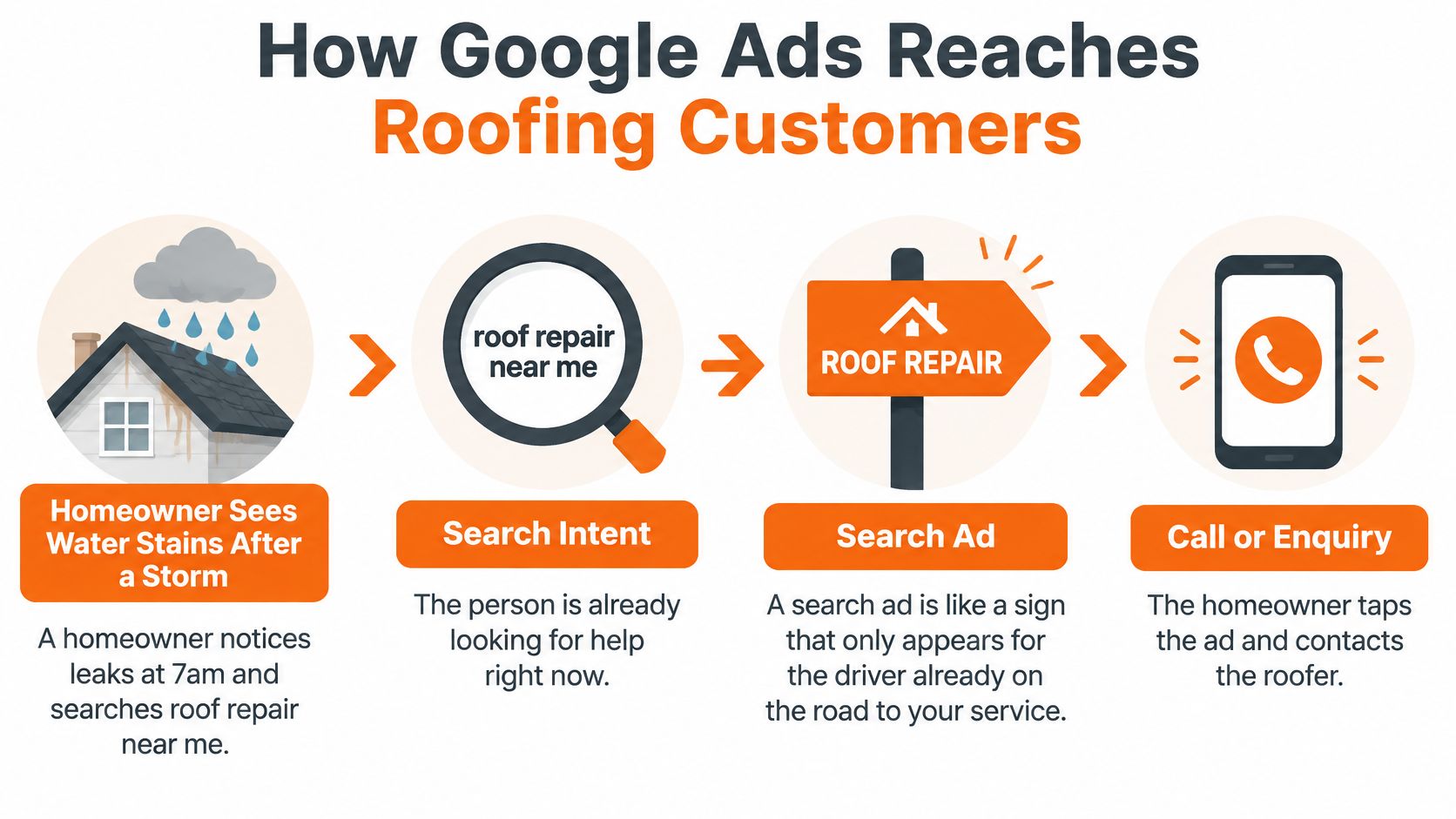
A search ad works like a signpost that only appears for the driver already heading your way. The billboard on the arterial route is seen by thousands of people who don’t need a roof. The search result is read by one person with water coming through the gib, and that difference is what separates search from every interruption-based channel.
The three moving parts
Three things happen in order, and a weak link anywhere loses the job. The keyword decides whether your ad is eligible for that search at all. The ad text decides whether the homeowner taps yours or the competitor sitting underneath it. The landing page or phone number decides whether the click becomes a booked inspection or a bounce back to the search results.
Search is also the largest single slice of digital ad spend in New Zealand, ahead of social and display. You’re bidding in the most contested part of the local market, which is why the suburbs you target and the terms you bid on matter more than the size of the daily budget.
You don’t set the price of a click. You bid against other roofers for each search, and what you pay depends on how relevant your ad and your page are to what was typed, not only on the size of your bid. A tight keyword group, an ad that repeats the service, and a page about that exact job usually cost less per click than a broad term pointed at the homepage. Anyone can outbid you on volume. Relevance is the part you control.
Judge the whole chain by one figure: booked and completed jobs. A click that never rings the phone is just another line on the Google invoice, GST included.
Campaign Types to Start With
Start with search and remarketing, and leave everything else until those two are producing tracked enquiries.
| Campaign type | What it does | Best use for a roofer | When to start |
|---|---|---|---|
| Search | Shows ads when someone types a roofing query | Repairs, leaks and replacements in your service area | First, in week one |
| Remarketing | Shows ads to people who already visited your website | Bringing back visitors who did not call | Second, once search brings enquiries |
| Performance Max | Automated ads across several Google placements | Adding reach once conversion data is reliable | Later, after two to three months of tracked jobs |
| Video or display | Visual ads on websites and YouTube | Building awareness in a new area | Later, if at all |
Why search carries the early money
Search is the only campaign type where the customer has already told you what they want. Split it by intent rather than lumping every service into one ad group: repairs, leaks, replacements, gutters and commercial work each get their own ad group, their own ad text and a landing page that speaks to that job. A leaking-roof searcher wants to hear about same-week inspections. A replacement searcher wants to know what it costs and how long the scaffolding stays up.
Remarketing is the second chance
Many visitors to a roofer’s site do not call the same day. Remarketing puts your ad back in front of them, and it should cover everyone who visited the site rather than only those who arrived from an ad click. Visitors who found you through a blog post, an SEO result, or Instagram are equally valuable, and a good setup follows them too.
Performance Max and video can wait. Both need reliable conversion data before automation has anything to learn from, and both spread budget across placements you can’t easily inspect. On a small account, that’s an expensive way to buy impressions.
The launch order is simple. In week one, search only, with a handful of tightly themed ad groups. Once search is producing enquiries you can count, add remarketing. After two to three months of tracked jobs, consider Performance Max.
Watch the seams: every extra campaign type adds tracking you have to check. If a campaign is live but the phone has gone quiet, fix the conversion path before adding another channel. FOMOchat’s breakdown of failed ad campaigns covers the usual culprits, from forms that never send to offers that don’t match the ad.
Keywords to Bid On and Block
The most expensive mistake in roofing ads is bidding on roofing or roof replacement because the volume looks impressive. High volume means a wide mix of people, and most of them are not hiring anyone this month.
| Keyword group | Example searches | What to do |
|---|---|---|
| High-intent repairs | roof repair near me, leaking roof repair | Bid and prioritise |
| Replacements | roof replacement cost, re-roofing quote | Bid, with tight ad text and a matching page |
| Generic terms | roofing, roofers | Restrict to exact or phrase match |
| DIY and research | how to paint a roof, how to fix a leaking roof | Add as negative keywords |
| Job seekers | roofing apprenticeship, roofing jobs | Add as negative keywords |
The reasoning is straightforward once you see the invoice. Someone looking for a tutorial will never sign a quote, and someone hunting an apprenticeship will never sign one either, yet both cost you the same click.
Blocked terms cost nothing. Clicks from them cost plenty.
Search is where this discipline pays, because New Zealanders rely on it to find businesses. IAB New Zealand’s 2025 commerce report found that 61% of New Zealanders discover brands through search, compared with 56% in Australia. That demand arrives through a query box, which means the query you match decides whether the click turns into a booked job or a wasted spend.
Match types in plain language
Exact and phrase match keep you on the searches you chose. Broad match widens reach and hands more control to Google’s matching, which can work once you have conversion history and a long negative list, and rarely earns its keep before that. On a roofing budget under NZD 3,000, start narrow. Build that figure with GST included, so the number you approve is the number on the invoice.
Treat negatives as a blocklist and grow it deliberately. Add them at account level so they apply everywhere, then read the search terms report weekly for the first month. Every odd query you find, from free roof advice to roof cleaning chemicals, becomes a new block. Build the first list straight from the non-buying searches in the table above: DIY tutorials, job-seeker queries and research terms. A published negative keywords list for local campaigns is worth cross-checking against your own before any bid goes live.
Geographic rules matter as much as keywords. Target the suburbs you drive to and exclude the rest. A Christchurch roofer has no reason to pay for clicks from Tauranga, and location settings that include people “interested in” your area can show your ads to searchers who will never book a local inspection. The aim is a keyword list where every click is a homeowner who can say yes, at a cost that still stacks up when a completed job is the only scoreboard that counts.
Measure Lead Quality, Not Just Clicks
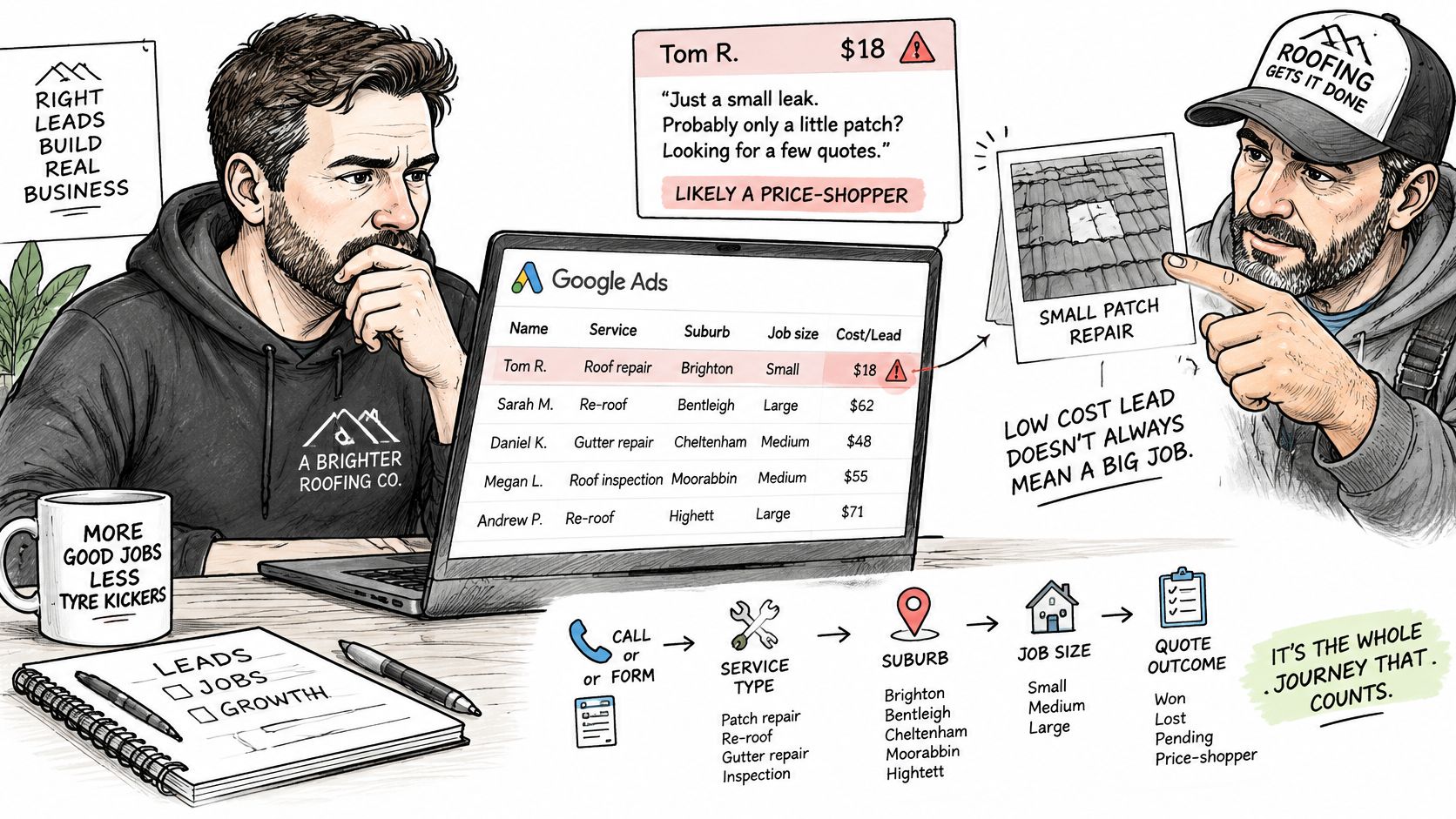
A cheap enquiry can be a price shopper with a five-year-old quote from someone else, or a homeowner wanting a patch on a leaky shed. Cost per lead alone will call both of those a win and keep buying more of them.
The chain to track runs further than most accounts go. For every enquiry, you want the call or form, the service type, the suburb, whether an inspection was booked, whether the quote was accepted, and the job value. Without those fields you’re guessing which keywords fund your week and which ones fund Google’s quarter.
Here’s the pattern that makes it concrete. Say two campaigns each produce 20 calls at NZD 40 a call, so both look identical on a cost-per-lead report. Campaign A’s calls include four accepted replacement quotes. Campaign B’s include one small patch repair and a lot of people asking whether you do free inspections. Same spend, same lead cost, entirely different business. Campaign A is the better buy and a lead-cost report alone can’t tell you that.
Feed outcomes back, not just clicks
Value-based tracking is the practical answer. Give a full replacement or a commercial job a higher conversion value than a small repair, and the bidding starts favouring the searches that produce the profitable work. Then import the outcomes your call tool or CRM already holds, such as accepted quotes and completed jobs, so the algorithm learns from revenue rather than from form fills.
That connection matters more as competition grows. New Zealand’s digital advertising market reached NZ$2.967 billion in 2025, with search at approximately NZ$1.44 billion and growing 12% year on year, according to the IAB New Zealand Q4 2025 digital advertising revenue report. More advertisers bidding for the same searches means measurement quality decides who wins, and the same report notes MBIE found only 40% of New Zealand businesses promoted themselves online through digital marketing, SEO or online advertising.
If your setup is still counting page views as conversions, fix that before you spend another dollar. Our walkthrough of Google Ads conversion tracking for roofers covers calls, forms and the offline events worth importing.
The three numbers to review monthly
- Cost per qualified opportunity. Total spend divided by enquiries inside your service area for work you do.
- Cost per accepted quote. Spend divided by quotes the customer signed, which tells you whether the landing page is filtering or just collecting.
- Cost per completed job. Spend divided by finished roofs. This is the only figure that touches your bank balance.
The stop rule: if cost per completed job is higher than the profit that job earns, change the targeting before you change the budget.
One more thing belongs in this chain: the page the click lands on. If it takes four seconds to load on a phone, no bid strategy rescues it, and a website builder and hosting plan comparison is often a better use of an evening than another budget increase.
DIY or Managed Services for Roofing Ads
| Factor | Doing it yourself | Managed service |
|---|---|---|
| Time each month | A few hours of checking, search term reviews and bid changes | Handled by the provider, with monthly reporting |
| Expertise needed | Keyword, bidding and tracking setup | Roofing-specific setup and optimisation |
| Cost | Ad budget plus your own time | Ad budget plus a management fee, which is flat or a percentage of spend |
| Account control | Full control in your own account | Full control if the account stays in your name, so check the contract |
| Main risk | Wasted spend while learning | Fees paid without measurable jobs |
Doing it yourself works under specific conditions: you have a few hours a week, you serve one or two suburbs with a short list of services, and you will open the search terms report and read it. Miss any of those and the account drifts, spending on searches you never asked for while bids sit stale.
Cost is the reason many owners hesitate. MBIE’s Business Digital Capability Monitor, based on a survey of 2,702 businesses, found that 48% said affordability or value-for-money concerns prevented them from being as digitally enabled as they could be. That worry is fair. A management fee only looks expensive when nobody can tell you what it bought in booked jobs, so the question is whether the fee comes with measurement, not whether the fee exists.
When a managed service earns its fee
Multiple service types, several towns, no reliable call tracking, or a crew so busy the ad account gets opened once a fortnight. In those situations a specialist pays for itself, because the optimisation work happens weekly rather than whenever someone remembers.
Before you sign anything, get straight answers to five questions:
- Who owns the ad account? It should sit in your name, with the provider added as a user, and you keep ownership of the account and its data if the contract ends.
- Is the fee flat or a percentage of spend? Percentage fees reward higher budgets whether or not the extra spend books jobs.
- How is the ad budget paid, and who receives the GST invoice? You want to pay Google directly, with the management fee invoiced separately and GST included so the figure is clear before you commit.
- What report arrives each month? Calls, forms, quote outcomes and job value, not impressions.
- Can the provider access the account only with your explicit permission, and only for campaign management? Expect that standard from anyone you hire.
Still weighing it up? You can find a results-driven roofing marketing partner by comparing what a specialist does month to month against your own hours.
The honest way to frame the choice: would your hours earn more on the tools than in the ad account? If a day on site bills better than a day of keyword reviews, buy the expertise. If you enjoy the data and have one simple service area, run it yourself and keep the fee.
Set Up Your First Campaign This Month
The goal is modest and achievable: a live search campaign in one or two suburbs within a week.
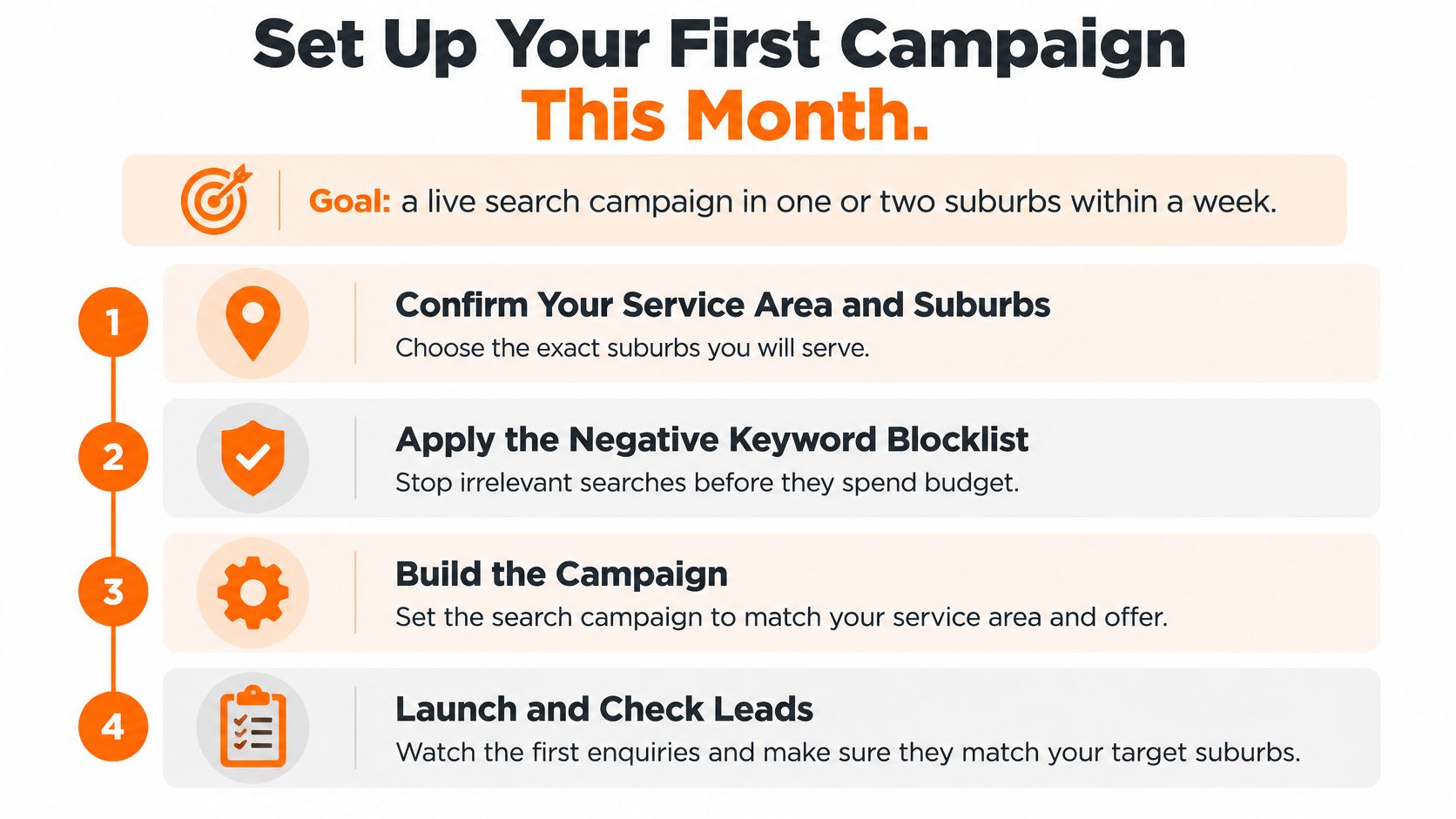
Work through this in order. Each step exists because skipping it costs money later.
- Confirm your service area and suburbs. Write the list down before you touch the platform, including the ones you’ll exclude.
- Load the blocked terms and keyword groups. Negatives go in first, at account level, so no bid goes live without protection.
- Write one ad group per service. A leaking-roof ad group, a replacement ad group, a gutters ad group, each with ad text that repeats the job.
- Send each ad group to a matching page. A phone number near the top, a short quote form, and a headline that mirrors the search. A 2025 NZBusiness report on local digital trust, citing Thryv’s Business Index and Consumer Report, found 75% of New Zealand SMEs believed they had a strong digital profile while only 52% of consumers agreed, so assume the page needs to prove competence faster than you think.
- Set up call and form tracking, and mark an accepted quote as a conversion. Not a page view. Not a scroll.
- Set the monthly budget with GST included, using the invoice total from the table at the top of this guide.
- Review the search terms report at seven days and again at thirty. Add negatives as you go.
A healthy first month looks like this. Enquiries arrive within days rather than weeks, most of them from inside the service area, and a few are the replacements or repairs you want. A quiet first fortnight isn’t a failure, but a month with clicks and no calls is a signal to check tracking, targeting and the landing page before you change the budget.
The account stays in your name throughout, and the data inside it belongs to you. Bluelight builds campaigns in the client’s own Google Ads account, so nothing is locked away if you later change how it’s managed.
Bluelight builds and manages Google Ads for roofing companies only, which means the campaigns are written around the searches homeowners type when a roof is leaking or a re-roof is being planned. If you want to know where your current account stands before you commit another month of spend, the team offers a free 30-minute ad review that shows what’s working, what’s leaking budget, and the two or three changes that would move your numbers fastest. Book that review at Bluelight.
Related service Google Ads for Roofers