Contractor Marketing Agency for Roofers: A Buyer's Guide
Your phone’s ringing, but too many callers want work you don’t do or live beyond your crews’ service area. The agency report looks healthy, yet your estimator’s diary has gaps and you can’t tell which ads produced the jobs you won.
A contractor marketing agency should help you resolve that mismatch, not sell you more clicks. For a roofing business, the buying decision comes down to control of your accounts, reliable tracking through to paid work, and a budget that fits local demand and crew capacity.
Table of Contents
- What a Contractor Marketing Agency Does for Roofers
- Google Ads Campaigns Roofers Should Start With
- Landing Pages and Call Tracking That Turn Clicks into Quotes
- Measuring Leads, Cost and Return Honestly
- Matching Your Budget to the Construction Cycle
- Questions to Ask and Ownership Checks Before You Sign
- What the First 90 Days Should Look Like
What a Contractor Marketing Agency Does for Roofers
A contractor marketing agency runs the paid search, website and tracking systems that turn homeowner searches into quote-ready enquiries. It should report results in terms of calls, quotes and booked jobs, with enough detail for you to decide where to spend next.
A roofing specialist builds around services such as roof replacement, re-roofing, leak repair, gutters and storm damage. A generalist selling a calendar of social posts may offer useful brand exposure, but that isn’t a substitute for reaching someone who needs a roofer and giving them a clear way to book an inspection.
The services need to connect. Accurate targeting won’t rescue a confusing website, and a good website won’t tell you which campaigns deserve more budget unless tracking works.
Agency services and what each delivers
| Service | What It Does for a Roofer | What You Should Receive |
|---|---|---|
| Google Search Ads | Shows ads when homeowners search for repair or replacement | Account in your name with monthly keyword and negative keyword review |
| Landing pages | Sends each service to a page built for that job | Conversion layout and quote form, tested on mobile |
| Call and form tracking | Links each phone call or quote form to the ad that drove it | Lead source recorded against every enquiry |
| Performance Max and remarketing | Extends reach and follows visitors who did not enquire | Campaign setup and monthly performance review |
| Monthly reporting | Shows cost per enquiry and booked jobs by service area | Written report with spend, enquiries and booked inspections |
| SEO for roofers | Improves organic search visibility for local service pages | Scope of work and reporting schedule in writing |
| Storm damage lead generation | Targets urgent searches after severe weather | Campaign plan with a clear service area and crew capacity |
| Website design | Rebuilds a site that does not convert visitors | Written page list, mobile layout and tracking install |
At Bluelight, our services include Google Ads for Roofers, Roofing Lead Generation, Roofing Advertising, SEO for Roofers, Storm Damage Leads and Website Design. The written scope should distinguish what’s included in your engagement from services available separately.
Check the work behind the service name
A good agency can name every service it sells and show the account structure behind it. For a practical starting point when checking service terminology, the local roofing SEO tips from LPagery can help you compare roofing keyword ideas with the jobs you want.
Don’t accept a broad label such as digital management without deliverables. Ask for last month’s report and check whether it lists spend, calls, forms and booked jobs by service area, rather than stopping at clicks.
Google Ads Campaigns Roofers Should Start With
Two campaign types earn their place at launch: search and remarketing. Search reaches homeowners already typing a repair or replacement term into Google. Remarketing puts your name back in front of people who visited and left without enquiring, and it only earns its budget once search has built enough traffic for that audience to be worth following.
Hold the rest until those two produce enquiries you would quote. An account with three or four clean service groups is far easier to diagnose in week six than a launch carrying seven campaigns where nobody can say which one delivered the good lead.
Google Ads campaign types for roofers
| Campaign Type | Best For | When to Add It |
|---|---|---|
| Search | Homeowners typing repair or replacement terms | From day one |
| Remarketing | Visitors who viewed the site but did not enquire | Once search brings steady traffic |
| Performance Max | Wider reach across Google placements with automated bidding | After search and remarketing convert well |
| Storm damage search | Urgent demand after hail or wind events | When local storms create a surge in demand |
Performance Max is the one to hold back on purpose. It spreads spend across Search, Display, YouTube and Discover, and it shows you far less of the exact wording that triggered an ad. On a young roofing account that wording is how you learn which suburb, service and problem are producing real jobs, so automation can wait until search and remarketing have taught you what a good enquiry looks like. Storm search sits in the same category: switch it on when a weather event hits your service area and you have crews free to answer the phone, then dial it back when demand normalises.
Build around the job and the address
Group keywords by service and practical service area. A re-roof search in Hamilton should land on a Hamilton re-roof page from a business that can get there, not a leak-repair page written for Auckland homeowners. Budget follows the same logic. There is no point paying for clicks in towns your installers would not drive to on a Tuesday.
You don’t need a separate campaign for every suburb. Split campaigns only where you need independent budget control, then organise related keywords into tightly matched ad groups.
Negative keywords exclude searches you don’t want to pay for. Review terms associated with students, DIY researchers and job applicants, including roofing courses, roofing jobs and how to fix a roof leak. Avoid blanket exclusions that could remove genuine buyers, such as blocking every search containing cost.
Practical rule: Expand reach only when you can distinguish useful enquiries from activity that merely looks busy.
Bluelight’s Roof Flow™ full management package includes Google Ads setup in 5 business days, search campaigns, Performance Max, remarketing, landing-page optimisation, call tracking, lead attribution, monthly reporting and ongoing management. A capability being available in the package is not a reason to switch it on before the account can support it.
Search-term history is the account’s memory: the negatives you have added, the queries that converted, the suburbs that wasted money. Keep that history inside an ad account you own, and a change of agency becomes a handover rather than a rebuild from zero.
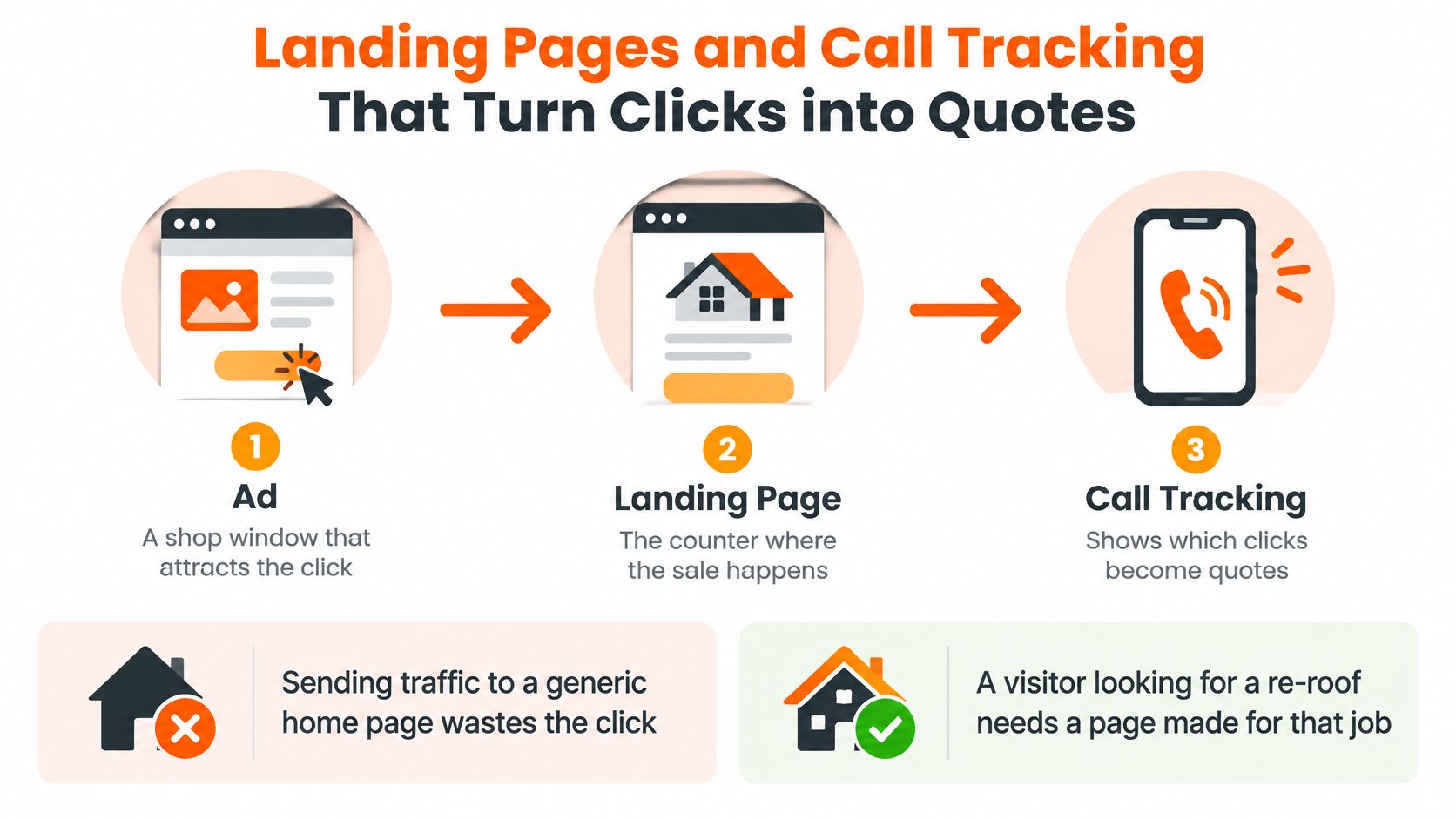
Landing Pages and Call Tracking That Turn Clicks into Quotes
An ad is the shop window; the landing page is the counter where the sale happens. Sending paid visitors to a generic home page makes someone looking for a re-roof hunt for the right service.
Build and test the enquiry path
-
Match the page to the job. Give re-roofing, leak repair, metal roofing and commercial work appropriate destinations. Match the headline to the ad instead of making every visitor read the same general introduction.
-
Make contact easy on mobile. Put a tappable phone number and short quote form near the top. Ask for contact details, location and job type, not a complete technical specification before you’ve spoken.
-
Test call and form tracking. Make a real test call and submit the form, then check that the source reaches the enquiry record. This call-tracking software overview explains the role of tracking in connecting calls with advertising.
-
Improve trust and remove friction. Test headlines, relevant reviews, genuine licence and insurance details, and form length. Adwave’s guide to convert more roofing estimates is useful when reviewing the path from initial interest to a quoting conversation.
-
Record what happened next. Send enquiries into your customer relationship management system, or CRM, and mark inspections, quotes and won jobs. Otherwise, you’ll know who contacted you but not which advertising produced work.
Our proprietary Roof Flow system combines targeted search, fine-tuned landing pages, call tracking and conversion optimisation. We set up the website’s conversion layouts and build the ad account within 5 work days; testing belongs inside that setup, not after launch.
Qualify the scope without making consent promises
Include a job-type field covering maintenance, repair, alteration or larger replacement. It gives your estimator context without asking the homeowner to diagnose the roof.
Some repair and maintenance work may be exempt under Schedule 1 of the Building Act, but all building work must comply with the Building Code, according to the government’s building-consent guidance. Never advertise every roof job as consent-free or universally requiring consent; confirm requirements with the relevant local council.
Measuring Leads, Cost and Return Honestly
A cheap enquiry isn’t a cheap job. Cost per lead only becomes useful when you follow it through to inspections, won work and what remains after delivering the job.
Say one suburb produces inexpensive enquiries, but most callers only want a price comparison. Another costs more to reach, yet produces booked inspections and replacement jobs that suit your crew. Choosing the cheaper suburb on enquiry cost alone could leave your estimator busier and your business worse off.
Lead and return metrics to track
| Metric | How to Calculate It | Warning Sign |
|---|---|---|
| Cost per enquiry | Ad spend divided by tracked calls and forms, after removing duplicates | Low cost but few booked inspections |
| Cost per booked inspection | Ad spend divided by inspections booked | Rising while enquiry volume stays flat |
| Close rate | Won jobs divided by quotes given | A sustained fall in quote-to-win rate |
| Average job value | Revenue from won jobs divided by jobs won | Falling as small repairs fill the pipeline |
| Return on ad spend | Revenue from won jobs divided by ad spend | Return too low to cover materials and labour |
| Gross margin per job | Job revenue less direct materials and labour; also check the result after allocated overheads | Profitable-looking leads that earn thin margins |
Keep the accounting distinction clear: gross margin excludes general overheads. Checking the contribution after overheads helps you judge the business outcome, but don’t let an agency redefine the measure between reports.
Reconcile the report with your books
Match Google Ads records to tracked calls, forms, CRM outcomes and invoices each month. Remove repeat contacts and spam, then check whether reported revenue represents quoted, accepted, invoiced or paid work.
A marketing-attribution system should make those connections inspectable. Keyword Kick’s discussion of an SEO reporting tool is also useful when assessing reporting usability, but no dashboard replaces accurate job records.
We generated $575K in revenue for Modern Roofing over 15 months, an 8x return on ad spend. That’s a specific client outcome, not a forecast for another roofer or a statement of profit.
Revenue return tells you what advertising brought in. Your job-cost records tell you whether it was worth winning.
Review results by service and suburb. If inspection costs keep rising while enquiry volume holds, investigate qualification and follow-up, then pause the weakest area if another produces stronger close rates. Gross margin per job matters more than lead volume, and every return figure should stand up against your own books.
Matching Your Budget to the Construction Cycle
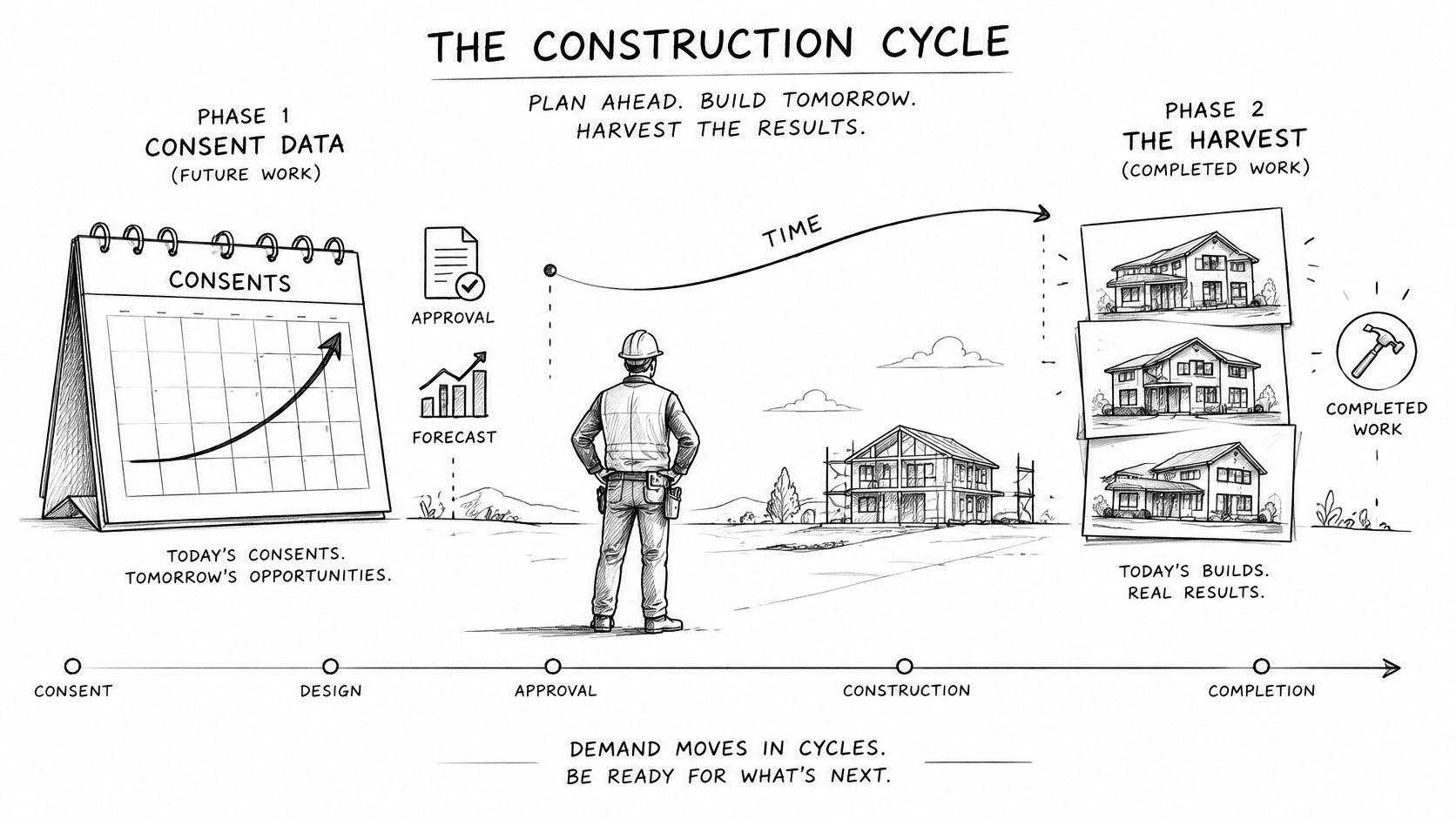
Consent data is the forecast; completed work is the harvest. Don’t treat planned construction as immediate roofing revenue, or assume a change in national activity will affect every local service equally.
Construction sales reached NZ$22.3 billion in the June 2025 quarter, while building work put in place represented NZ$7.9 billion, according to Stats NZ. These are different measures, not interchangeable estimates of roofing demand.
The National Construction Pipeline Report 2025 projected residential building activity to fall from NZ$29.2 billion in 2024 to approximately NZ$26.1 billion in 2025, before rising to NZ$32.3 billion by 2030. That forecast supports caution about relying entirely on new-build work, not a guaranteed recovery timetable for your business.
Allocate by urgency and buying cycle
- Urgent repairs and leaks: Protect coverage where you can respond promptly. These enquiries can support immediate cash flow, but travel and small-job costs still need checking.
- Planned re-roofing and restoration: Keep replacement campaigns visible when homeowners are comparing scope and timing. Don’t judge these enquiries by the same turnaround expectations as an active leak.
- Commercial maintenance and coating: Target property managers, body corporates and facilities teams with planned-work messaging. Recurring opportunities deserve their own qualification process, not a homeowner emergency form.
Validate national signals locally
The Stats NZ building-consent dataset includes regional and territorial-authority breakdowns, building types, and alterations and additions. Use those categories to investigate your actual service area rather than spreading budget according to national headlines.
When residential demand softens, protect viable repair and replacement campaigns and test commercial maintenance where suitable work exists. Require a spend breakdown across these groups, then validate each shift against booked jobs and available capacity rather than treating a forecast as a promise.
Questions to Ask and Ownership Checks Before You Sign
Ownership questions come before performance promises. A persuasive pitch is little comfort if leaving the agency means losing access to your advertising history and enquiry records.
Take the same questions to competing agencies so you can compare their answers rather than their presentation skills. A written scope matters more than an enthusiastic assurance on an introductory call.
Questions to ask and how to judge the answers
| Question | Good Answer | Red Flag |
|---|---|---|
| Who owns the Google Ads account? | You own it, with admin access and your lead data | The agency holds the account and you lose it if you leave |
| How is the fee structured? | A flat monthly management fee, with the ad budget paid directly to Google | A fee tied to your spend that is not explained in writing |
| What is the setup fee? | A stated amount based on your current setup and starting point | A verbal promise with no written scope |
| How fast can leads start? | A written launch timeline and realistic expectations after launch | A vague answer such as it takes time |
| Which campaigns will you start with? | Search and remarketing first, then tests of other types | Many campaign types launched immediately |
| How are calls and forms tracked? | Call and form tracking linked to advertising, with lead attribution | Reports showing only clicks and impressions |
| Are the leads exclusive? | Leads go only to your business | Leads shared with several roofers |
Our ad budget is separate from the management fee and paid directly to Google. You own the ad account, control the spend and keep the account if you leave; the leads we generate are exclusive to your business.
We charge a flat monthly management fee and a one-time setup fee based on your current setup and starting point. Get those amounts and the agreed deliverables in writing, rather than comparing proposals by a headline fee that may exclude essential work.
Complete the checks before committing
- Inspect a recent report. Check for spend, enquiries, booked inspections and won jobs by service area. A redacted sample is reasonable when another client’s details need protecting.
- Verify access. Confirm account and lead-data ownership in writing, then check your administrator access rather than relying on a screenshot.
- Separate the costs. Record the management fee, setup fee and advertising budget as distinct items in the scope.
- Agree on the review point. Make continuation depend on tracked job outcomes and a documented improvement plan, not an open-ended request for patience.
Before signing: A missing written scope is a red flag even when the sales conversation sounds convincing.
Use the intro call to test practical understanding. Explain your service boundaries, crew capacity, preferred job types and quoting bottlenecks, then listen for a plan that reflects those constraints. An agency that recommends more demand without asking how you’ll service it hasn’t finished the diagnosis.
What the First 90 Days Should Look Like
Treat the opening quarter as a controlled launch, not a period when the agency disappears behind the account. Say you’re a regional roofer seeking more replacements while keeping room for repair work. A healthy engagement should give you visible evidence of progress at each stage.
Establish a working system
- Weeks 1 to 2: The agency builds the account, checks the landing page on a phone and tests calls and form submissions end to end. Search goes live first, with remarketing configured and activated when the audience is eligible. You should be able to trace a test enquiry into the record your office will use.
- Weeks 3 to 6: Review search terms weekly and add exclusions where searches don’t match your services. Check actual enquiry addresses, not just the campaign’s location settings, and flag work your crews can’t reach or aren’t equipped to perform.
Early feedback needs to come from your office as well as the agency. Mark unsuitable enquiries with a reason, such as outside area, wrong service or duplicate contact, so the next adjustment addresses a specific problem.
Judge outcomes before adding complexity
During weeks 7 to 10, examine cost per booked inspection, close rate and average job value. Check that the CRM distinguishes an inspection from a quote and a quote from accepted work, while allowing for replacement jobs that haven’t reached a decision yet.
At week 12, decide whether Performance Max or storm campaigns have a useful role. Consider moving budget between repairs, replacements and commercial maintenance only where the job records and local demand signals support it.
| Continue improving | Challenge the engagement |
|---|---|
| The agency explains changes using enquiry and job records | There’s no written monthly report |
| Unsuitable enquiries have recorded reasons and corrective actions | Tracking stops at clicks |
| Budget decisions reflect capacity and profitable work | Enquiries rise while booked jobs stay flat without an explanation |
Don’t change agencies just because every enquiry hasn’t become a job. Do reconsider the relationship if the agency can’t show what it changed, why it changed it or how you’ll judge the result. The measure that matters is booked, profitable roofing work, not a fuller inbox.
Bluelight offers roofing-specific Google Ads management, landing-page optimisation, call tracking and lead attribution, with exclusive enquiries generated in your own ad account. Visit Bluelight to book a free intro call and discuss your service areas, crew capacity and the roofing jobs you want more of.
Related service Google Ads for Roofers