Lead Generation Marketing for Roofers: A Practical Guide
Your diary’s quiet for two weeks, then three enquiries land in one morning and two are tyre-kickers from outside your area. That’s the usual pattern when work depends on referrals and luck. Good lead generation marketing doesn’t fix that by chasing more clicks. It fixes it by building a measurable path from a homeowner searching for help to a booked inspection, then to a signed job, with a cost attached to every stage. Judge every channel that way and the choices get simpler, because the cheapest enquiry often produces the most expensive job you’ve ever won.
Table of Contents
- What a Roofing Lead Really Costs
- How to Build a Search Campaign That Brings Roof Jobs
- How to Qualify Leads Before You Send a Quote
- Channels to Add Once Search Brings Calls
- Track Leads Across Calls, Reviews and Job Records
- Decide When to Scale Your Roofing Spend
What a Roofing Lead Really Costs
Cost per stage for two sample roofing campaigns
| Metric (NZ$3,000 monthly spend) | Sharper campaign | Broad campaign |
|---|---|---|
| Enquiries received | 60 | 150 |
| Cost per enquiry | NZ$50 | NZ$20 |
| Qualified leads | 30 | 20 |
| Cost per qualified lead | NZ$100 | NZ$150 |
| Inspections booked | 15 | 6 |
| Cost per inspection | NZ$200 | NZ$500 |
| Jobs won | 5 | 1 |
| Cost per job won | NZ$600 | NZ$3,000 |
Both campaigns spend NZ$3,000 a month. At the top of the table the broad campaign looks like the winner, because NZ$20 per enquiry beats NZ$50. Walk down the rows and it flips. The sharper campaign wins five jobs at NZ$600 each, while the broad one wins one job at NZ$3,000.
The Four Stages in Plain Words
An enquiry is any call or form, useful or not. A qualified lead is inside your service area and wants a real job you do. A booked inspection is a site visit in the diary, and a job won is signed work. Each cost is spend divided by the count, so the sharper campaign’s cost per inspection is NZ$200, which is NZ$3,000 across 15 inspections.
Practical rule: Cost per enquiry is a vanity number. Cost per job won is the one to steer by, with cost per inspection as your early warning.
The figures above are illustrative, so swap in your own before you make decisions. What’s not in doubt is the opening. MBIE reported that only 40% of New Zealand businesses promoted themselves online using digital marketing, search engine optimisation, or online advertising in 2024, according to the MBIE business digital capability monitor findings for July 2024. A steady search pipeline is still a real edge, not a crowded default.
Do one test before changing anything. Take last month’s spend, divide it by jobs won, and write that figure down.
How to Build a Search Campaign That Brings Roof Jobs
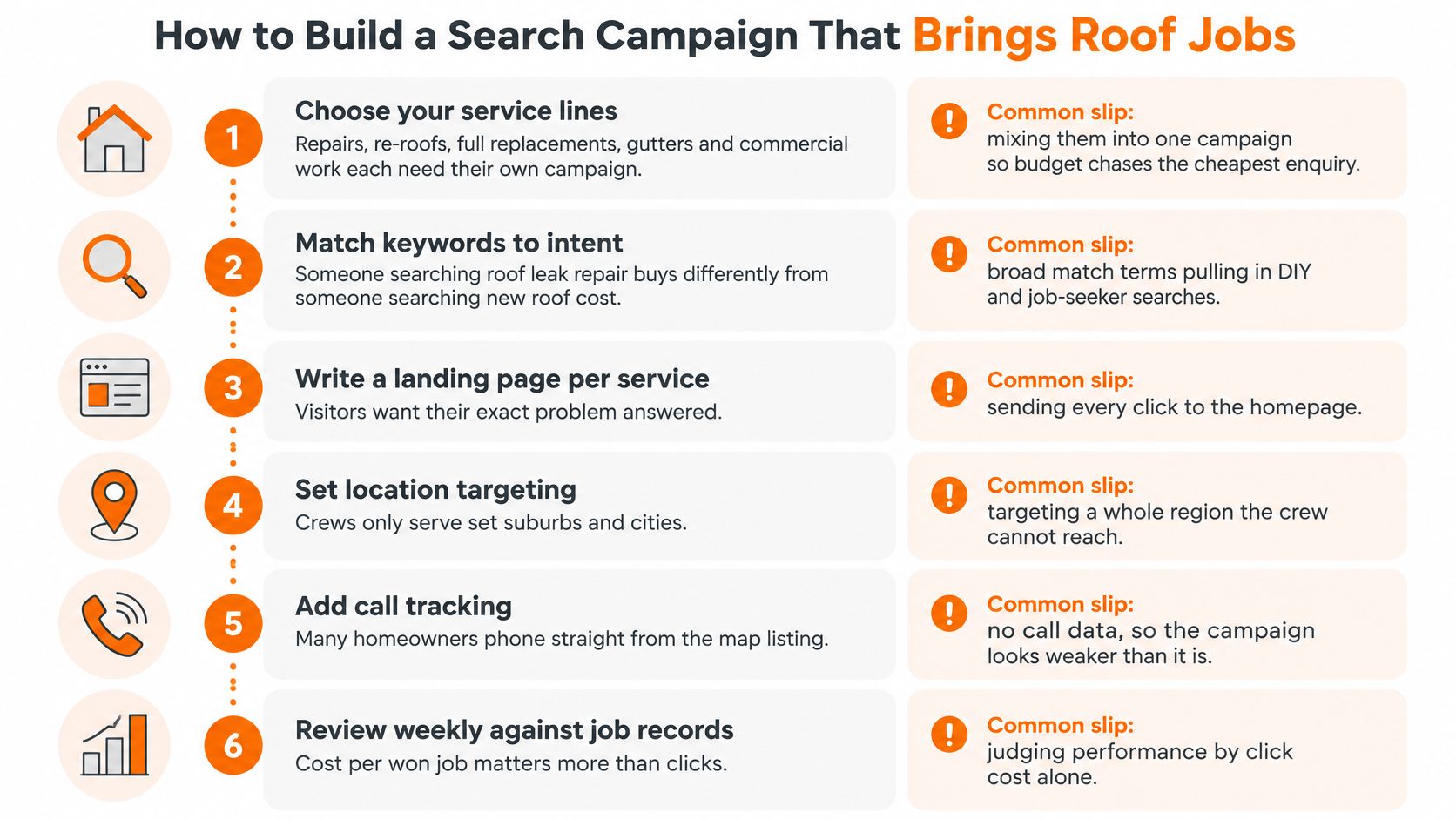
Search comes first because it’s where homeowners with a problem right now go looking. Build it in this order, and don’t skip the boring steps.
-
Choose your service lines. Split repairs, re-roofs, full replacements, gutters, and commercial work into separate campaigns. A homeowner with water coming through the ceiling isn’t responding to the same message as a building manager pricing a flat roof. The common slip is lumping everything into one campaign, where budget drifts toward whichever enquiry is cheapest rather than whichever job is worth winning.
-
Set a service area you can actually staff. Draw the boundary around how far a crew can reach in a day and still make margin, not around the whole region. Every job you win beyond that line costs you travel, supervision, and callbacks. The slip is a big map that wins work you can’t service properly.
-
Build keyword lists around intent. Start with phrases like roof repair near me, emergency roof leak, and roof replacement cost, because each one signals a different stage of buying. Add negative keywords for employment, DIY, materials only, and tutorial searches from day one. The slip is running a bare term like roofing, which pulls in apprentices, students, and people pricing sheets of iron.
-
Send each campaign to a matching landing page. The leak campaign lands on a leak page, the replacement campaign on a replacement page, with the phone number visible before anyone scrolls. Never send paid traffic to the homepage and make a stressed homeowner hunt. If you want the detail on layout and copy, work through these landing page best practices for converting visitors into calls before you build.
-
Track calls, forms, and booked inspections separately. A form submission isn’t a sale, and treating it as one makes weak campaigns look strong. Record each stage on its own so you can see where enquiries die. The slip is reporting one blended conversion number that hides the leak.
-
Review search terms weekly for the first month. You’ll find wasted queries fast, and every one you block frees budget for terms that produce inspections. Shift money toward the queries and suburbs bringing site visits, not just clicks. The slip is waiting a quarter to look, by which point you’ve paid for three months of other people’s research.
What a Useful First Month Looks Like
Don’t expect perfection in week four. Expect a shorter list of wasted search terms, a clear pattern showing which services produce calls, and a few booked inspections you can trace back to a specific campaign. That’s enough to make the next decision with evidence instead of opinion.
One caution sits outside the campaign build itself. Follow-up messages carry legal duties under New Zealand’s spam rules, so keep consent and unsubscribe handling in mind as part of your system design, as set out in the Department of Internal Affairs spam frequently asked questions. The qualification steps below cover how to handle that properly at the form.
How to Qualify Leads Before You Send a Quote
Qualifying isn’t about being picky. It’s about not sending your best person across town to quote a job you were never going to win.
- Confirm the address first. In the first minute, check the property sits inside your service area. If it doesn’t, say so politely and refer them on if you can.
- Ask what happened and when. An active leak needs a different response from storm damage last month or a re-roof planned for six months from now. Timing tells you urgency and likely budget.
- Check who decides. Confirm the caller owns the property or decides on the work, or can get that person onto the next call. Quoting through a tenant wastes everyone’s time.
- For storm work, ask about insurance. Find out whether a claim is open and which insurer is involved before you scope anything.
- Book only when the answers fit. If the first four answers stack up, book the inspection. If they don’t, send a price guide and set a follow-up date instead.
- Score every lead. Mark it hot for an inspection this week, warm for a call back within a fortnight, or cold for your nurture list.
If you’re refining that scoring step, these lead scoring tips for service businesses offer a useful outside perspective on structuring the funnel. And handle missed calls properly. A same-day text with your name and a booking link recovers enquiries that would otherwise ring your competitor.
Getting the Quote Form Right
Separate the request for roofing help from any optional marketing tick-box. State who’ll contact the person, why you’re collecting their name, phone, address, and project details, and which channels you’ll use. Keep a timestamped record of consent, because under the Unsolicited Electronic Messages Act, promotional texts and emails need consent, sender identification, and a working unsubscribe, as explained in this Chambers comparison guide on New Zealand electronic marketing rules.
Don’t dress a service follow-up up as a promotion, and don’t blur the two. Connect call tracking and CRM data only after you’ve set retention, access, and deletion rules, since passing personal data between platforms without a clear purpose is where most firms come unstuck.
Channels to Add Once Search Brings Calls
Roofing lead channels compared by intent and speed
| Channel | Lead intent | Time to first enquiry | Main limit |
|---|---|---|---|
| Google Business Profile and Maps | High, local | Days once the profile is complete | Depends on recent reviews and photos |
| SEO service pages | High, but slow to build | Several months | Needs steady content and local links |
| Client referrals and review requests | High trust | Ongoing once started | Volume is hard to scale |
| Remarketing to website visitors | Warm | Days after visits start | Needs traffic already on the site |
| Facebook and Instagram | Low to medium | Days | Reaches people not yet looking for a roofer |
| Storm damage response | High and urgent | Within days of a weather event | Spiky volume that needs crew capacity |
The image below sets out the main directions you can take once search is producing calls reliably.
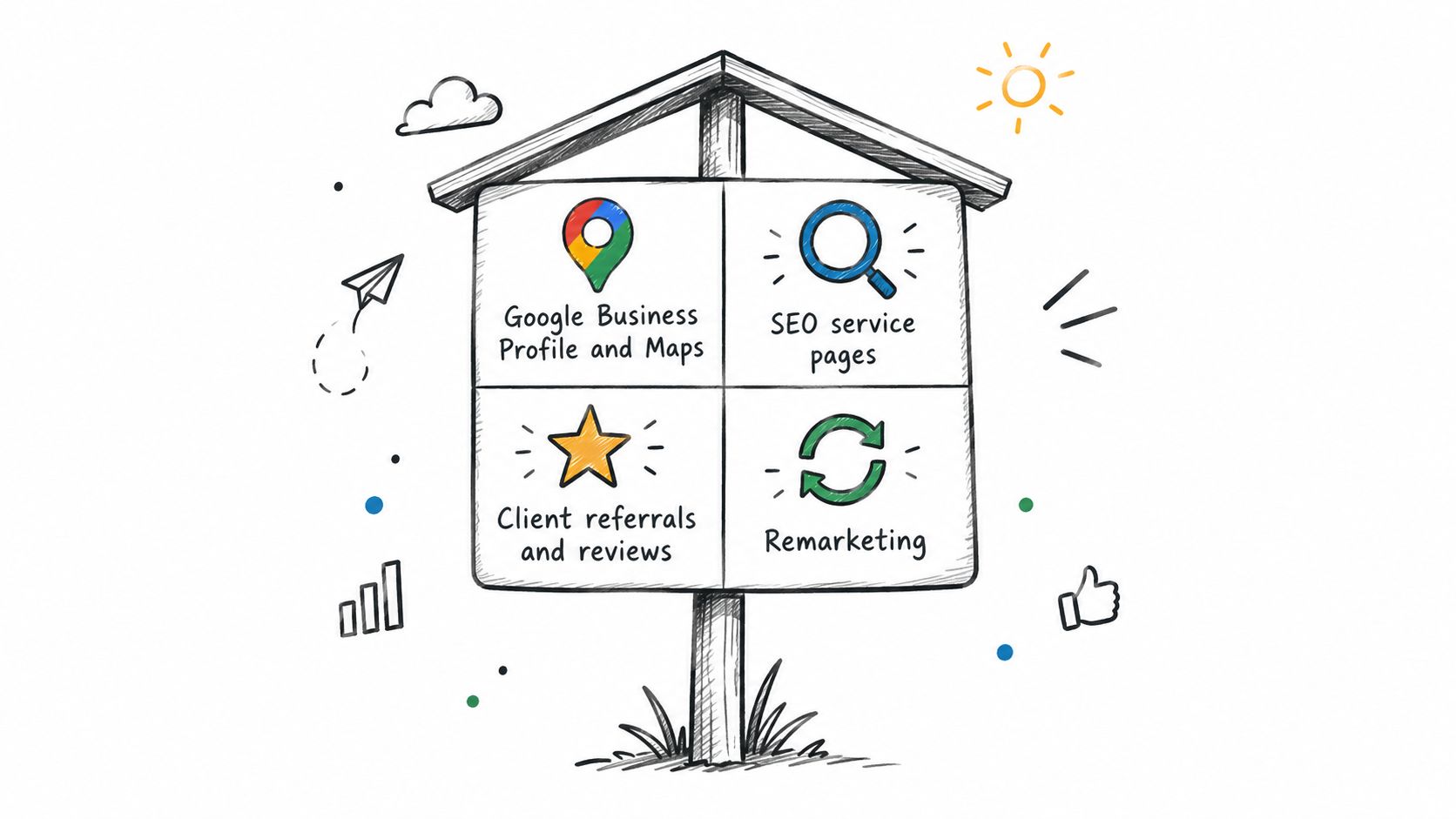
Reviews sit in the middle of the order for a reason. A 2025 Trans-Tasman consumer report found 81% of New Zealand consumers check reviews before buying from a small business, made up of 32% who always do so and 49% who sometimes do, according to the IAB New Zealand summary of the 2025 Pureprofile commerce report. A profile of old five-star ratings does less work than recent reviews naming the actual job, like a leak repair or a re-roof finished on time.
- Ask while the crew’s still there: request the review before you leave site and send a direct link by text.
- Reply to every review: answer the poor ones too, within a few days, calmly and specifically.
- Check the phone number: the number on your profile must be one that gets answered during work hours.
Add channels in this order. Get the profile and search right first, then referrals and remarketing, then social and storm response once crew capacity allows. Storm work deserves a warning, since demand spikes hard and can flood a team with urgent jobs that don’t match your normal margins.
One related habit carries across every channel. The Privacy Commissioner treats opt-in as better practice for marketing and expects businesses to explain what personal information they collect and what they’ll do with it, as outlined in the Privacy Commissioner knowledge base guidance on marketing consent. Keep that explanation visible wherever you ask for details.
Track Leads Across Calls, Reviews and Job Records
Website sessions mislead roofers. Local industry reporting says 69% of searches ended without a click in 2025, up from 56% in 2024, according to the Marketing Association article on GEO and AEO growth in New Zealand. A homeowner can read an AI summary, check your map listing, and call you without your website recording a thing.
The funnel below shows the pipeline worth measuring instead, from first visibility through to signed work.
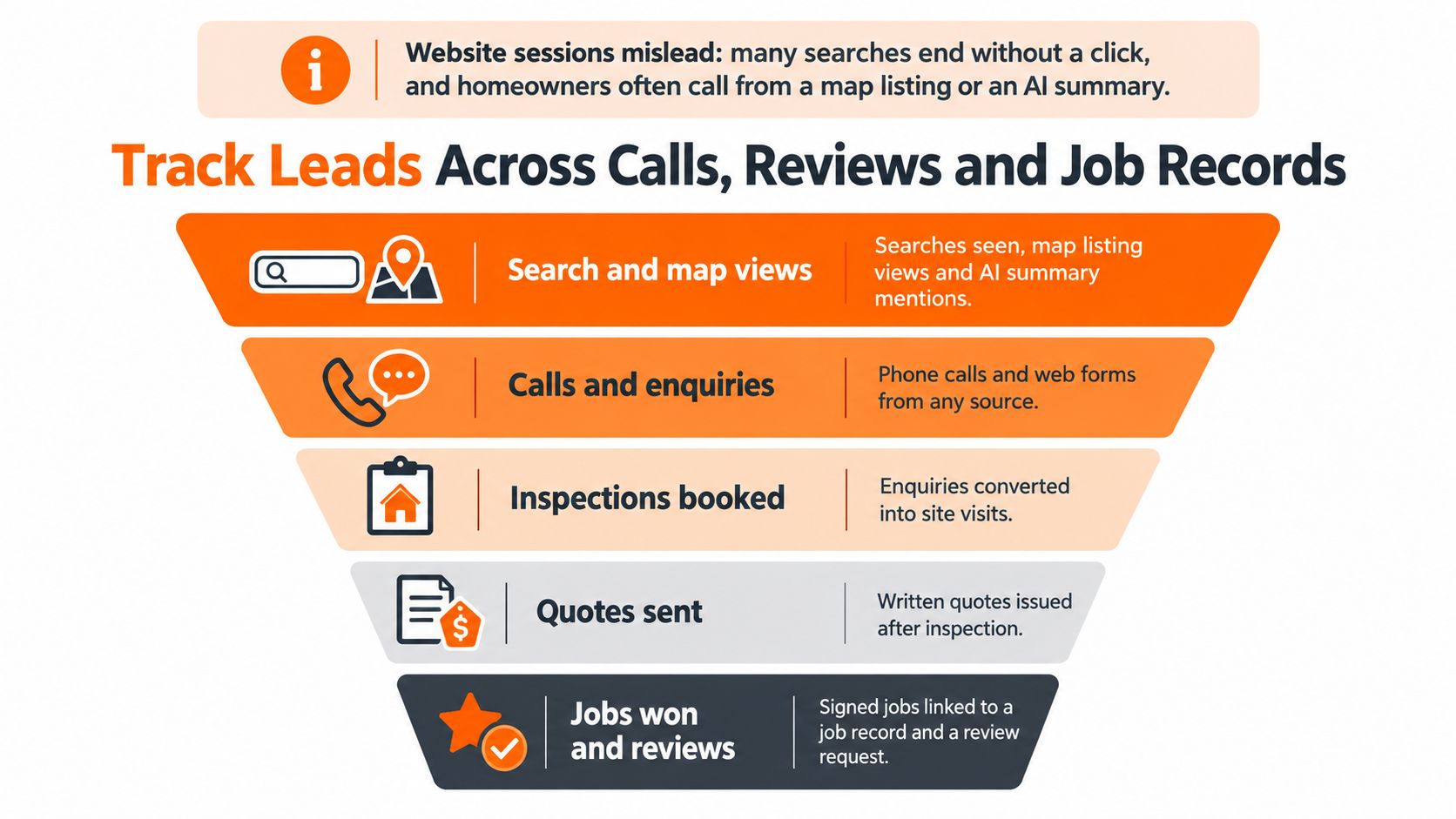
Build the view in five layers. Count impressions from Google Ads and your Google Business Profile, then calls from call tracking, then quote requests from forms, then booked inspections from the diary, and finally closed jobs from invoices. Purpose-built call tracking software for attributing phone enquiries to campaigns makes the call layer far easier to reconcile.
The short video below walks through how that tracking fits together in practice.
Four steps tie the layers together. Assign a tracked number to each campaign and listing, ask every caller where they heard of you and log the answer, match each booked inspection to a source in your CRM or a shared spreadsheet, and pull invoices monthly to tie each job back to its source.
Report the same fields every month. We provide monthly reporting showing what was spent, how many leads came in, what each lead cost, and what was changed, and your own report should carry those same fields so each month explains the last. Remember that fewer sessions with more booked jobs is a good result, not a decline. Finish with a lost-lead check by counting enquiries left unanswered for more than an hour, because those are leads you already paid for and then wasted.
Decide When to Scale Your Roofing Spend
The decision rule is simple. Scale when cost per job won holds steady and your crew can book the extra inspections. Everything else supports that call.

- Set a baseline in month one. Record cost per job won, cost per inspection, and your lead-to-inspection rate before you touch the budget.
- Compare monthly against that baseline. Note what changed in campaigns, landing pages, and call handling, so you know what moved the numbers.
- Raise spend in steps of 10 to 20 per cent. Do it only when cost per job has held steady for two monthly reviews and the team can handle more inspections.
- Cut what doesn’t pay. Pause any campaign whose cost per job sits above what you can afford, and move that budget to the service line winning work most cheaply.
- Stop when the crew’s full. Build a waitlist or review pricing before adding spend you can’t service.
Here’s the worked example. A roofer with a baseline cost per job won of NZ$600 on NZ$3,000 monthly spend, holding steady for two reviews with capacity to spare, can step up 10 per cent to NZ$3,300 as a safe first move. If cost per job climbs to NZ$750 after the increase, hold at NZ$3,000 and check call handling before adding another dollar.
More budget never fixes a broken follow-up process. It just buys you more unanswered enquiries, faster.
Before you scale, sanity-check your numbers against outside material. We offer an ROI calculator, sample leads, a roofing ads report, case studies, client reviews, and website transformations as resources for exactly that comparison. Your one action this month is building the baseline now, then making the scaling call at the next review.
If you’d rather have this system built around booked inspections and won jobs than clicks, that’s the work we do every day. Bluelight builds and manages Google Ads, landing pages, and call tracking exclusively for roofing companies, with monthly reporting tied to real enquiries and costs. Visit Bluelight to see sample leads, run the numbers on your market, and book a free intro call.
Related service Google Ads for Roofers