Search Engine Marketing for Roofers: A Practical Guide
For roofers, Google Search and Performance Max are the strongest paid-search ROI priorities, with remarketing reserved for a second pass at visitors who didn’t enquire. NZ trades clicks commonly cost NZ$5–NZ$15, so at a 10% conversion rate, you’re looking at roughly NZ$50–NZ$150 per tracked conversion before management fees.
You’ve got work on the calendar, quotes waiting for approval, and no clear answer about what comes after those jobs finish. That’s the problem search engine marketing should solve: not more website activity, but a measurable way to bring suitable roofing work into the business.
Table of Contents
- The Lead Gap Every Roofing Owner Feels
- What Search Engine Marketing Actually Means
- The Three SEM Campaigns Roofers Actually Run
- What Roofers Actually Pay Per Click and Per Lead
- Setting a Roofing SEM Budget That Actually Fits
- Where SEM Fits in a Roofing Marketing Mix
- Common SEM Mistakes That Drain Roofing Budgets
- Your First 30 Days With Roofing SEM
The Lead Gap Every Roofing Owner Feels
You start the week checking whether a replacement quote has been accepted. A referral needs an inspection, a website enquiry hasn’t answered your callback, and a marketplace prospect wants your cheapest price before discussing the roof.
None of those enquiries is necessarily worthless. The problem is that you can’t confidently plan crew availability around them.
Referrals deserve attention, but you can’t turn them up when the schedule opens. Shared enquiries also put you into a comparison process you don’t control. Your pipeline needs a channel you can manage against available capacity, not just whatever arrives.
Replace uncertainty with a buying signal
Consider the difference between promoting your business broadly and appearing when someone searches for a roof leak investigation in your service area. The latter gives you a specific problem, a location, and an opportunity to offer the next step.
Google is a sensible starting point in New Zealand. In an IAB New Zealand survey of 250 upper North Island adults, 96.8% named Google their primary search engine, while 82.4% used search engines several times daily. That’s a regional survey, not a census of every Kiwi, but it supports prioritising Google rather than spreading a small budget across platforms.
Practical rule: Buy enquiries your estimator and crews can actually service, not leads that merely make the report look busy.
Before buying traffic, define what belongs in the pipeline:
- Suitable work: Specify the roofing services you want to sell.
- Viable locations: Include travel time, not just a map radius.
- Commercial outcomes: Record whether an enquiry became an inspection, quote, or booked job.
For broader acquisition planning, BatchData’s guide to building a predictable pipeline is a useful companion resource. Paid search should support that pipeline, not become a disconnected advertising expense.
What Search Engine Marketing Actually Means
Search engine marketing, as used here, means paid advertising that helps homeowners discover and contact your roofing business. SEO is different: you improve your website and content to earn unpaid visibility rather than buying an advertising placement.
Paid visibility can begin once campaigns are approved and eligible to run. Organic visibility takes ongoing work, and neither approach guarantees enquiries. Don’t confuse being visible with being commercially effective.
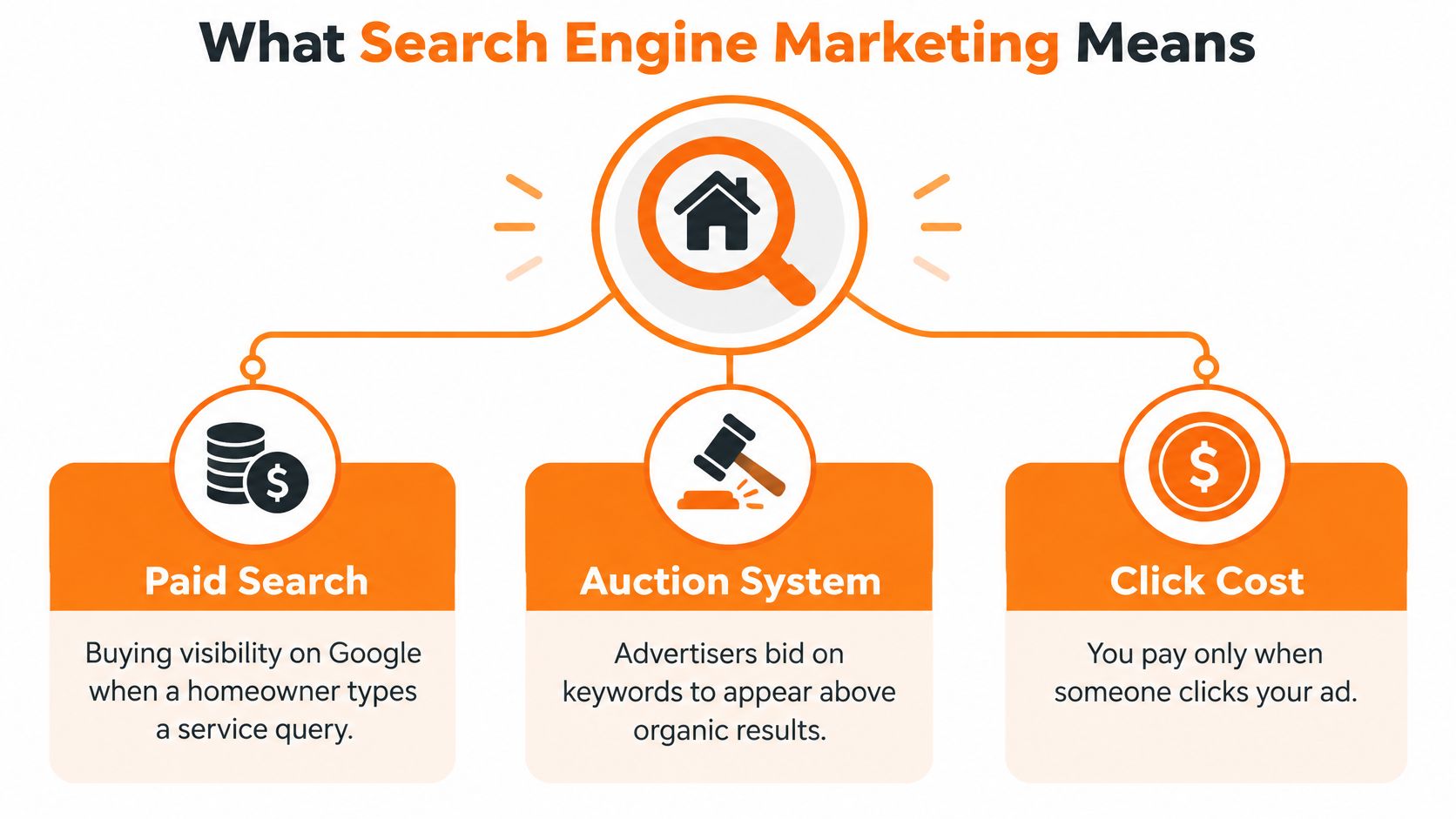
The basic mechanics are straightforward.
What you’re buying
With Search Ads, you choose relevant keywords, write advertisements, and compete for eligible placements through an auction. You set budgets and bidding instructions, but you don’t purchase a guaranteed stream of profitable jobs.
In a pay-per-click campaign, the click is the chargeable interaction. The enquiry still depends on whether the person sees a convincing offer, understands your service area, and can contact you easily.
Keep these distinctions clear:
- Google Ads: The platform used to manage campaigns, spending, advertisements, and conversion reporting.
- Search Ads: Advertisements associated with relevant search queries.
- Performance Max: A goal-based campaign that can use placements beyond conventional search results.
- Remarketing: Advertising aimed at eligible people who have previously interacted with your business.
Maps and YouTube are placements, not interchangeable campaign strategies. Shopping-style product advertising also shouldn’t be confused with selling a roof inspection or replacement service.
Why owners should care about the distinction
Ask your provider exactly where your budget goes. “Google marketing” isn’t an adequate answer if you can’t distinguish search enquiries from broader advertising interactions.
Search represented NZ$1.44 billion, approximately 49% of New Zealand’s digital advertising market in 2025, according to IAB New Zealand’s annual digital advertising report. That establishes the channel’s scale, not your likely return.
Your decision should depend on suitable enquiries and profitable work, not on how much other advertisers spend.
The Three SEM Campaigns Roofers Actually Run
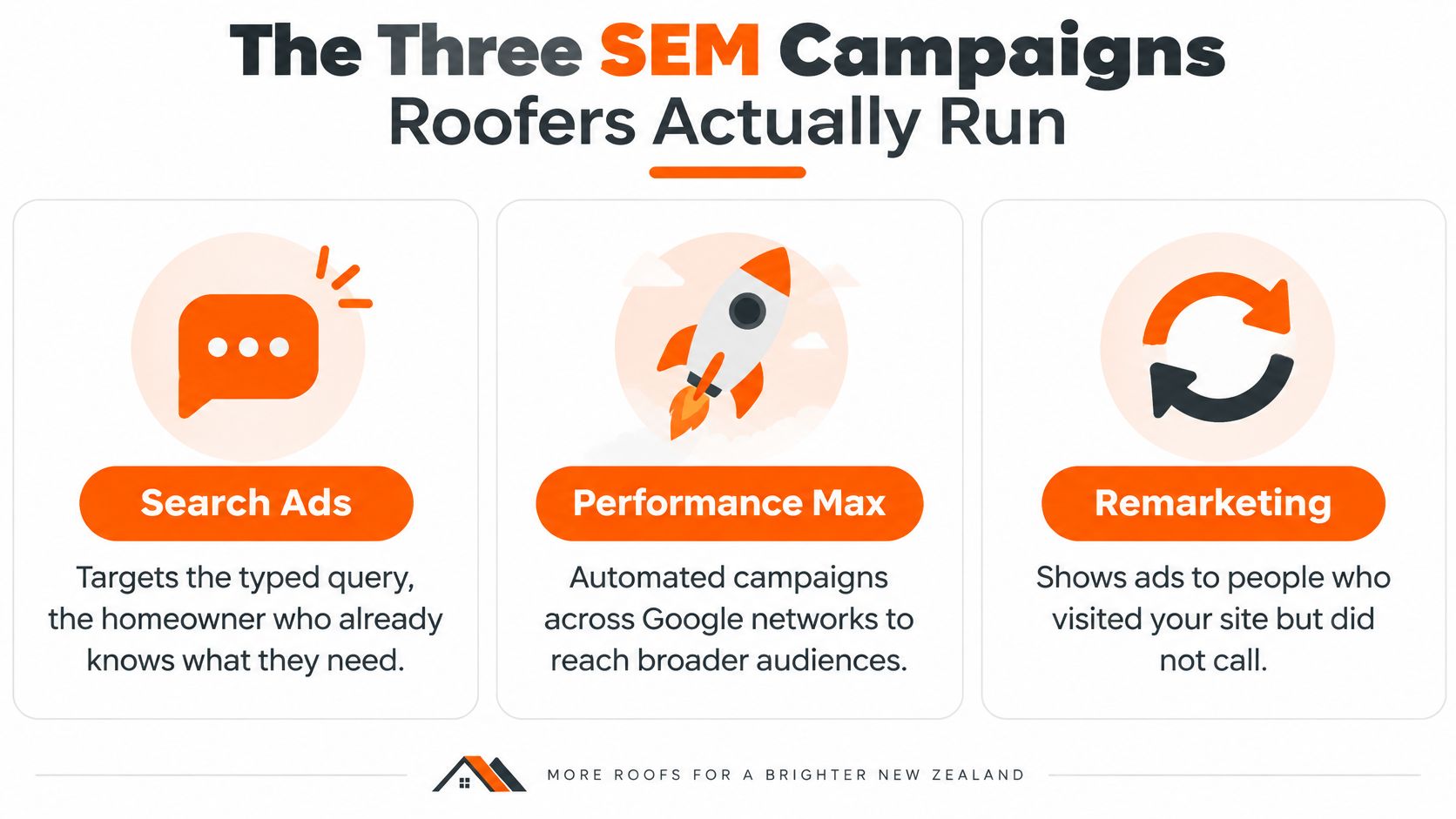
Give each campaign a job: Search captures expressed demand, Performance Max expands distribution, and remarketing supports follow-up. Treating them as equal budget buckets ignores how differently homeowners encounter them.
This is the campaign structure to keep in mind.
Search first, expansion second
Build Search around distinct buying needs. Emergency repairs, planned re-roofing, gutters, and commercial roofing shouldn’t all share the same message or landing page.
Map each search theme to the appropriate service page before launch. MD TECH TEAM’s 2026 small business keyword mapping provides a companion resource for organising that work.
Performance Max can distribute advertising across Search, Display, YouTube, Discover, Gmail, and Maps, as described in this NZ-focused Performance Max analysis. Supply genuine project photographs, service-specific copy, accurate locations, and conversion signals that distinguish useful enquiries from noise.
The important recent improvement is visibility into performance. Google’s Performance Max product update introduced clearer search-term insights and more granular asset-group reporting, including device and time breakdowns. That makes it more practical to investigate where roofing enquiries originate rather than accepting a single blended conversion total.
Remarketing needs a reason to return
Someone comparing replacement quotes may leave your website before contacting anyone. Remarketing gives you another opportunity to explain your inspection process, show relevant completed work, or answer a concern about disruption.
Use eligible audiences and appropriate consent. A partial form submission or abandoned call doesn’t automatically make someone identifiable or available for remarketing.
- Use proof: Show roofing work relevant to the service they considered.
- Offer a next step: Invite an inspection or a discussion about scope.
- Exclude unsuitable audiences: Don’t keep pursuing people who aren’t viable prospects.
Don’t call cold-audience advertising remarketing. And don’t expect repeated exposure to fix an unclear offer.
For a complementary walkthrough, use the video below.
What Roofers Actually Pay Per Click and Per Lead
Cheap clicks aren’t the target. Affordable, qualified roofing opportunities are. A low-cost visitor looking for roofing materials can be worth less than a more expensive homeowner requesting a replacement quote.
NZ Google Ads cost guidance covering roofing and related trades places clicks commonly around NZ$5–NZ$15, with Auckland and Wellington towards the higher end. At a 10% conversion rate, that implies approximately NZ$50–NZ$150 per tracked conversion, excluding management and other costs.
The roofing advertising report provides the roofing-specific conversion benchmark of around 10%. Treat that as a planning reference, not a promise that an untested website will perform at that level.
Roofing SEM cost ranges by market
| Metric | NZ range | US/AU range | What it means |
|---|---|---|---|
| Trades CPC | Benchmark above | No verified comparable range provided | Obtain local auction estimates |
| Tracked conversion rate | Roofing benchmark above | Validate in each account | Don’t transfer results automatically |
| Paid-media cost per conversion | Indicative calculation above | Requires local CPC and conversion data | Excludes management and sales costs |
| Cost per booked job | Account-specific | Account-specific | Connect advertising to accepted work |
Canada needs the same local treatment. Currency conversion alone won’t account for different searches, service terminology, geography, or competition.
Calculate backwards from the booking
Use these relationships when reviewing performance:
- Tracked enquiry cost: Advertising spend divided by recorded enquiries.
- Qualified opportunity cost: Spend divided by enquiries you can service.
- Booked-job cost: Spend divided by accepted jobs attributed to the campaign.
Improving the page’s conversion rate can reduce enquiry cost without requiring cheaper clicks. But a conversion lift means little if the extra enquiries don’t qualify.
Use call tracking software alongside form tracking so telephone enquiries enter the same assessment. Deduplicate repeat contacts before reporting lead volume.
If you’re comparing providers, Wistec’s affordable Google ad specialist offering is another service option to evaluate. Compare tracking, landing-page responsibilities, account ownership, and management scope, not the fee alone.
Setting a Roofing SEM Budget That Actually Fits
Your advertising budget should reflect the work you can quote, win, and complete. Don’t fund an aggressive enquiry target while your estimator is already struggling to return calls.
Start with available capacity, then work backwards through your own quote and booking records. If you don’t know your close rate, keep the initial campaign narrow while you establish it.
Starting allocations, not industry averages
The following are proposed planning tiers, not reported market benchmarks or promises of lead volume:
| Operating position | Suggested monthly NZ media allocation | Initial focus |
|---|---|---|
| Small operator with limited quoting capacity | NZ$1,500–NZ$3,000 | Concentrated Search coverage |
| Growing operator with several crews | NZ$3,000–NZ$7,500 | Search plus controlled Performance Max testing |
| Regional operator with established sales capacity | NZ$10,000-plus | Separate service and location priorities |
These amounts are starting recommendations. Replace them with a forecast based on local click estimates, the conversion benchmark discussed earlier, and your observed qualification and booking rates.
Don’t convert these NZ allocations directly into Australian, Canadian, or US budgets. Build the forecast in the account’s billing currency using local demand and actual service economics.
Set a spending ceiling before scaling
Calculate the gross profit available from a typical job after direct materials, labour, and travel. Then decide how much of that contribution you’re prepared to spend acquiring the work while still covering overhead and profit.
My conservative screening rule is to keep acquisition cost below half the expected job gross profit. That’s an editorial guardrail, not a universal profitability threshold. A business with heavy overhead may need a substantially lower ceiling.
- Scale selectively: Increase spending where booked-job economics and crew availability support it.
- Investigate before cutting: Check sales follow-up and attribution before blaming campaign targeting.
- Protect cash flow: Separate advertising spend from management, landing-page, and tracking costs.
A campaign that produces suitable enquiries can still be unaffordable if the business quotes poorly or takes too long to follow up.
Where SEM Fits in a Roofing Marketing Mix
A regional roofing business shouldn’t depend entirely on paid traffic. Use search engine marketing for current demand while maintaining the assets homeowners inspect before choosing a contractor: service pages, project evidence, reviews, and an accurate Google Business Profile.
Consider an illustrative NZ$8,000 monthly marketing allocation, not a client case study. The owner chooses to put roughly 50%–70% into paid search during a growth phase, with the remainder supporting organic content, profile maintenance, reviews, and selective offline activity.
That split is a proposed management choice, not an industry average. It only makes sense if the paid campaigns meet the business’s acquisition-cost ceiling.
The channels should support the same buying journey.
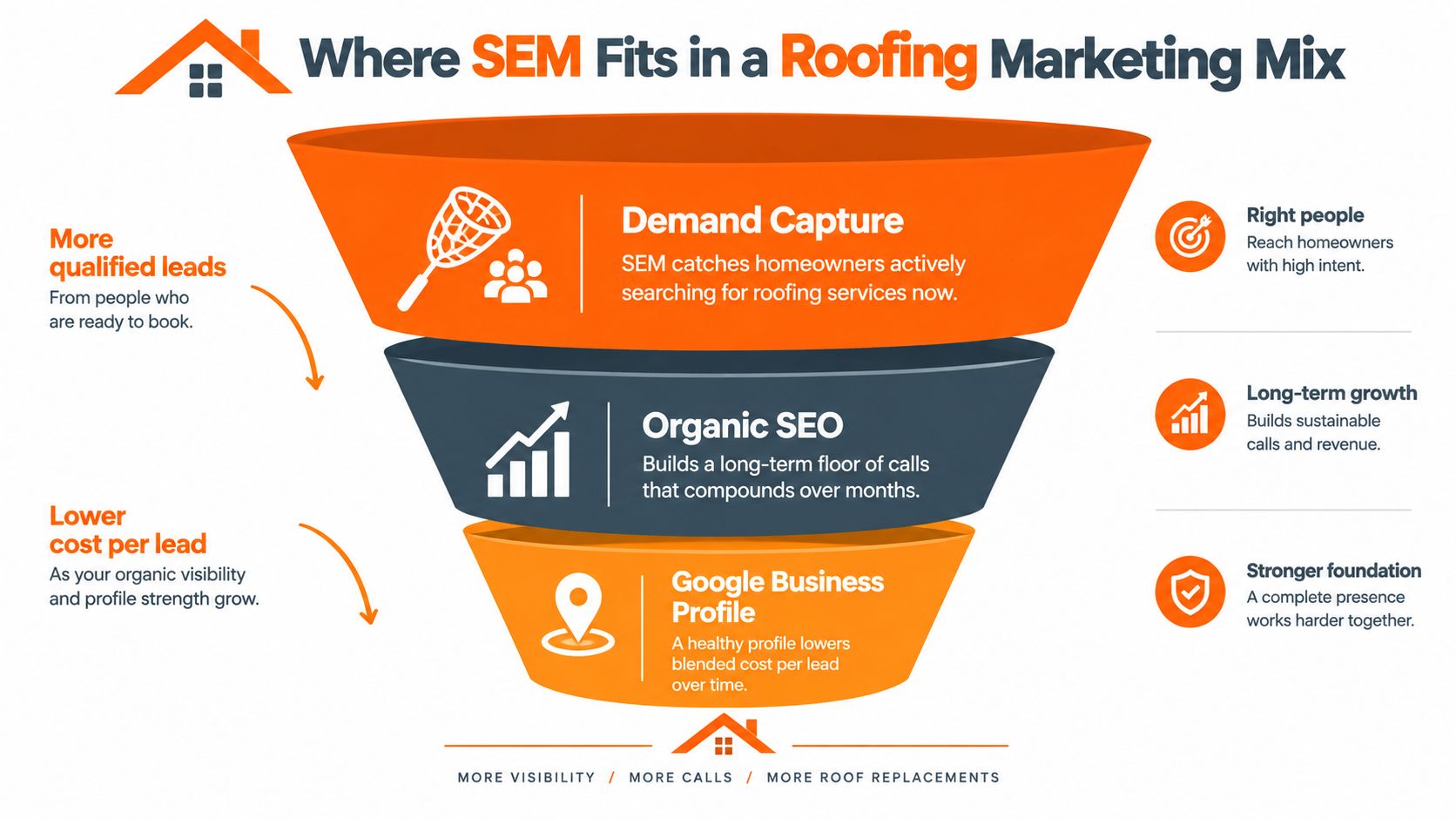
Judge the mix through a shared booking record
The owner shouldn’t receive unrelated reports claiming credit for the same customer. Record the first known source, subsequent interactions, and final booking without adding assisted contacts together as separate jobs.
- Paid search: Assess qualified opportunities and accepted quotes.
- SEO and profile activity: Track attributable calls and forms while recognising that some journeys remain ambiguous.
- Referrals and direct mail: Record the referring person or campaign when the customer supplies that information.
- Additional platforms: Test Bing Ads or US Local Services Ads only where available and commercially appropriate.
The decision between Google Ads, SEO, or both should follow your immediate capacity needs and existing visibility, rather than a blanket preference for paid or organic.
Don’t equate fewer sessions with fewer prospects
NZ industry reporting on AI-mediated and zero-click discovery describes searches that end without an external website visit. That makes website traffic alone an incomplete business measure.
A homeowner may consult several results and then call directly. Record what you can verify, acknowledge attribution gaps, and don’t claim every branded interaction represents demand your advertising created.
Common SEM Mistakes That Drain Roofing Budgets
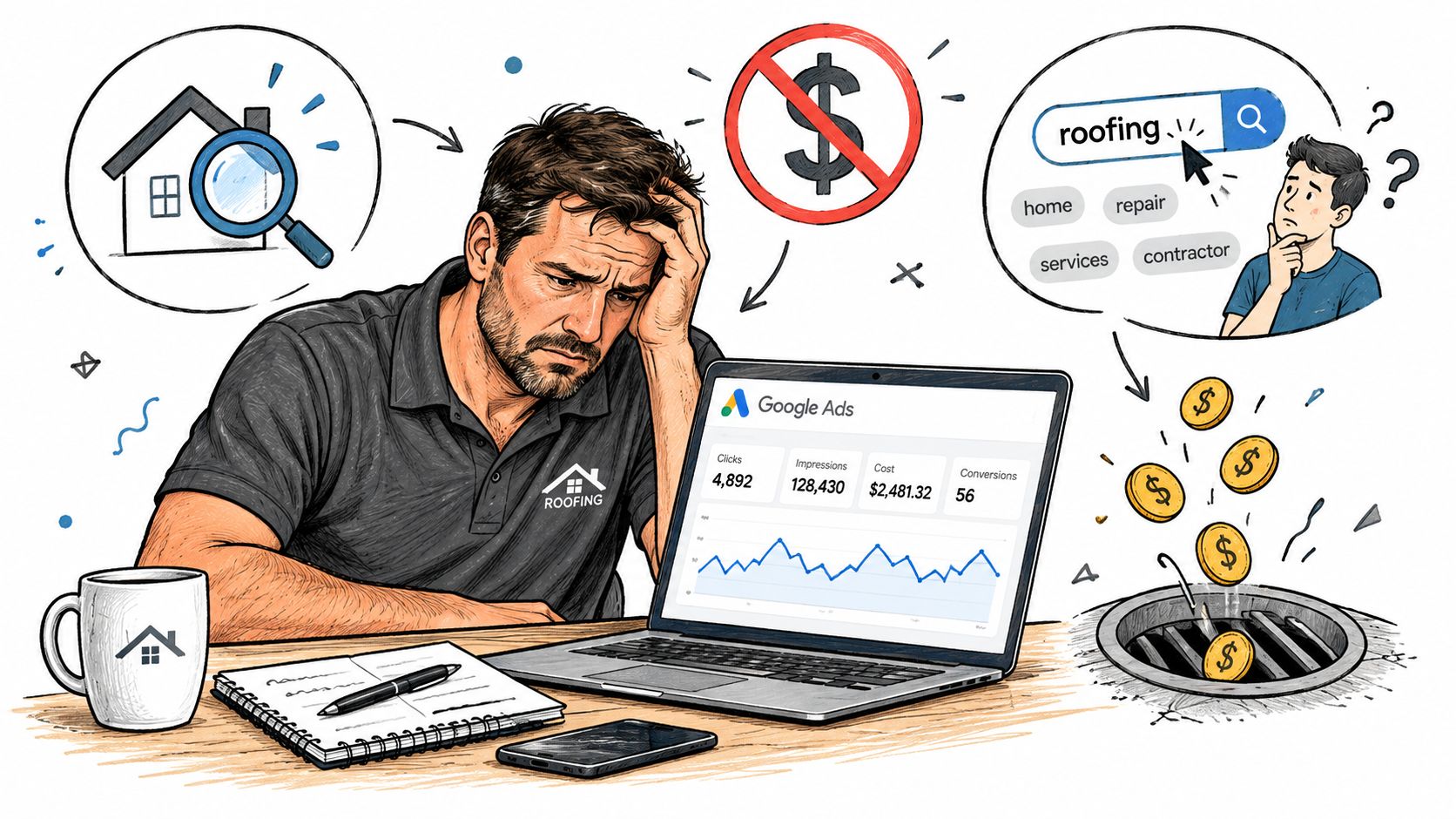
Before increasing spending, ask your manager to show you what the current budget bought. A polished dashboard isn’t evidence that the underlying enquiries were useful.
The warning signs are usually visible in search queries, landing-page paths, conversion settings, and call outcomes.
Inspect the search, not just the keyword
A keyword describes your targeting instruction. The search-term report shows the queries that triggered advertising.
Broad terms aren’t automatically wrong, but they need evidence and control. Don’t pay indefinitely for jobs, apprenticeships, training, materials, or DIY searches when you sell installed roofing services.
- Check exclusions: Maintain negative keywords, but avoid blanket exclusions that block relevant buying queries.
- Check geography: Review where enquiries originate and whether the crew can profitably service them.
- Check service separation: Repairs and commercial replacements need different qualification questions and sales expectations.
Test the customer path yourself
Open the advertisement on a phone and follow it through to contact. Can a homeowner immediately confirm the service, location, and next step?
A generic homepage can force the visitor to search again inside your website. Use a relevant service-and-area page with genuine project evidence, clear contact options, and an explanation of what happens after enquiry.
Owner’s check: Ask to see an actual qualified enquiry traced from campaign to contact to quote status. Don’t accept a conversion total as a substitute.
Check conversion settings just as carefully. A thank-you page visit can be legitimate tracking, but it must correspond to a successful submission rather than a reload or unrelated visit.
- Test forms: Confirm submissions arrive and aren’t counted repeatedly.
- Test telephone attribution: Verify that eligible calls reach the business and enter reporting.
- Review call quality: Where recordings are used, apply appropriate notices, consent, and privacy safeguards.
- Remove false success signals: Keep low-value interactions separate from primary lead goals.
Don’t promise emergency availability unless someone can answer and organise the response. Advertising an unavailable service wastes both the customer’s time and your budget.
Your First 30 Days With Roofing SEM
Treat the opening month as a controlled build and validation period. Your objective is to establish reliable measurement, launch a focused acquisition system, and learn which enquiries deserve further investment.
Don’t launch every campaign type because the platform makes it easy. Expansion should depend on trustworthy outcomes.
A practical launch checklist
- Establish tracking. Test calls and forms, record current enquiry sources, and agree on the definitions of qualified opportunity and booked work.
- Launch focused Search. Choose your priority services and viable suburbs, then apply the query controls discussed earlier.
- Add Performance Max when signals are useful. Supply service-specific assets and judge expansion against lead quality, not inexpensive traffic.
- Introduce remarketing deliberately. Use eligible previous visitors and appropriately consented audiences, with relevant proof or a clear next action.
- Review booked-job economics weekly. Investigate missed calls, unsuitable locations, duplicate enquiries, and unclosed quotes before reallocating spend.
Questions to resolve before signing
Do roofers need an agency?
Not necessarily. You need someone accountable for targeting, tracking, landing-page performance, and commercial reporting, whether that’s an employee, specialist, or agency.
How quickly can leads arrive?
Eligible advertisements can generate enquiries after launch, but timing depends on demand, approvals, targeting, and budget. Don’t confuse an early enquiry with proven profitability.
What minimum budget is realistic?
Use the planning tiers above as a starting discussion, then narrow the geography and service offering to fit your resources. A concentrated campaign is preferable to spreading insufficient spend across everything you offer.
How do you know it’s working?
You can trace suitable enquiries into quotes and accepted work at an acquisition cost the business can sustain. You should also know who owns the account, who receives the data, and what happens if you change providers.
Bluelight offers roofing-only Google Ads management, service-specific landing pages, and call and form attribution for companies in New Zealand, Australia, Canada, and the United States. Visit Bluelight to discuss your service areas, available crew capacity, and a campaign plan measured against qualified enquiries and booked roofing work.
Related service Google Ads for Roofers