Running a Roofing Business That Actually Grows
You’ve got a crew ready to work, but next week’s diary is nearly empty. Or the phone won’t stop ringing, yet most callers want the cheapest price, live outside your service area, or aren’t ready to book. Both problems are familiar to roofing business owners, and neither is solved by merely “doing more marketing.”
A healthy pipeline depends on what happens from the first search to the finished job. You need a reliable way to bring in enquiries, a disciplined process for identifying the right ones, and enough operational capacity to quote and deliver the work well. If one part is weak, the rest can’t carry the business for long.
Table of Contents
- Where Most Roofing Businesses Get Stuck
- The Three Engines Behind a Roofing Pipeline
- Why Google Ads Is the Core of Roofing Lead Flow
- Qualifying and Converting the Leads That Arrive
- Why More Leads Will Not Always Fix a Roofing Business
- How Roofing-Specialist Marketing Partners Compare to Generalist Agencies
- A 90-Day Plan for Building a Predictable Lead Pipeline
Where Most Roofing Businesses Get Stuck
The feast-or-famine pattern often starts with good work. A referral comes in, a neighbour sees a roof being replaced, or a property manager gets in touch. The crew is busy, the jobs get done, and marketing slips down the list. Then the current work wraps up, referrals slow, and the owner is back to chasing the next job.
The opposite problem looks healthier from the outside. Enquiries arrive every day, but the owner spends hours quoting work that never had a real chance of going ahead. Some callers are outside the service area. Others want a price without an inspection, or have contacted several roofers and are choosing on cost alone. A busy phone doesn’t necessarily mean a profitable pipeline.
These situations have different symptoms, but they share a cause: the business hasn’t built a dependable path from demand to completed work. Turning on ads won’t fix slow callbacks, and more referrals won’t help if the business can’t tell a serious replacement enquiry from a casual price check.
New Zealand’s roofing market has become more crowded. Stats NZ business-demography data reproduced by Figure.NZ counted 888 roofing-services enterprises in February 2000 and 1,662 in February 2024, an increase of approximately 87.2% over that period (Figure.NZ’s roofing-services enterprise data). That doesn’t mean every roofer faces the same competition, but it does make clear why relying on a handful of informal sources can leave a business exposed.
The aim isn’t to chase every enquiry. It’s to build a system that brings in relevant work, helps your team act on it, and gives your crews a realistic path to deliver it. That means looking beyond marketing tactics and examining how the whole pipeline works.
The Three Engines Behind a Roofing Pipeline
Think of your roofing pipeline as a three-part system. Each part has a different job, and a weakness in any one of them limits the whole business.
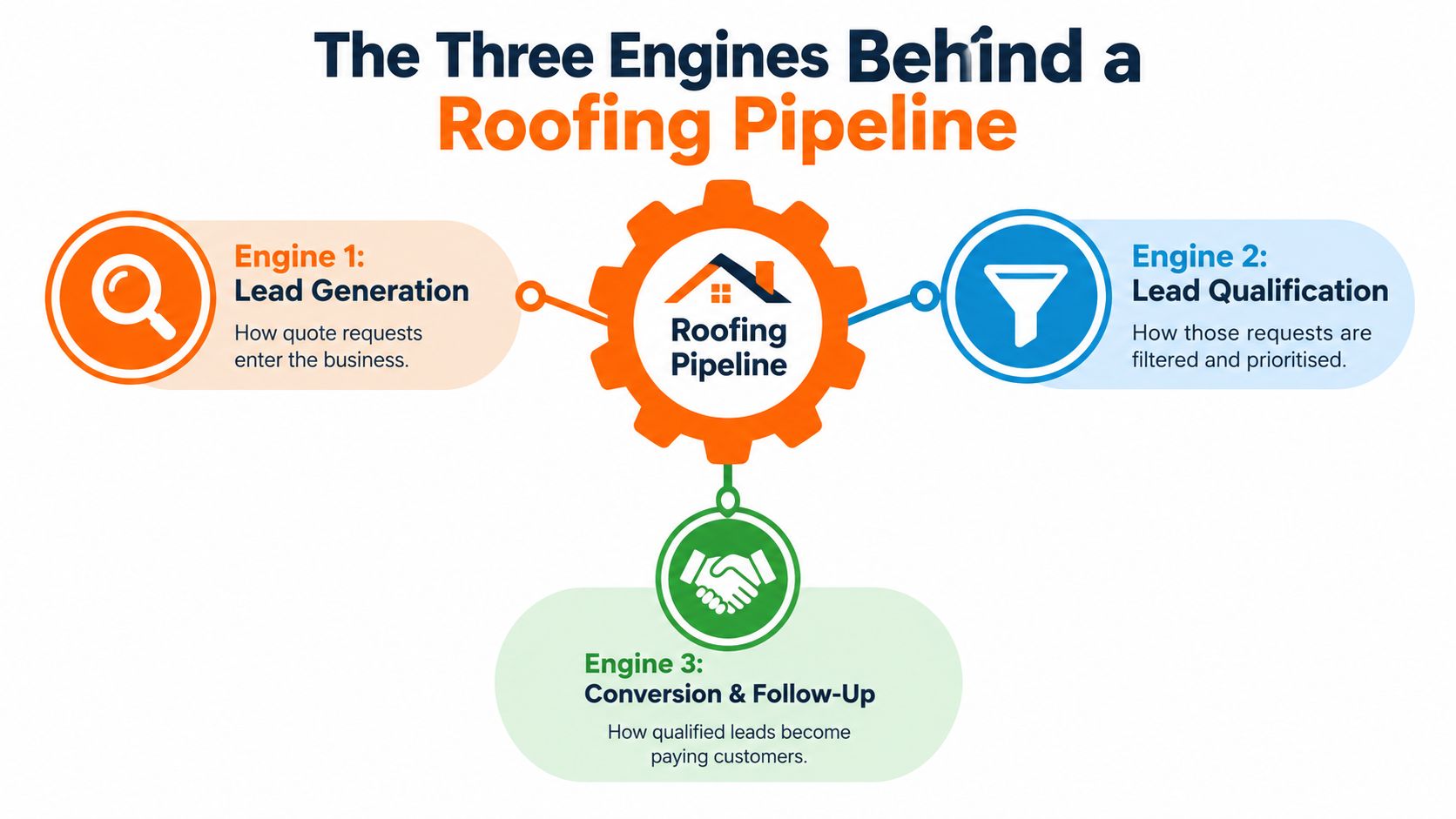
Lead generation brings enquiries in
The first engine is lead generation: how potential customers find you and ask for a quote. Referrals, your Google Business Profile, organic search, and paid search can all contribute. They don’t produce identical enquiries, though. A homeowner searching for a roof repair is showing a different need from someone who sees a social post and saves it for later.
Your job is to choose channels that can reliably reach the customers you want, in the areas you serve, for the services you offer. If you’re weighing paid search against organic visibility, this guide to when to use Google Ads, SEO, or both can help you think through how they fit together.
Lead qualification turns enquiries into opportunities
The second engine is lead qualification. It’s the process of responding, finding out what the customer needs, checking the location and project fit, and agreeing on a useful next step. A form submission isn’t a booked site visit. A missed call isn’t a lead your team can confidently price.
Operational delivery turns booked work into a completed job
The third engine is operational delivery. Your quoting process, crew availability, scheduling, materials, site communication, and invoicing all affect whether you can take on new work and complete it profitably. If jobs stall after booking, pushing more enquiries into the same process won’t solve the underlying problem.
Practical rule: Diagnose the narrowest part of the pipeline before investing in the next tactic.
This model also helps you judge whether a proposed fix addresses a real constraint. A better profile can improve how customers find and assess you. For practical advice on presenting a contractor business, see RecensioAI’s contractor profile guide, published by RecensioAI B.V. But a profile won’t make your team call people back faster or create space in an overloaded schedule.
Why Google Ads Is the Core of Roofing Lead Flow
Google Ads can put your roofing business in front of people actively searching for a roofer. That’s its main advantage. Someone searching for roof repairs or a roof replacement is already describing a problem and looking for a solution. A broad social campaign may reach people who could need roofing work one day, but search advertising responds to demand that’s already visible.
The commercial case needs to be grounded in qualified enquiries, not click volume. Roofing clients running properly built Google Search Ads typically land between $20 and $80 per qualified lead. One documented roofing company averaged $32 per lead, reached $5.6M in revenue, and recorded a 114x return on ad spend. Those are specific results, not a promise that every roofer will get the same outcome. Your service area, job mix, follow-up, conversion rate, and ability to take on work all affect what a campaign can deliver.
The video below gives another view of how roofing businesses can approach paid search:
The campaign build decides what you pay for
A sloppy account can spend money on searches that don’t match your services, attract people outside your area, or send every visitor to a homepage that doesn’t answer their question. A homeowner looking for a leak repair shouldn’t have to hunt through a generic site to find out whether you handle repairs. Neither should someone comparing a full reroof.
A well-built campaign separates services and locations, uses negative keywords to block irrelevant searches, and sends each visitor to a relevant landing page. That gives prospects a clearer next step and gives you a better chance of seeing which searches produce useful enquiries.
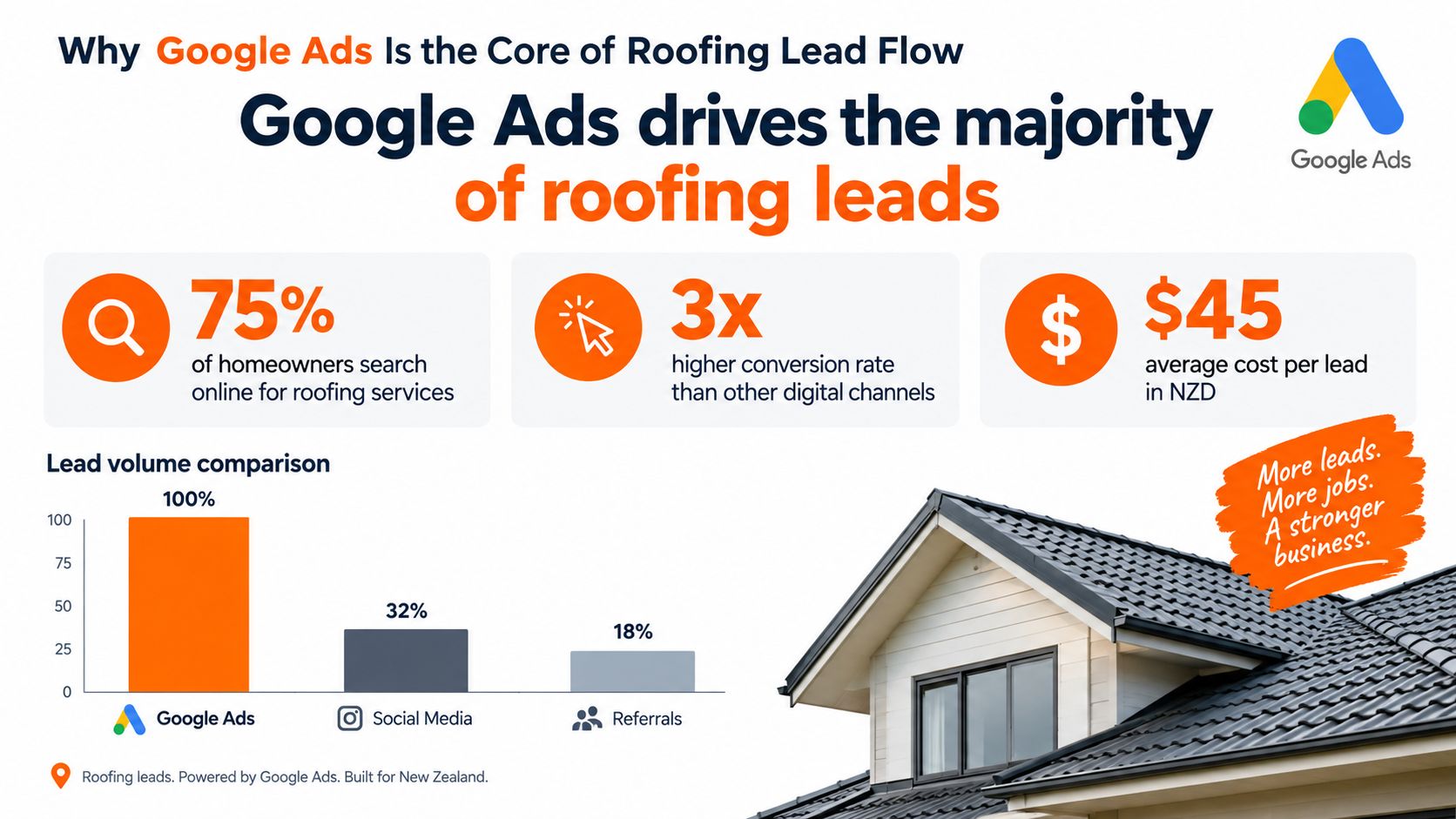
The infographic’s figures about homeowner behaviour, conversion rates, and average lead cost aren’t supported by the verified data available here, so they shouldn’t be treated as evidence. Use the documented $20–$80 per qualified lead range as a reference point, then judge your own campaign by qualified enquiries and completed work. A low cost per lead is not a win if those leads can’t be reached, quoted, or served.
Qualifying and Converting the Leads That Arrive
When the phone rings, the marketing job isn’t finished. Your response determines whether a promising enquiry becomes a site visit or disappears into a competitor’s inbox.
Start with a clear intake process. Record where the enquiry came from, what service the customer needs, where the property is, and how urgent the issue is. Ask whether they’re looking for a repair, reroof, replacement, gutters, or another service. These aren’t complicated questions, but they stop your team from treating every call as the same kind of job.
Route the enquiry to the right next step
A leaking roof that needs prompt attention should not sit in the same queue as a planned replacement enquiry with a flexible schedule. Assign responsibility for each kind of enquiry, and decide what happens when the first call is missed. If a customer completes a form, set a response routine that makes it clear who follows up and when.
Don’t promise that a specific response window will double conversion unless you have reliable evidence for that claim. The practical point is simpler: people looking for a roofer want a clear response, and a delayed callback can give them time to contact someone else. Make it easy for your team to respond quickly and consistently.
Track phone calls and forms against their advertising source. Call tracking software can help connect phone enquiries to the campaigns that generated them, so you’re not relying on guesses about which marketing is paying off. Keep the useful details in a shared system, even if that starts with a well-maintained spreadsheet rather than a complex CRM.
Make the landing page match the job
Send repair searches to a repair page and replacement searches to a replacement page. Do the same for commercial roofing, metal or long-run roofing, tile, membrane, gutters, and restoration when those are services you provide. Each page should make your service area clear, explain what happens next, and give the customer a direct way to call or request an inspection.
The follow-up process matters just as much as the page. Record whether the prospect was contacted, whether the site visit was booked, and whether a quote went out. If you’re comparing tools for organising prospects and sales follow-up, see Otter A/B’s top picks. Choose something your team will use consistently. A neglected system doesn’t improve conversions; it just creates another place for details to go missing.
Why More Leads Will Not Always Fix a Roofing Business
More leads help only when the business can answer, quote, schedule, and deliver the work. Otherwise, increased demand adds pressure without improving the result.
Take a company that books 40% more leads but responds more slowly, sends quotes out in two weeks instead of two days, and has no crew availability for the next month. That example is a warning about the operating model, not a claim about typical results. If prospects move on before the quote arrives, or the business can’t give them a realistic start date, the extra enquiries don’t automatically become extra revenue.
Find the bottleneck before you increase spend
Check the path from first contact to completed job. Are calls being answered? Are site visits scheduled promptly? Do quotes go out while the customer is still engaged? Can the owner see which jobs are waiting on materials, crew time, or customer approval?
A simple weekly review can show where work is getting stuck. Compare enquiries received with the number of customers contacted, site visits completed, quotes sent, jobs booked, and work delivered. You don’t need a complex dashboard to spot a recurring delay. You do need consistent records and someone responsible for acting on them.
Subcontracting overflow work can keep jobs moving, but it has trade-offs. If you routinely depend on another company’s crews to honour work sold under your name, you may sacrifice margin and control over the customer experience. That might be a deliberate capacity decision, but it’s not a substitute for understanding what your own team can deliver.
More demand is useful only when your quoting and production capacity can absorb it.
Don’t increase your marketing budget to hide a slow quoting process or an overloaded schedule. Fix the constraint first, then decide whether more lead volume makes sense. If you want campaigns to be assessed against completed work rather than just enquiries, this guide to syncing offline conversions covers the idea of linking later sales outcomes back to paid advertising.
How Roofing-Specialist Marketing Partners Compare to Generalist Agencies
A generalist agency may know how to set up search campaigns. The question is whether it understands how roofing customers search, how roofing services differ, and what counts as a useful lead for your business.
A specialist should be able to discuss the difference between repair and replacement intent, how to separate service areas, and why a commercial roof enquiry shouldn’t be measured in the same way as a small residential repair. Ask for details about tracking, account ownership, pricing, and how leads are handled. Don’t settle for a report full of clicks if you can’t connect those clicks to real enquiries.
| Criterion | Generalist Agency | Roofing-Specialist Agency |
|---|---|---|
| Industry knowledge | May work across many trades and industries, with varying familiarity with roofing services. | Builds campaigns around roofing terms, service types, and buyer intent. |
| Account ownership | Confirm who owns the ad account, landing pages, and campaign data. | Should clearly state whether the account and data remain in your name. |
| Lead handling | May focus on form fills or calls without checking the fit of each enquiry. | Should define what a qualified roofing lead means for your service area and job mix. |
| Tracking | Ask whether calls and forms are attributed to their sources. | Expect call and form tracking to be part of measuring performance. |
| Pricing | Some providers charge a percentage of advertising spend. | Flat-fee management can make the fee easier to plan and separate from media spend. |
| Best fit | Can work for an owner who already has a clear brief and internal marketing oversight. | May suit a company that needs roofing-focused campaign management and landing-page support. |
Judge the partnership, not the sales pitch
Percentage-of-spend pricing isn’t automatically wrong, but it can make fees rise as your budget grows. Ask what the provider does for that fee and whether the account stays yours if you leave. Shared leads are another concern: if the same enquiry goes to multiple roofers, you’re paying to compete for a prospect rather than building a direct relationship with them.
A specialist isn’t the right choice for every operator. A one-truck business with limited advertising budget may be better off managing a simple presence in-house while it builds its capacity. A larger company with multiple services, crews, or service areas may need more structured campaign management.
Bluelight is one option for roofers that need roofing-focused Google Ads, landing pages, call and form tracking, and flat-fee management. Evaluate any provider against the same questions: who owns the account, how are leads measured, and can the business handle the work the campaigns generate?
A 90-Day Plan for Building a Predictable Lead Pipeline
A pipeline improves when you make changes in the right order. Start by finding the leaks in your current process, then improve tracking and campaign quality before increasing spend.
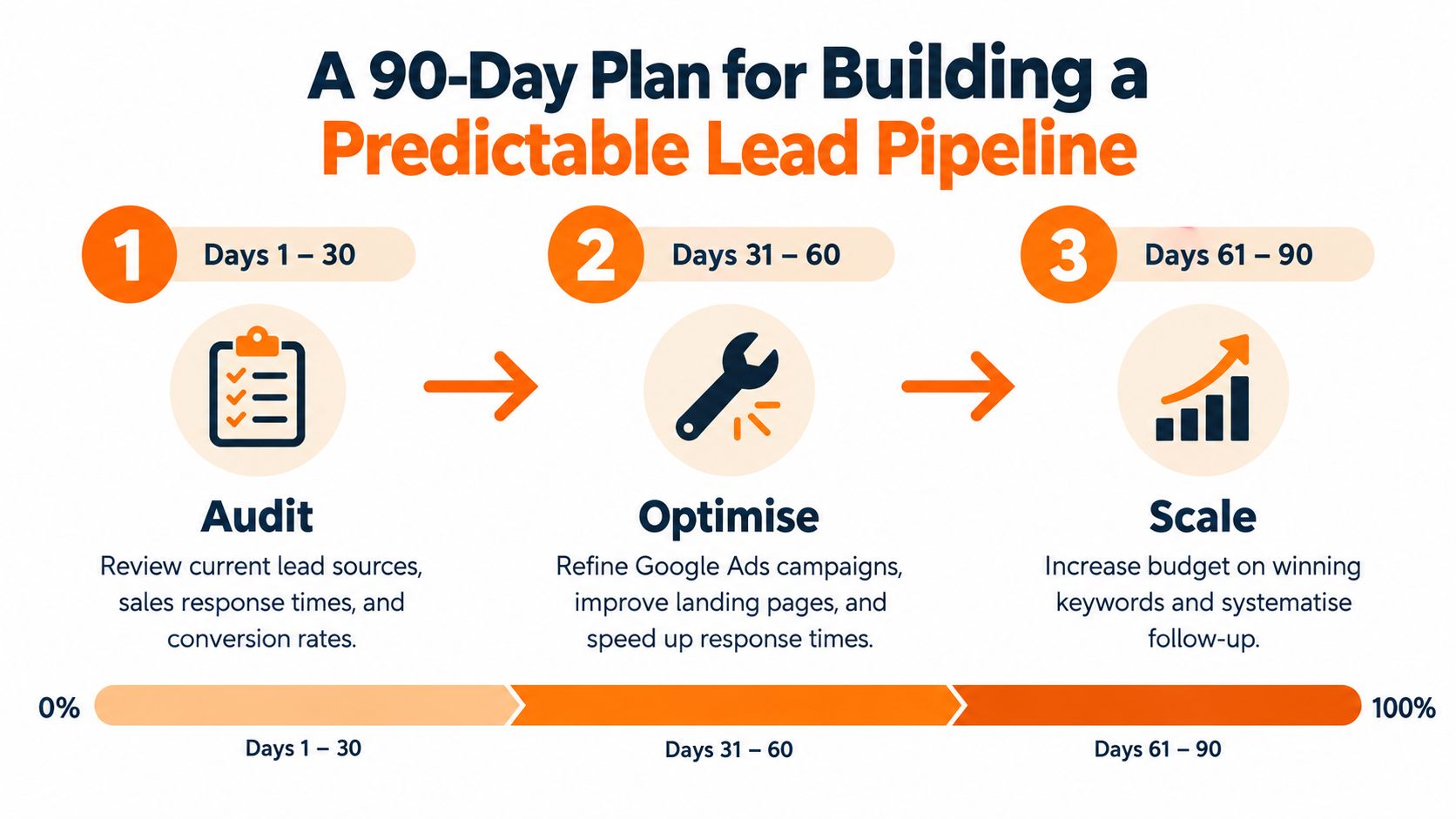
Days 1–30: Audit and repair the basics
Write down where enquiries come from and what happens after each one arrives. Check who answers calls, how quickly the team follows up, how long quotes take, and which services or locations you want more work from. Make sure someone owns each step.
Set up or verify call and form tracking, then review your website. A campaign can’t be judged properly if you don’t know which enquiries it generated. If you’re already using Google Ads, check whether campaigns and landing pages match the services you offer. If you’re starting from scratch, build around specific roofing services and locations rather than sending every search to a generic page.
Days 31–60: Refine targeting and follow-up
Review search terms and remove irrelevant traffic with negative keywords. Separate the enquiries you want from those you can’t serve, whether because of location, job type, or timing. Improve the landing pages that don’t make your service or next step clear.
Use your own qualified-lead costs as the decision point. The documented benchmark for properly built roofing Search Ads is $20 to $80 per qualified lead, but your results won’t mean much unless “qualified” is defined and your team records what happens after the first contact. Don’t scale a campaign just because it produces more form submissions.
Days 61–90: Plan capacity and scale carefully
Create a regular review of lead quality, quote follow-up, booked work, and crew availability. Increase budget only when you can identify the searches that produce suitable enquiries and your delivery team has room to take on more jobs. If the leads are weak, fix targeting or qualification. If good leads are waiting too long for quotes, address the sales process first.
Initial enquiries can arrive soon after a clean campaign launch, but don’t treat timing as guaranteed or assume that early volume proves the system works. Judge the pipeline by the fit of the leads and what your company completes. If you’re ready to assess your search campaigns, landing pages, and lead tracking as one connected system, Bluelight builds and manages Google Ads for roofing companies. Visit Bluelight to discuss whether your current lead flow matches your services, service area, and crew capacity.
Related service Google Ads for Roofers