Generative Engine Optimisation for Roofers: What Works
Generative Engine Optimisation is making a roofing business’s website and listings clear, consistent and verifiable enough that AI assistants can find, trust and name it when homeowners ask for a roofer.
You might already be paying for search ads, collecting reviews and updating your website, yet still have no idea whether an AI assistant recommends your business. The useful question isn’t whether you can get another mention online. It’s whether that mention brings a homeowner in your service area who needs work you want to quote.
Treat AI visibility as a lead-quality problem, not a ranking trophy. Build the evidence that helps homeowners choose you, then judge the effort by inspections, quotes and booked jobs.
Table of Contents
- What Generative Engine Optimisation Means for Roofers
- How AI Assistants Choose Which Roofers to Name
- What Your Website Needs to Be Recommended
- Why Local Evidence Beats Generic AI-Friendly Content
- How to Measure Whether AI Search Brings Jobs
- Risks and Misconceptions That Waste Budget
- Start With Two Pages This Quarter
What Generative Engine Optimisation Means for Roofers
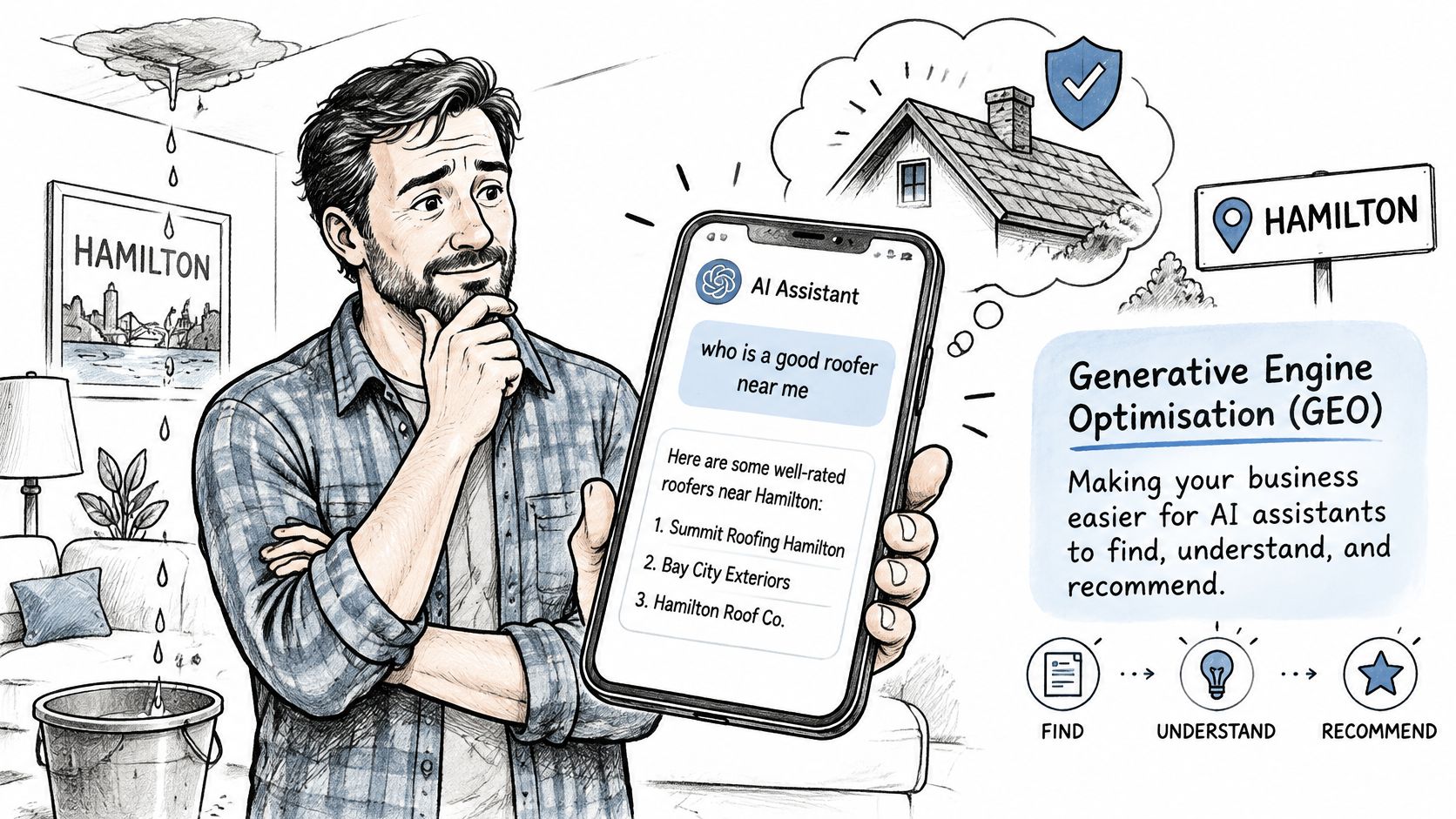
Say a homeowner in Hamilton notices a leak, asks an AI assistant who is a good roofer nearby, and gets three company names back. They haven’t compared a full results page. The assistant has already narrowed their options.
GEO means making your business information clear enough for that assistant to identify what you do, where you work and what supports a recommendation. You don’t control its answer, but you can improve the information available to it.
This is the kind of discovery moment you’re preparing for.
Classic search is closer to a shop window: you compete to be noticed among other businesses. An AI assistant is closer to a neighbour asked for a recommendation, although it can make mistakes and its answer isn’t an endorsement.
In a 2025 survey of 250 adults in New Zealand’s upper North Island, 39.2% had used an AI chatbot instead of a traditional search engine at least once, while 42.4% sometimes asked a chatbot first before purchasing, according to Internet Advertising Bureau New Zealand’s Pollfish survey.
Keep your existing search foundations
This sits alongside Google search and your Google Business Profile, not instead of them. For a cross-industry explanation of the same answer-first approach, Advisor Momentum on answer engine optimization provides a useful comparison, although roofing needs its own local proof.
Start with these checks this week:
- Business identity: Is your business name written consistently everywhere?
- Service coverage: Does your website spell out the services and suburbs you cover?
- Independent agreement: Do directory details and customer reviews describe the same business and work?
How AI Assistants Choose Which Roofers to Name
Classic search ranks pages, while an AI assistant combines information into an answer that may name businesses.
An assistant can draw on information absorbed during training and, when web search is enabled, material retrieved before answering. Webpages, directories, reviews and forum discussions can contribute, but you can’t assume every assistant searches live or checks every claim.
Classic search versus AI assistant answers
These are simplified output patterns, not fixed layouts or disclosed ranking formulas.
| Factor | Classic search | AI assistant answer | What a roofer should do |
|---|---|---|---|
| Goal | Rank a page in a list of links | Name a few businesses in one answer | Aim for both and keep classic SEO going |
| What gets read | Your pages, ranked by relevance and links | Pages, listings and reviews the AI can reconcile | Keep name, phone and suburbs identical everywhere |
| Typical output | Ten blue links and a map pack | Short answer with three to five names | Write service answers a short quote could come from |
| What wins | Keywords, backlinks and page speed | Clear, consistent, corroborated facts | Publish one service page per offering |
| How you judge it | Rankings and clicks | Mentions, referrals and calls | Track calls and ask every enquiry how they found you |
If your website says you handle commercial membrane work across Auckland, but directories describe you as a house painter in one suburb, your identity becomes harder to resolve. A consistent name, phone number and service footprint removes avoidable ambiguity. It doesn’t guarantee inclusion.
Strong corroboration means independent sites agree about your business, recent reviews describe identifiable work, and service pages explain the offering plainly. A customer describing a completed re-roof is more informative than an unsupported claim about outstanding service.
For adjacent work, roof repaint advice for Auckland landlords illustrates a distinct customer question: repainting isn’t automatically repair or replacement. Your content should preserve those boundaries rather than imply every roof problem needs the same solution.
Practical rule: Check whether the assistant recommends you for work you want, not merely whether it recognises your name.
For a baseline, select five questions from the 20-prompt measurement routine below, covering your main suburbs and service types. Record who appears, which sources are cited and whether the assistant describes your business accurately. Keep the wording unchanged for subsequent checks.
What Your Website Needs to Be Recommended
Give assistants and homeowners specific, supported answers, rather than claims they have to interpret. Each important page should make it straightforward to identify the service, coverage, evidence and next step.
New Zealand’s 2025 cross-agency AI survey recorded 272 AI use cases across 70 public-sector organisations, including assisted search, demonstrating institutional use of organised information retrieval rather than proving anything about roofing recommendations.
Build pages around real buying questions
Use this checklist to organise the work.
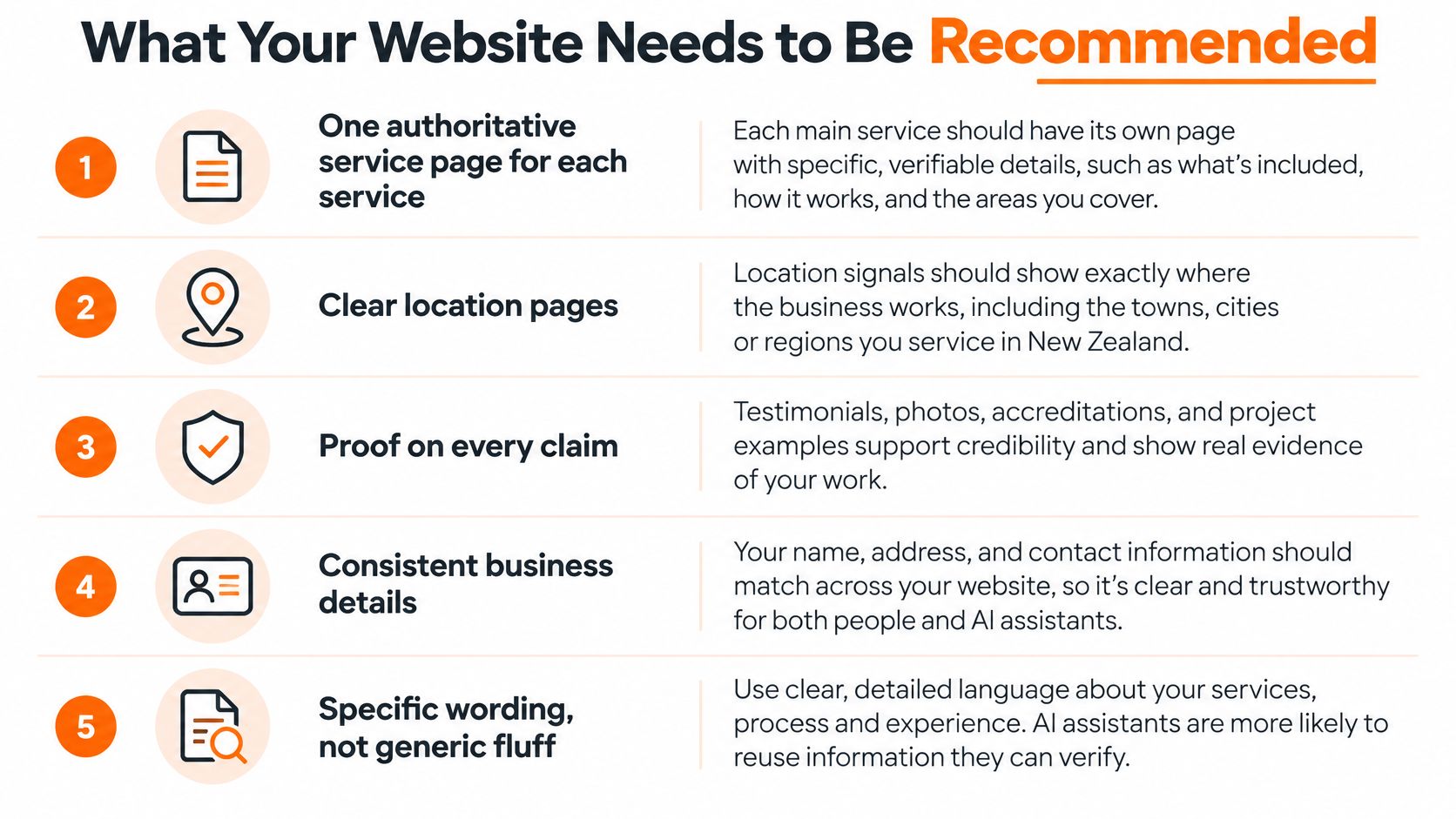
- Give each offering an authoritative page. Separate different services, such as roof replacement, roof repair, membrane roofing and gutters. Explain long-run metal and tile options where relevant, but don’t create duplicate replacement and re-roof pages merely to target synonyms.
- Make location pages earn their place. Include actual suburbs served, relevant project examples and local access or exposure considerations. Swapping a place name into otherwise identical copy adds little value.
- Answer the questions that delay enquiries. Explain what affects repair cost, how you assess repair versus replacement, and what determines a re-roof programme. Give conditional answers where an inspection is necessary rather than inventing certainty.
- Put evidence beside the claim. Add dated case studies, genuine project photographs and company credentials. For technical statements, identify the applicable manufacturer guidance or regulatory reference rather than presenting marketing copy as specification.
- Keep business details aligned. Your contact page, footer and service pages should agree about your identity and coverage.
For ideas about organising homeowner questions, SuperiorPRO’s frequently asked questions is a useful format reference. Write your own answers for your materials, contracts and New Zealand operating conditions.
Add accurate labels behind the page
Schema markup means hidden labels that describe your business and page content to search systems. Mark up the organisation, local business, services, areas served, FAQs and projects where supported, and reviews only where eligible.
The visible page must support every marked-up claim. Schema isn’t a shortcut to recommendations, and adding FAQ markup doesn’t promise special search treatment.
A well-labelled unsupported claim is still unsupported.
Include a clear call button and a quote form that asks for the property location and work needed. A roofing website design checklist can help connect information structure with enquiry usability.
Review prices, warranty terms, regulatory references and service areas quarterly. Remove unsupported superlatives, including best roofer, rather than trying to make them sound more convincing.
Why Local Evidence Beats Generic AI-Friendly Content
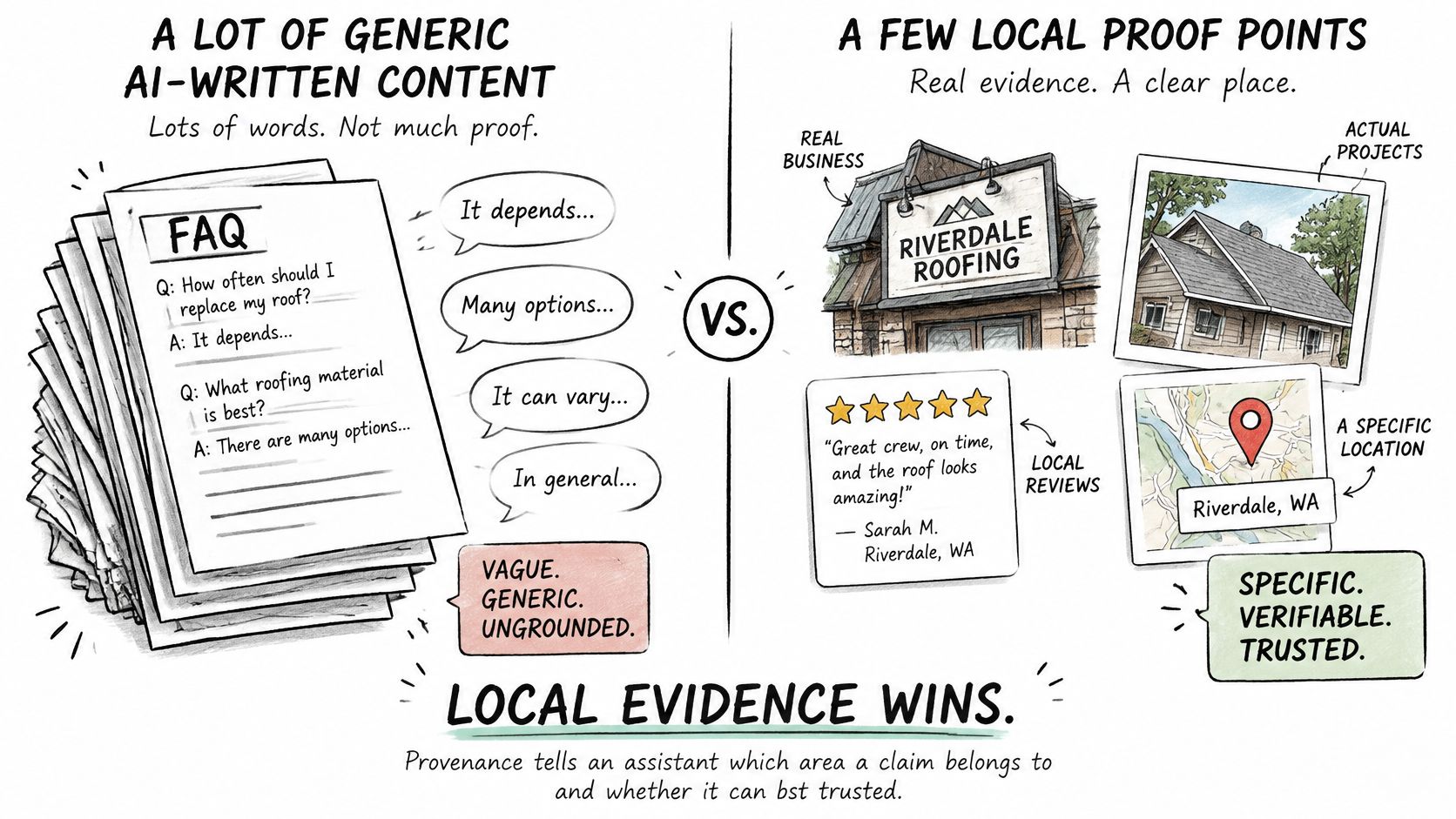
A small, credible local evidence base is a better starting investment than a large batch of generic AI-written FAQs. It gives homeowners something concrete to evaluate and gives an assistant information that belongs to your business rather than any roofer anywhere.
The difference is specificity, not whether someone used AI to help draft the text.
In InternetNZ’s 2025 Internet Insights survey, 55% of New Zealanders used AI in search engines. That makes local accuracy worth testing, but it doesn’t establish that publishing more pages produces more roofing leads.
Match the language to the job
A homeowner asking about an iron roof might need help identifying an existing material. Someone searching long-run could be comparing replacement options, while roof restoration may mean cleaning, coating or remedial work.
Use distinct pages when the service and decision differ. Don’t turn every wording variation into another near-identical landing page.
For regional content, document conditions your actual projects face. A Wellington coastal property may need discussion of salt exposure and wind; an older Auckland home may raise wet-weather scheduling and existing-condition questions; a Christchurch property may require identifying its construction or rebuild history. These are prompts for assessment, not specifications you should apply to every house in a city.
Use the following video alongside your own checks of how AI search presents business information.
Check credentials just as carefully. State the actual licence or certification, its holder and current status where applicable, then check whether external listings and the assistant’s answer match. Don’t imply a company-wide qualification from an individual’s unrelated credential.
Run the same local prompts monthly and assess whether cited sources are local, credible and relevant to the jobs you want.
Add these first:
- A dated local project gallery: Identify the work and general location without exposing customer details.
- A named credential: Make its scope verifiable.
- A weather note: Explain the exposure assessed on that project and how it informed the work.
How to Measure Whether AI Search Brings Jobs
A citation is an intermediate metric, not proof of revenue. An assistant might repeatedly cite your explanation of roof coatings without sending a homeowner who needs your services.
In Adobe’s February 2025 survey of 1,001 New Zealand consumers, 53% used AI assistants to research brands and products. Your tracking needs to account for someone discovering you through an assistant, then calling after a separate branded search.
Use a repeatable monthly routine
- Choose 20 fixed prompts covering your main services and suburbs. Include commercial intent and homeowner decision questions, not just requests for the best roofer.
- Run them monthly and log firms and sources. Record the assistant, date, search mode and answer so changes aren’t reduced to memory.
- Tag calls and forms with a source question. Ask how the customer found you and preserve both their answer and any available referral information.
- Compare enquiries by service type. Separate re-roofing, leak repair, gutters and commercial work so irrelevant demand doesn’t look like progress.
- Check branded searches and direct traffic. Treat changes as supporting signals, not proof that AI caused them.
- Follow enquiries through quotes, bookings and completed-job revenue. Keep the original source attached when a lead becomes a job.
The useful progression is from being seen to winning suitable work.
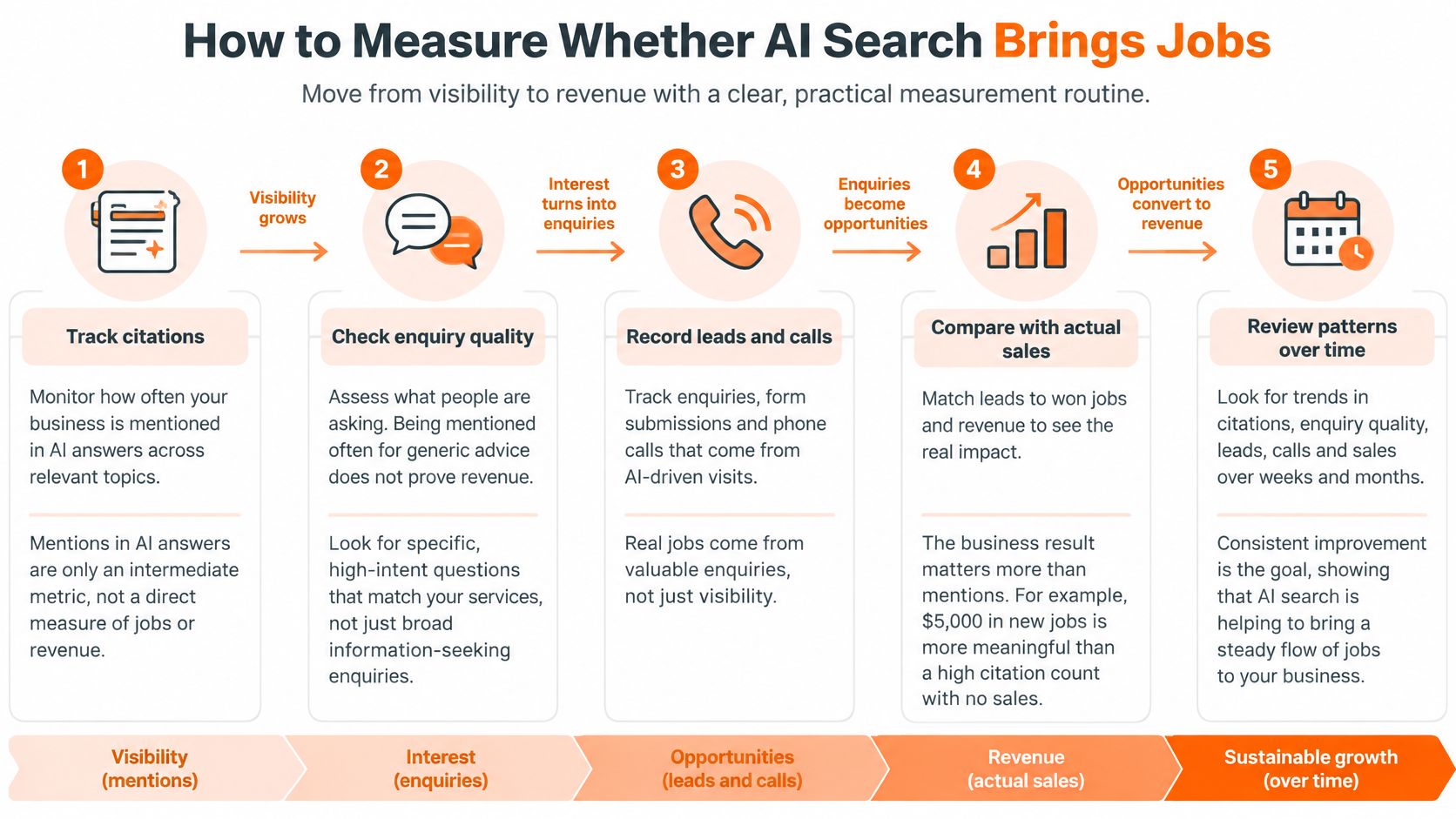
Measures that show AI search is producing jobs
| Measure | What it tells you | How to track it |
|---|---|---|
| Prompt appearances | Whether assistants name you for fixed local questions | Monthly prompt log with answers and cited sources |
| AI-referred calls | Callers who found you through an assistant | Call tracking with a source question |
| Quote requests from AI | Enquiries that mention an assistant or AI | Form field asking how they heard of you |
| Branded searches | People who may look you up after seeing an AI answer | Brand queries in Google Search Console |
| Booked inspections and jobs | Whether visibility turns into revenue | CRM or job sheet tagged by source |
Branded queries can’t identify an individual customer’s discovery route. Keep confirmed AI referrals separate from possible AI-assisted enquiries, and avoid counting the same job twice.
Use marketing attribution principles to reconcile website activity with phone enquiries and offline sales. If mentions improve but suitable enquiries and booked inspections don’t rise after your three-month review period, inspect the service pages and lead handling before commissioning more content.
Budget test: Would you still value the result if nobody showed you the citation report?
Risks and Misconceptions That Waste Budget
The most expensive mistake is paying for visibility without checking whether it attracts profitable, serviceable work. A polished dashboard can conceal enquiries outside your area, work you don’t undertake or calls nobody answers.
Five assumptions to reject
- More AI-written content gets you cited. Volume without distinctive evidence can produce interchangeable pages; safeguard your budget by prioritising the local evidence checklist.
- A citation equals revenue. A mention can inform someone without creating a buying opportunity; use the job measurement routine before assigning commercial value to it.
- One correct listing is enough. Conflicting directory records leave contradictory information available; apply the business identity self-test to your wider online presence.
- Unsupported claims help you stand out. Invented statistics, unverifiable warranties and exaggerated qualifications can mislead customers and create compliance risk; use the website evidence checks before publishing them.
- Everything should change immediately. Rewriting every service and suburb page makes the work harder to assess; follow the two-page starting plan to keep the test manageable.
Watch what remains online
Old information deserves its own check. An assistant may retrieve an outdated page or repeat superseded warranty terms, prices or coverage, even after you’ve updated your main service page.
The safeguard is to include old landing pages, downloadable documents and directory profiles in the website maintenance review, not just the navigation visitors usually see.
Don’t buy a promise of permanent placement in AI answers. Outputs can change with prompt wording, location, search availability and the assistant itself, so a successful demonstration isn’t a durable ranking guarantee.
Keep the commercial standard simple: accurate representation, appropriate enquiries and work your team can deliver. If a proposed tactic improves none of those, it needs a stronger justification than being labelled AI-friendly.
Start With Two Pages This Quarter
Pick the services with the strongest job economics and build those pages first. Roof replacement or re-roofing and leak repair are sensible candidates, but check your margins, capacity and preferred work before choosing.
A high-value contract isn’t automatically your most profitable job. Account for quoting effort, access, materials and the likelihood that your team can deliver it well.
Keep the first test bounded
- Write a page for each selected service. Include local detail, an indicative cost range only if you can substantiate it, and warranty terms you can stand behind.
- Add three short question-and-answer blocks and a dated project example to each. Choose questions that help a homeowner decide whether to book an assessment.
- Reconcile your business details. Match your name, phone, suburbs and services with your Google Business Profile and main directories.
- Add matching schema. Describe only what the visitor can verify on the page.
- Establish the baseline and source tracking using the measurement routine, then review at day 90 against booked work before expanding.
For paid acquisition alongside this test, we advise starting with search and remarketing before experimenting with other campaign types. Keeping the initial campaign mix limited makes the results easier to interpret.
An optional next move is our free 30-minute ad account review, covering what’s working, what’s leaking budget and the two or three moves that would change numbers fastest.
Bluelight works exclusively with roofing companies, combining Google Ads management, landing page optimisation and enquiry tracking. If you want to connect search visibility with qualified calls and booked work, visit Bluelight and book an ad account review.
Related service Google Ads for Roofers