Contractor Lead Generation for Roofers: What Works in 2026
Your crew is booked through Wednesday, then the second Thursday of the month goes quiet and the labour still has to be paid. You spent the morning on a marketplace enquiry that three other roofers had already priced. The phone looks busy. The diary does not.
That is the usual shape of contractor lead generation when you score it on enquiry count. A cheap form fill still costs an estimator a drive, a quote, and a follow-up that goes nowhere. I would score every source on one thing only: a job you booked, finished, and got paid for, in a suburb you can reach.
You do not need a giant tracking build to see that. You need the source, the suburb, the job type, and a status that ends in paid or lost. Privacy rules are part of that setup, not a side project. They stop you hoarding data you cannot use, and they stop you paying for activity that never becomes a roof.
Table of Contents
- Roofing Lead Sources Compared by Speed and Control
- How to Set Up Search Ads That Bring Quote Requests
- Local SEO and Marketplaces Worth Your Time
- Turn Enquiries Into Booked Roof Jobs
- Track Leads to Revenue Without Overbuilding Tracking
- Set Your Budget by Job Type and Cost per Booked Job
- Referral Systems That Keep Working Past Your Network
- Start With One Channel and Review It in 90 Days
Roofing Lead Sources Compared by Speed and Control
Say the crew sits idle every second Thursday once the storm work clears. The fix starts with knowing which source delivers which kind of job, and how fast. Speed without control fills the van with price shoppers. Control without any speed leaves wages running while you wait for the map listing to mature.
| Lead source | Time to first enquiry | Control over lead quality | Best use |
|---|---|---|---|
| Google Search Ads | Days after launch | High: you choose keywords, suburbs and landing pages | Replacement and urgent repair jobs |
| Google Business Profile and local SEO | 2 to 6 months to build | Medium: depends on reviews and listing accuracy | Steady calls from your own suburbs |
| Shared marketplaces | Days after sign-up | Low: the same enquiry goes to several contractors | Filling quiet weeks with smaller jobs |
| Referrals from past clients | Weeks, once a system runs | High: the client has already vouched for you | Larger jobs and repeat work |
| Direct enquiries from your website | As soon as ads or SEO send visitors | Medium to high: you control the page and the form | Converting visitors you already attract |
Shared marketplaces send the same enquiry to several contractors, so price competition is built in before you quote. That can plug a quiet week with a smaller repair. It is a weak place to win a reroof you want judged on scope, not on who blinks first.
Your website only converts people another channel already sent. If a side of the business touches short-stay property, a separate list such as find local vacation rental leads from CS Outsource is a different pool from homeowner roof searches. Do not drop those clicks into a roofing campaign and hope the form sorts them out.
Practical rule: If you need work within 30 days, start with search ads. If you have three months of capacity and a solid review base, build local SEO and referrals alongside them.
How to Set Up Search Ads That Bring Quote Requests
Search campaigns catch people who are already looking for a roofer. That intent is why the format is crowded. Scoop’s report on New Zealand digital ad spend put search advertising at NZ$1.44 billion in 2025, about 49% of digital advertising revenue, inside a digital market of NZ$2.967 billion. Search also dwarfed video at NZ$653.8 million and classifieds and directories at NZ$389.5 million. Broad terms such as “roofer” burn money in that crowd. Tight service and location terms do not.

Which searches to bid on
| Search type | Example | Likely buyer | Action |
|---|---|---|---|
| Replacement with a location | roof replacement Auckland | Homeowner ready to get quotes | Bid, and send to a replacement landing page |
| Urgent repair with a location | roof leak repair Christchurch | Needs a fix this week | Bid, with call tracking at the top of the page |
| Research question | how to fix a leaking roof | Browsing, may try a DIY fix | Add as a negative keyword |
| Job-seeker search | roofing jobs or roofer apprenticeship | Looking for work, not a roofer | Add as a negative keyword |
| Broad generic term | roofing | Mixed intent, high cost per click | Avoid, or keep only with tight negatives |
Setup in the order that protects spend
- Split campaigns by service: replacement, repair, gutters, and commercial. Each gets its own landing page and phone number. A mixed page blurs the offer, and the click lands on the wrong promise.
- Build keyword groups that pair the service with a suburb or city, such as roof replacement Auckland. The person has already named the job and the place.
- Add negative keywords for jobs, apprenticeship, how to, DIY, and cost of a tarp. You stop paying for researchers and people hunting work.
- Set the service area to suburbs you can reach within a day. A cheap lead two regions away is not cheap once the estimator’s day is gone.
- Put a click-to-call button and a short form above the fold on each landing page. Urgent callers should not have to scroll.
- Track calls with a unique number per campaign, and count qualified calls, not clicks. A click that never becomes a real job is not a result.
- Review the search-term report weekly and move wasteful queries into negatives. The first fortnight always surfaces junk the keyword list missed.
The main pitfall is optimising for cheap form fills. The conversion rate looks better while the close rate falls, and the estimator spends the week on people who were never going to book.
Local SEO and Marketplaces Worth Your Time
A Google Business Profile is often the first thing a local homeowner sees, so wrong details cost you the call before a website ever loads. Set the primary category to roofing. List only the service areas you cover. A profile that claims the whole island sends calls you cannot take, and those missed calls train people to try the next name.
Photos, reviews, and suburb pages
Upload photos of finished roofs. Put the suburb in the file name and in the caption, so the listing matches the street the searcher lives on. Ask for the review within 48 hours of handover, while the new roof is still in view. Reply to every review, including the unhappy ones. A blank reply reads as if you disappeared after the invoice.
Build one location page for each suburb cluster you serve. Two or three real project photos and a short note on the work done there beat a copied paragraph with the suburb name swapped in. A useful companion is a focused SEO setup for roofers that ties those pages to the services you sell. Most local SEO takes two to six months before it shows calls, so judge it on a six-month view, not on week three.
What to ask a marketplace before you pay
Marketplaces can fill a hole. They can also sell you the same name your competitor bought this morning.
- How many contractors get this enquiry? If the answer is several, you are in a price race.
- Can you see job size before you pay? A one-line “roof issue” is not enough to spend on.
- How do you dispute junk leads? Out-of-area and job-seeker contacts should not sit on the bill.
Trial one marketplace for 60 days. Track booked jobs from it, not the leads they email you. Drop it if the cost per booked job eats the margin on a standard repair.
A listing that looks busy and a marketplace that looks cheap can both fail the same test: no paid job in the suburbs you cover.
Turn Enquiries Into Booked Roof Jobs
A homeowner with water coming through the ceiling may call another roofer if nobody answers promptly. Set a callback target for business hours and assign someone to cover calls when the crew lead is on a roof. Record the roof type, problem and next step before ending the call.
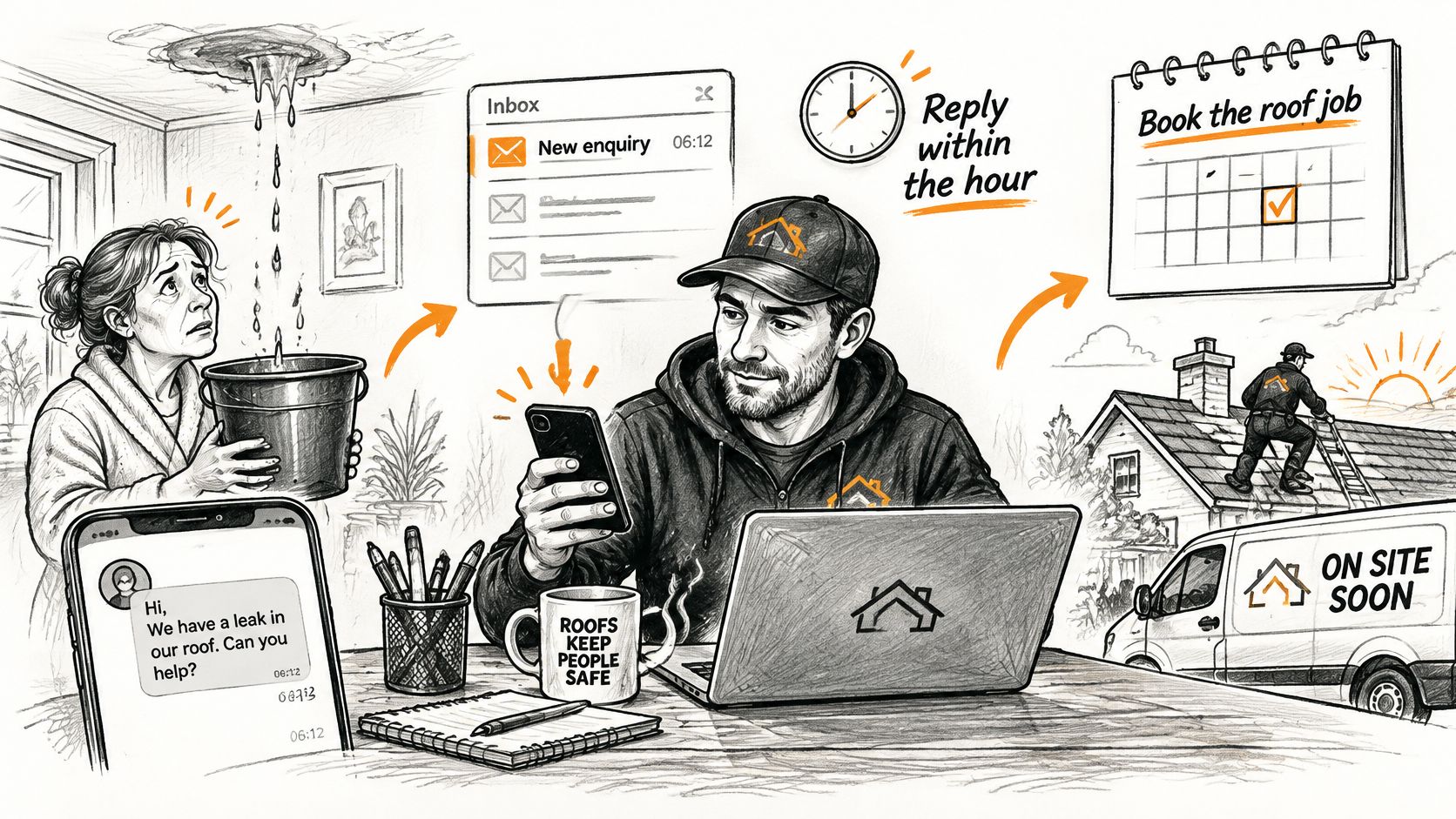
Four questions before you book the drive
Ask what type of roof it is and roughly how old it is. Find out whether the issue is a leak, storm damage or a planned replacement, and when the homeowner wants the work done. Confirm they own the property or can approve the spend. An owner dealing with an active leak needs a different response from someone planning a replacement next year.
Proof that matches the risk
A strong review gives a prospective customer details they can compare with their own job: roof type, suburb, scope of work, warranty terms, communication and clean-up. A star rating alone does little to show what the crew delivered.
Repair work can lead to disputes when expectations and the actual scope differ. Put inspection limits, response times and an escalation path on your website and in the quote. If the website suggests a full replacement but the visit is only for an inspection, the mismatch can start a complaint before work begins.
Qualify enquiries against the jobs your crew can take on and deliver as promised. The goal is a booked, paid job, not a busy phone log.
Track Leads to Revenue Without Overbuilding Tracking
A campaign can produce a steady stream of enquiries and still fail to book profitable work. Track each lead through to the paid job, so emergency call volume does not distract from the replacement work that earns more.
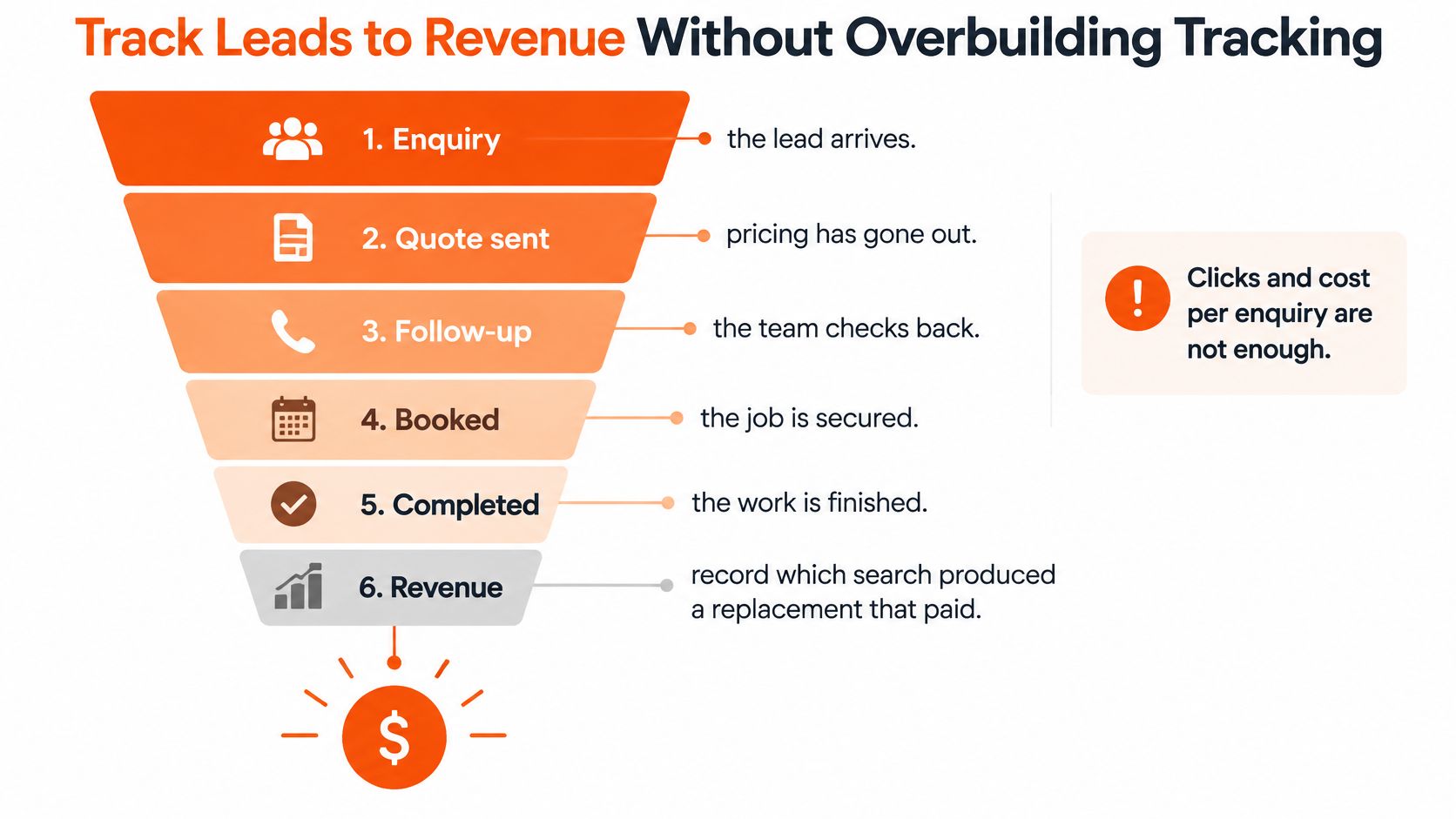
Six stages, one row per lead
| Stage | What to record | Example entry |
|---|---|---|
| Enquiry | Source, suburb and job type | Google Search Ads, Christchurch, leak repair |
| Qualified | Job type, roof age and owner status | Replacement, older roof, owner occupier |
| Inspection booked | Inspection date and estimator | Booked, estimator name and date |
| Quote sent | Quote value and send date | Quote value entered when sent |
| Job won | Won or lost, and reason if lost | Lost, reason: price |
| Revenue | Invoiced and paid amount | Paid amount, tagged to source |
Use a separate call-tracking number for each campaign, then record phone and form enquiries in the same lead record. When a quote becomes a won job, pass that outcome back to the ad platform as an offline conversion. This helps campaigns optimize toward booked work instead of treating every form submission as a success. Marketing attribution for connecting calls, forms and revenue can help when enquiries are split across different inboxes.
Consent without a surveillance stack
Keep tracking proportionate to the decisions you need to make. Record the source, job type, suburb and progress through the quote, then limit access to the information to people who need it.
For marketing messages in New Zealand, collect only what you need, get consent before sending, identify your business and provide a working unsubscribe option. Keep permission to respond to a quote request separate from permission for marketing follow-up. Confirm your wording and process with a privacy adviser before automating texts.
If one replacement lead is worth more than three emergency tarp calls, judge the campaigns by paid outcomes, not enquiry totals. A report grouped by source, suburb and job type shows which activity produced paid work and which brought enquiries you could not turn into jobs.
Set Your Budget by Job Type and Cost per Booked Job
Split the offers before you split the money. Replacement, repair, maintenance, gutters, commercial, and restoration each need their own service area, landing page, call-tracking number, and target cost per qualified enquiry. One blended average hides a gutter campaign that looks cheap and a replacement campaign that pays the wages.
New Zealand construction is large and cyclical, so the budget should flex. Stats NZ’s construction briefing put construction at 7.8% of national GDP in the year ended March 2024, and the 2024 National Construction Pipeline Report forecast residential activity to fall 7.6% during 2024. MBIE’s 2025 pipeline report then forecasts residential building activity to fall from NZ$29.2 billion in 2024 to NZ$26.1 billion in 2025, before a recovery to NZ$32.3 billion by 2030. Those are planning figures, not a count of roofs you will sell.
Where the dollars go when volumes soften
Protect budget for replacement and reroofing during the weaker stretch. Cut repair and gutter spend first when enquiry quality drops. Those jobs are easier to restart when the phone quality returns.
Set the ceiling from margin, not from what a rival claims to pay per lead. The highest acceptable cost per booked job is the gross profit on a standard job of that type, minus the overhead you need to keep. If a new channel’s 60-day test sits above that ceiling, it does not get a second month.
Building consent totals measure approvals, not roof-replacement customers. Use them to see where alteration and new-build activity is stronger, then check that against your own booked jobs. They are not a demand forecast for your brand.
Referral Systems That Keep Working Past Your Network
Referrals close better than most cold enquiries, and they arrive in lumps. One month you are turning work away. The next month the past clients have gone quiet. The job is to make the ask a routine, not a mood.

A routine you can run without a campaign
- Ask at handover, while the client is happy and the finished roof is in view. A text three weeks later loses the moment.
- Thank the referrer with something local and non-cash, such as a gutter clean or a voucher for a neighbourhood café. A discount teaches people to wait for a deal.
- After a job on a street, leave a door hanger offering a free roof check to neighbours. The truck was already there.
- Record the referral source in the CRM, including which client sent it, so you can see who sends work.
- Follow up any referral within one working day. Trust decays if the friend has to chase you.
A short handover note can ask for the review and the referral together. Thank them for the job, name the suburb, and offer one line they can forward. It stops feeling transactional when the work is already done and you are not begging in the same breath as the invoice.
Partners who send work more than once
Neighbours run out. Property managers, builders, real estate agents, and body corporates send repeat maintenance and commercial work if you make it easy to use you again. Give each partner a named contact and a quote turnaround they can rely on. A relationship dies when their tenant waits three days for a price you could have sent the same afternoon.
Start With One Channel and Review It in 90 Days
Pick the single primary channel from the speed and control comparison, based on how soon you need work. Do not open five taps on the same Monday.
In the first 30 days, confirm the suburbs you can reach in a day, write one landing page per service, set up call tracking, and log every enquiry’s source and job type in the CRM. At 90 days, count booked jobs and paid revenue by source, not enquiries, and compare each source with the cost-per-booked-job ceiling you set from margin. Add a second channel only after that review. Keep a marketplace only if its 60-day test cleared that ceiling.
If you want that build done for you, the ad account should be in your company’s name, the account and its data should stay with you if you leave, and the tracking should connect to the jobs you won. We set the account up in your name, you keep it if you leave, and we connect it to most roofing CRMs and job management tools. Most of our roofing clients see their first leads within 7 days of launch.
Bluelight builds Google Ads and landing pages only for roofing companies, so the enquiries match replacement, repair, and quote-ready work instead of shared marketplace noise. The tracking is there to show which searches become booked, paid jobs, which is the only score that should guide the next month’s spend. If you want that setup in your own account, visit Bluelight.
Related service Google Ads for Roofers