What Is PPC for Roofers in Plain English
After a wet night, a homeowner spots a ceiling stain and searches for roof repair in their suburb. A PPC ad can put your company in front of them while they are looking for help. You pay when they click, not because the ad appeared.
A billboard costs money whether anyone calls. With PPC, a click is the first cost in a longer chain: search, enquiry, qualified opportunity, booked job. A low cost per click means little if the caller is outside your service area or only wants a price for work you do not offer.
The goal is to judge what you pay for a qualified opportunity and the revenue each ad dollar brings in, not clicks alone. A click earns its place when it helps put a profitable roofing job on the calendar.
Table of Contents
- What PPC Means for a Roofing Company
- The Path From a Click to a Booked Job
- How Bids Keywords and Ad Rank Work
- Which Google Ads Campaigns to Run First
- A Roofing ROI Sum You Can Recalculate
- Ad Claims That Break Fair Trading Rules
- Check Fit Before You Spend on PPC
What PPC Means for a Roofing Company
PPC, or pay-per-click, is advertising where you pay only when someone clicks your ad, not when it is shown. A homeowner sees that ceiling stain and types roof repair near me. The ad at the top of that search is a PPC ad. You pay Google only if they click it.
A billboard and a boosted post charge you for being seen. Search charges you for the tap.
Three labels are enough to read a roofing account without a jargon lesson.
CPC is cost per click, what that one tap costs.
CTR, click-through rate, is the share of people who saw the ad and clicked.
ROAS, return on ad spend, is revenue from booked jobs divided by what you paid for the ads.
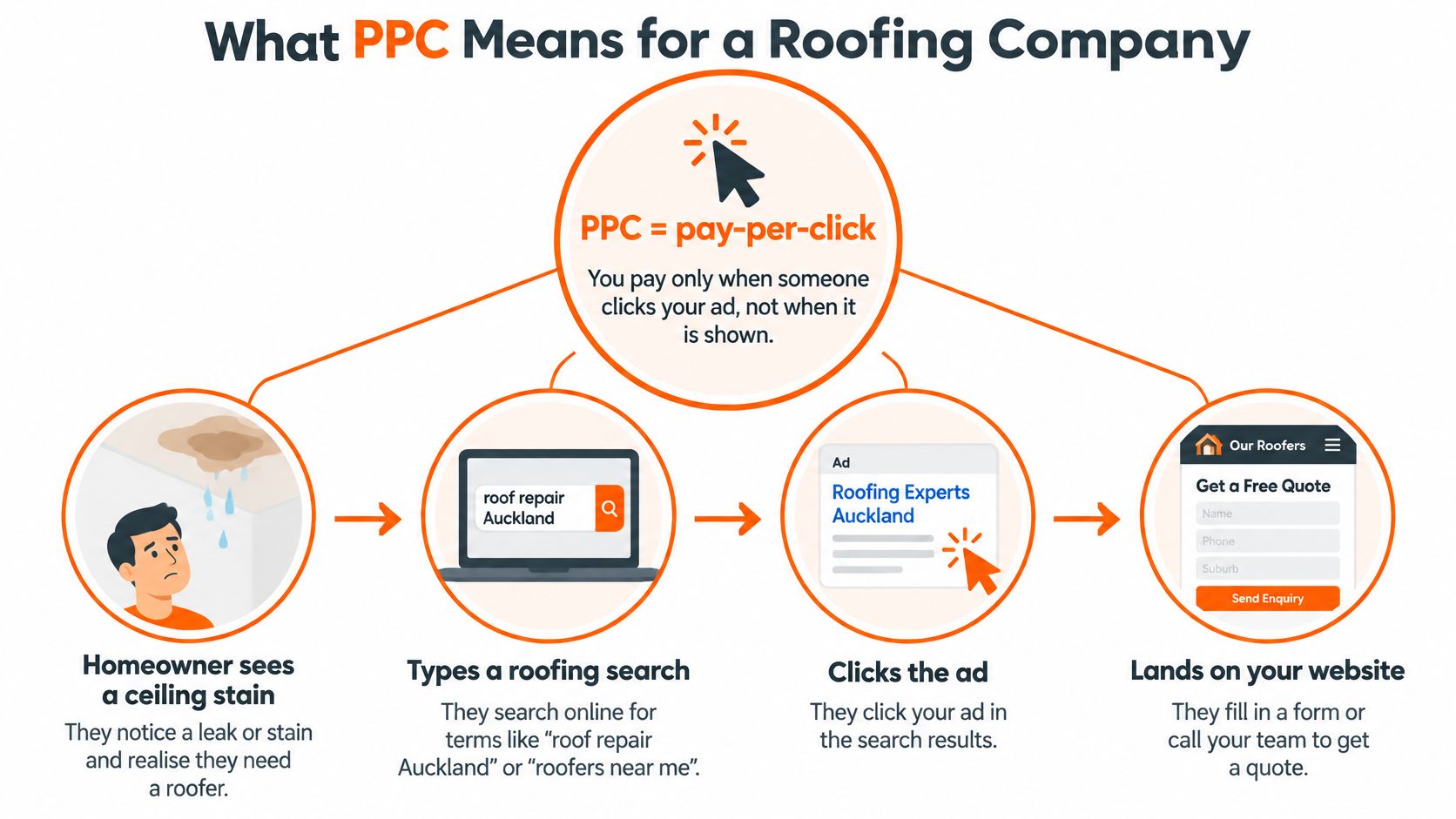
IAB New Zealand reported digital advertising revenue of NZ$2.967 billion in calendar year 2025, up 12%, with search generating NZ$1.44 billion, also up 12%, about 48.5% of digital advertising revenue. That is where people already look when they name a job. It does not mean your firm will win the work.
You can limit campaigns to Auckland, Wellington, Christchurch, or a set radius, and you can aim them at emergency repair or a full replacement. A click is not a deposit. The useful score is booked work, starting with one enquiry followed from the search box to a quote you can accept or decline.
The Path From a Click to a Booked Job
Walk one leak or one replacement all the way through. If a step is blank in your records, the ad account can look healthy while the business is not.
- Intent. Someone searches emergency roof repair, or re-roof cost, in a suburb you cover.
- Auction. Google may show your ad after weighing your bid and how useful the ad looks. You do not buy a permanent box.
- Click. You pay a cost per click only if they pick you.
- Landing page. They should land on a page about that service. A homepage menu makes them hunt. Strong landing page practice keeps the promise of the ad on the page they hit.
- Enquiry. They call, or they finish a form.
- Qualified opportunity. Right area, right roof type, ready to proceed. A how-to search and a tyre-kicker are not this.
- Quoted, then booked. You scope it, they accept, and you can tie the revenue to the ad.
A strong click-through rate, or a bargain cost per click, can sit next to a silent diary. A cheaper lead from a vague query is often worth less than a dearer lead from someone searching a local re-roof, a replacement, or an urgent leak repair.
Practical rule: Cost per qualified opportunity, and revenue per advertising dollar, are the finish line. Cost per click is only a toll on the way there.
The Advertising Standards Authority turnover report puts search at about 49% of New Zealand’s digital advertising market in 2025, roughly NZ$1.44 billion and up 12% year over year. That scale still will not save an account if calls are untracked, enquiries are shared, or low-intent searches eat the budget.
Record the call, the missed call, the form, the service, the suburb, whether it was qualified, the quoted value, and the revenue. Then fill last month into the rows below. Leave a blank where tracking is missing. A blank is the warning.
| Stage | What happens | Metric that matters | Warning sign |
|---|---|---|---|
| Search | Homeowner types a job such as roof repair or re-roof in your area | Search term and impression | Budget spent on how-to, jobs or supplier queries |
| Click | They tap your ad and you are charged | Cost per click | A cheap click from someone not ready to hire |
| Landing page | They reach a page about that exact service | Engaged visit, not a bounce to the homepage | Ad promises a repair and the page is a generic menu |
| Enquiry | They call or submit a form | Cost per lead | Missed calls and forms with no suburb or roof type |
| Qualified opportunity | Right area, right service, ready to proceed | Cost per qualified opportunity | Price-shoppers and out-of-area calls counted as wins |
| Quote accepted | They accept a scoped quote | Quote-to-job rate | Lots of quotes, almost no deposits |
| Booked job | You book paid work under your brand | Revenue per ad dollar | A healthy ad account with no revenue tied back |
How Bids Keywords and Ad Rank Work
Think of the auction as a silent tender. It runs every time someone searches, and it is settled in a fraction of a second. You do not buy a fixed position the way a Yellow Pages box used to work.
Ad Rank is broadly your bid combined with quality. Google looks at expected click-through rate, how closely the ad matches the keyword, and whether the landing page answers that search. A lower bid can still beat a higher bid when the ad and the page are tighter. Raising the bid is not the first fix I would make.
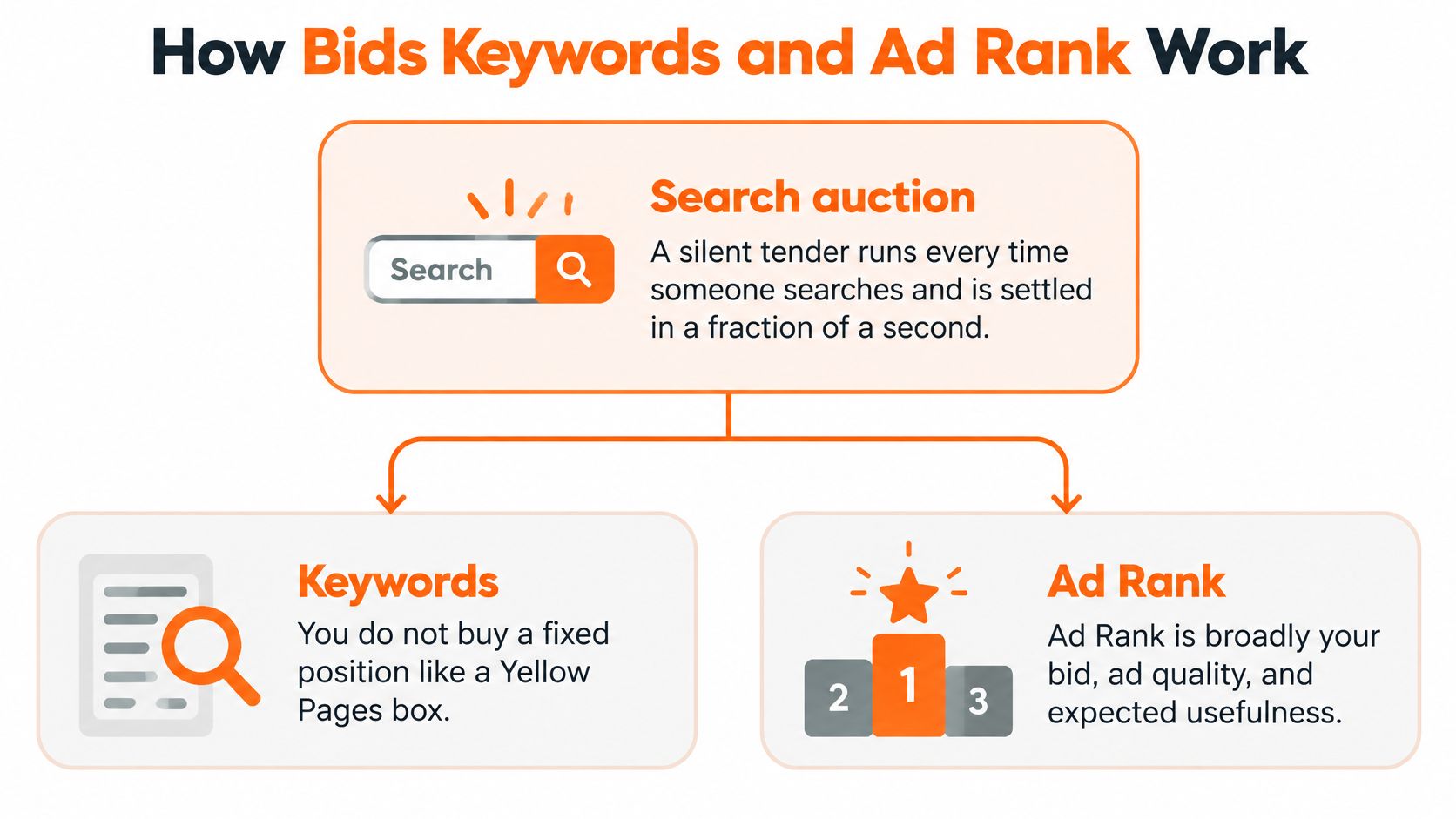
Keywords are the door
Keywords are the phrases that enter you in that tender. Tight terms such as roof replacement, leak repair, metal roofing, and gutter replacement sit near people who can hire you. A broad word like roofing also pulls students, DIY searches, and suppliers.
Negative keywords are the block list. Start with how to, jobs, apprenticeship, cheap, free, and materials people want to buy and fit themselves. Match type narrows or widens the net. Start tighter. Loosen a term only when the search-term report shows real jobs, not curious clicks.
The daily budget caps what you can spend. It does not guarantee leads. You pay only when the ad is clicked, and the cost per click you are charged is often below the maximum you set.
Write ten money keywords and ten negatives before anyone raises a bid.
| Input | In plain language | What you control | If you ignore it |
|---|---|---|---|
| Max cost-per-click bid | The most you are willing to pay for one click | Bid and daily budget | You either never show or overpay for weak clicks |
| Expected click-through rate | How likely your ad is to be clicked for that search | Ad headlines that name the service and area | A relevant offer still sits below vaguer ads |
| Ad relevance | How closely the ad matches the keyword | Separate ads for repair, replacement, metal, tile, gutters | One generic ad serves every search badly |
| Landing page experience | Whether the page answers the search quickly | A page for that service, mobile-friendly, with a clear call | Clicks land on the homepage and leave |
| Keywords and negatives | Which searches you enter and which you refuse | Money terms in, how-to and jobs out | Budget drains on people who will never book |
Which Google Ads Campaigns to Run First
Google Search is the first campaign for most roofers. The person has already named the job, and they often want someone this week. I would not open with video, display, or a catch-all campaign while the phone script and the pages are still untested.
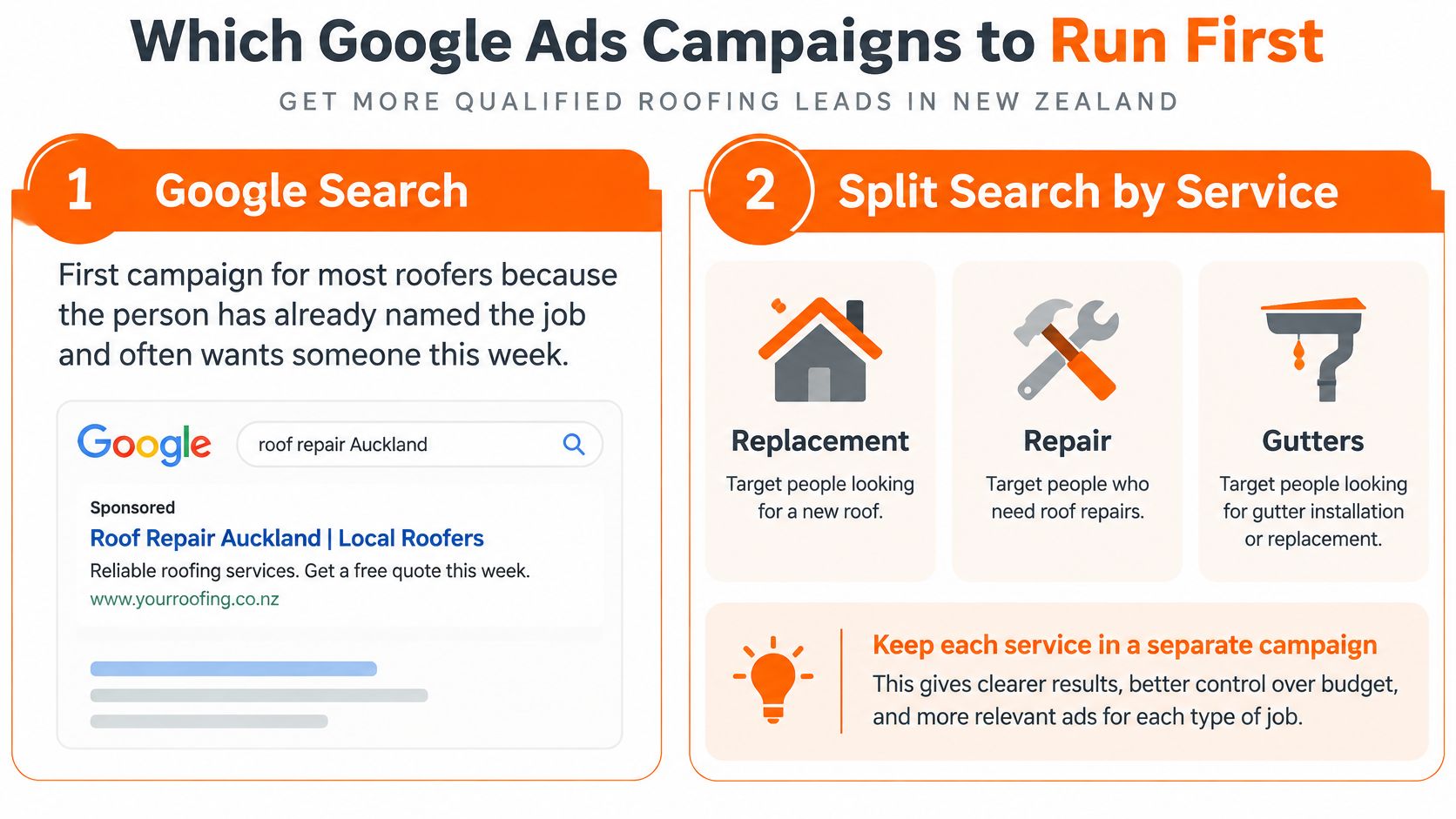
Split search by service and by catchment. Replacement, repair, gutters, metal, tile, membrane, and commercial work do not convert the same way. Auckland, Wellington, Christchurch, or a defined radius should not share one budget, or a busy repair suburb will eat the re-roof money and you will not see it.
The 2024 New Zealand Consumer Survey found that 91% of consumers had purchased something online, and the government’s summary reported that 93% had made an online purchase in the previous six months. That does not prove every roofing customer starts on Google. It does mean digital paths are normal enough to run search as a proper acquisition channel, with separate campaigns so you can see which work converts.
What comes second, and what waits
Remarketing is second. It shows follow-up ads to people who already visited and are still comparing roofers. It is too small to carry the pipeline on its own.
Performance Max can add reach later, once search economics are proven. It hides many of the queries that spent the money, so it is a poor classroom. Leave display and video until search is booking jobs. Microsoft Advertising can mirror the search campaigns at lower volume once Google is behaving.
Review search terms and conversion settings every month. Count qualified calls and completed forms as separate primary conversions, and use a minimum call length or a CRM check so a pocket dial is not a win. Use value-based bidding only after you have enough verified jobs in the data. Before that, the system chases the easiest form fill, not the better-margin roof.
This short walk-through shows the same search-first order on screen.
| Campaign type | Best for | When to start | Main risk |
|---|---|---|---|
| Search | People typing repair, replacement, metal, tile, gutters or commercial roofing in your area | First, on day one | Broad keywords and homepage traffic |
| Remarketing | Visitors who already saw your site and are still choosing a roofer | Second, once the site has visitors | Too small to carry the pipeline alone |
| Performance Max | Extra reach after search economics are proven | Later, with conversion data | Opaque queries and hard-to-see waste |
A Roofing ROI Sum You Can Recalculate
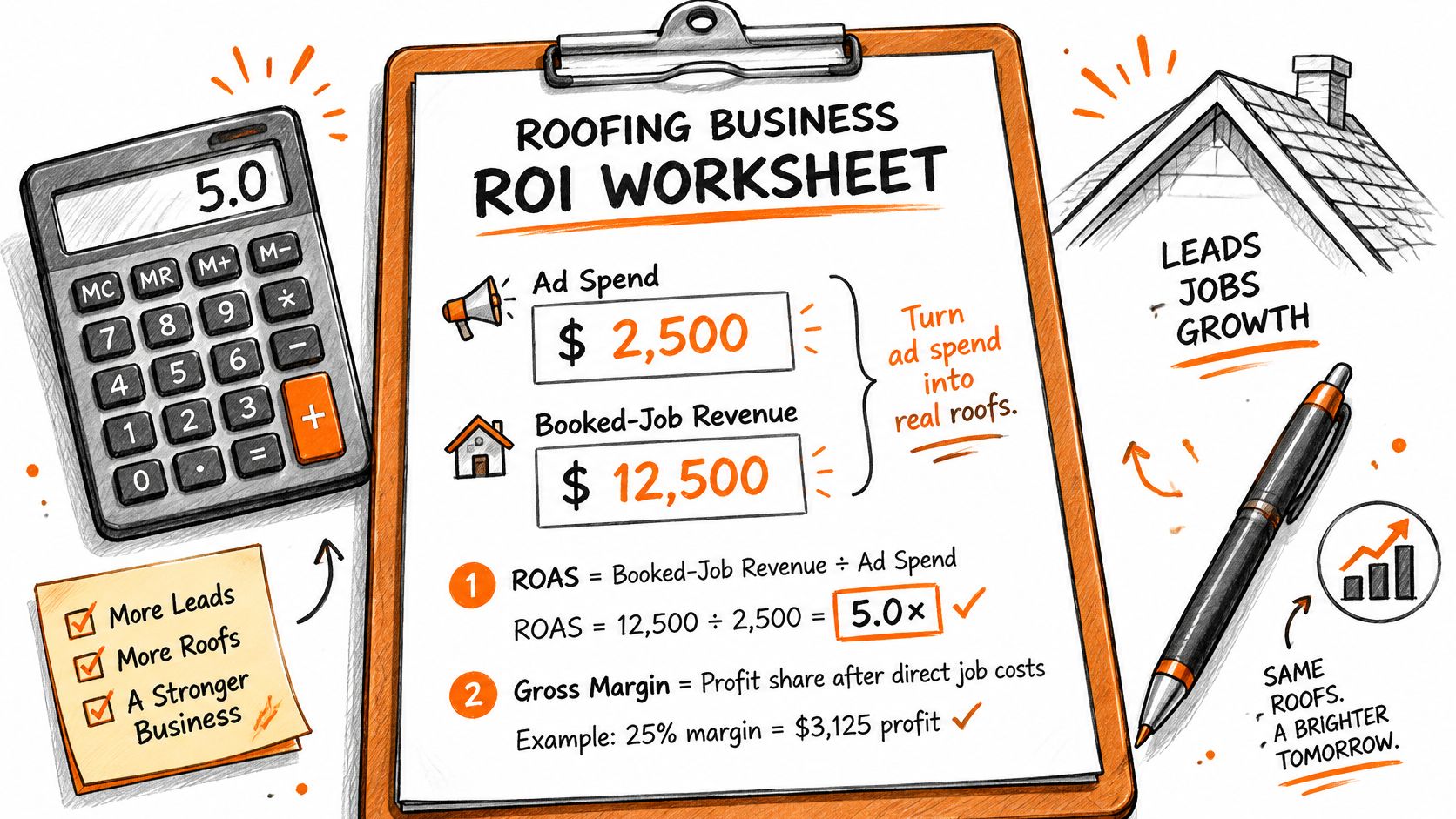
A month with NZ$3,000 in ad spend can produce a profit or a loss, depending on which enquiries turn into jobs. The figures below are an illustration, not a New Zealand benchmark. Replace them with your own numbers.
ROAS is booked-job revenue divided by ad spend. Gross margin is revenue left after materials and direct labour, before overheads and quoting time.
At an average cost per click of NZ$8, NZ$3,000 buys about 375 clicks. If 8% become enquiries, that is 30 leads at roughly NZ$100 each. If one in five is a qualified opportunity, six good prospects cost about NZ$500 each. Two booked jobs with NZ$4,000 gross margin apiece produce NZ$8,000 in margin against NZ$3,000 in ad spend.
When the same spend flips
If half those leads are tarp requests or outside your service area, the spend buys far fewer real opportunities. Improving lead quality can matter more than cutting a dollar from the click. A cheap click is poor value if it never becomes a suitable job.
A new account has no booked-job history for automated bidding to learn from. Set up conversion tracking for calls and form enquiries, then check which enquiries become booked jobs. Otherwise, the system may optimize for the easiest action to count rather than the work with the strongest margin.
If your crews are booked for the next two months, extra leads may only mean more declined calls. Reduce spend until you have capacity to take on work.
Each month, record ad spend, qualified leads, and the value of jobs booked from those leads. Use those figures to judge cost per qualified opportunity and return on ad spend, not click-through rate alone.
Ad Claims That Break Fair Trading Rules
The line that gets a roofer into trouble is rarely a cartoon lie. It is the confident headline typed in a hurry. “New Zealand’s best roofer.” “Guaranteed leak-free.” “Same-day repair.” “Save 30%.” Loose warranty, material, and outcome claims sit in the same pile.
Under the Fair Trading Act, every claim in the ad and on the landing page needs reasonable grounds at the moment you publish it. The ban on unsubstantiated representations still applies even if the claim later turns out to be true. Misleading or deceptive conduct is banned as well. Evidence has to exist first: supplier documents, job records, written warranty terms, or a real capacity process behind a same-day promise.
The overall impression counts. Photos, prices, and layout can mislead even when no single sentence is false. A headline that promises a fixed price or a rapid response has to open a page that states roof type, location, exclusions, and conditions. Fine print does not rescue the headline. The duty covers online advertising and websites used by businesses trading with New Zealand consumers.
Prices, free quotes, and who you are
A from-price has to be explainable by roof size, access, material, pitch, or repair scope. Do not show it as a typical total if most eligible jobs cost much more. “Free quote” must not hide a call-out charge, an inspection fee, or a push to proceed. If an honest price is impossible before someone is on the roof, advertise a clearly described assessment and say the conditions up front.
Read the ad, the call extension, the page headline, the form confirmation, and the office script as one offer. Urgent searches make this sharper, because the homeowner often rings the first result that sounds certain.
The Commerce Commission expects online traders to disclose trader status clearly and prominently wherever a customer can request a service, and the Fair Trading Act still applies to traders based outside New Zealand. Put the legal business name, contact details, service area, and a plain statement that you are trading as a business on the landing page. Do not look like an anonymous directory listing.
Before launch, read the ad as a stressed homeowner and write down the price and the timing they will expect. If you cannot back that expectation today, change the line.
Check Fit Before You Spend on PPC
PPC fits when you can answer the phone, quote the services named in the ads, and tell which calls came from the ads. It does not fit as a patch for a crew booked solid for months, or when nobody will mark which enquiries became jobs.
Three questions before the first dollar
Can you answer calls within the hour during working hours? A missed call on an emergency search is spend you already lost.
Do you have a price or an assessment process for each service you will advertise? If you cannot scope metal, tile, or a small repair, do not bid on that phrase yet.
Will someone log every enquiry as a booked job, a quote, or a dead lead? If the answer is no, you will argue about clicks instead of margin.
If all three are yes, start small. Search plus remarketing is enough for a first test. The ad budget is paid to Google and is separate from any management fee. Keep the Google Ads account and the billing in the owner’s name so the data stays with the business if you change help later.
Before you raise that budget, write down the three monthly numbers: ad spend, qualified leads, and the value of jobs booked from those leads. Then export last month’s search terms and cross out every query that was never going to become a deposit.
Judge any agency on the same numbers: qualified opportunities, quote-to-job rate, and revenue per ad dollar. Click volume and promised rankings are the wrong contract. Across our roofing clients the average ad spend is $560 per booked job, and we took CRS Roofing from startup to $5.6M in revenue, a 114x return on ad spend. Those results still depend on a crew that can answer and a log of what each lead became. We also offer a free 30-minute ad account review that covers what is working, what is leaking budget, and the two or three moves that would change the numbers fastest.
If you want that review on your own roofing account, we will look at what is working, what is leaking budget, and the two or three moves that would change the numbers fastest. Bluelight builds and manages Google Ads only for roofing companies, with the account kept in your name. Book the 30 minutes and bring last month’s search terms.
Related service Google Ads for Roofers