Google Ads Management for Roofers: Services and Pricing
Say you’re watching roughly $2,000 a month leave your roofing business’s account, with only a handful of calls to show for it. That’s an illustrative situation, not a spending benchmark, but the frustration is familiar: you can see the bill, yet you can’t tell which searches produced worthwhile enquiries.
Good Google Ads management makes that connection visible. Judge a manager by the account structure, tracking and decisions you can inspect, not just the fee or a promised lead count.
Table of Contents
- What a Professional Google Ads Management Service Covers
- How a Roofing Google Ads Account Is Built, Step by Step
- Roof Flow™ Keyword Strategy by Service
- Bid Strategy, Budget Control and Monthly Reporting
- Landing Pages and Local Signals That Turn Clicks Into Calls
- What Management Costs and How to Start
What a Professional Google Ads Management Service Covers
Professional management involves six linked jobs, not just switching ads on. Each job should produce something you can check without becoming a Google Ads specialist.
What a management service covers
| Component | What the manager does | What you should receive |
|---|---|---|
| Account build | Sets up campaigns, geographic targeting and conversion tracking | A working account you own, with tracking tested before spend |
| Roof Flow™ keyword strategy | Chooses service terms, suburbs and negative keywords | A keyword map grouped by service and area |
| Bid and budget management | Sets bids and pacing against the monthly budget | Budget changes explained in each report |
| Ad copy and landing pages | Matches the ad promise to the service page | Written ad groups and page change notes |
| Conversion tracking | Tracks calls, forms and booked inspections | Call and form data tied to specific campaigns |
| Monthly reporting | Reviews search terms, cost and qualified enquiries | A monthly report that lists actions taken and why |
These components depend on each other. A strong bid strategy won’t rescue a page that advertises roof replacement when the visitor needs an urgent leak repair, and missing tracking leaves the manager guessing about which spending is useful.
According to IAB New Zealand’s digital advertising revenue report, New Zealand search advertising revenue reached NZ$1.44 billion in 2025, growing 12% year over year. That establishes the scale of the channel, not the results an individual roofer should expect.
Buy deliverables, not activity
Competing roofers can bid on the same searches you want. Account size alone isn’t an advantage if your manager mixes unrelated services, targets places your crew can’t reach, or reports enquiries nobody has checked.
The account should be understandable at a glance. Keywordme’s guide to how to organize your Google Ads account is a useful reference when checking whether campaign names and groupings reflect your actual services.
Proposal test: If a manager names a task but can’t identify its deliverable, you don’t yet have a clear scope.
Before spend starts, get a written checklist covering each component, its deliverable and who is responsible. Clarify whether landing-page work means recommendations, actual edits or a separate project. Otherwise, both parties can believe the other is fixing the part that’s preventing enquiries.
How a Roofing Google Ads Account Is Built, Step by Step
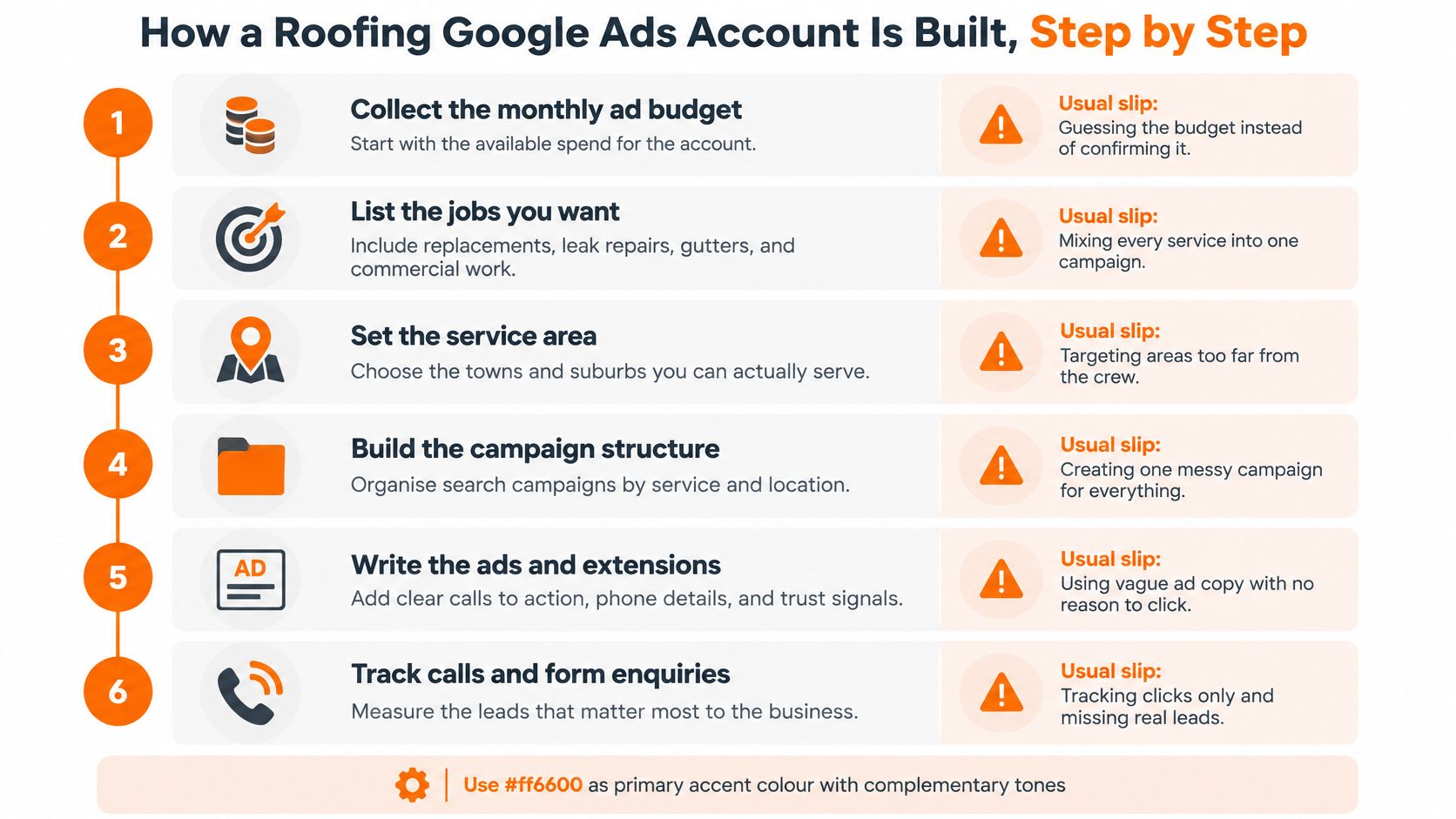
A sensible build starts with your business constraints, not a list of keywords. At Bluelight, we collect the client’s advertising budget and marketing goals during onboarding, so the account reflects the work they want.
The launch sequence
-
Confirm the budget, jobs and service area. List replacements, leak repairs, gutters and commercial work, then identify the suburbs your crew can realistically serve. The usual slip is targeting an entire region without accounting for travel time or available installation capacity.
-
Build a keyword-based Search campaign first. We start every new account this way, keeping service themes in distinct ad groups and excluding broad, irrelevant searches from day one. Start with controlled match types rather than unrestricted broad match; the SemDash guide to keyword match types helps explain what those settings allow.
-
Add remarketing second. This follows up with website visitors while they compare roofers, including visitors who arrived through SEO, blog posts, Facebook or Instagram. Don’t assume everyone is eligible to receive ads: audience availability, privacy choices and platform requirements still apply.
-
Test call and form tracking before launch. Submit a test enquiry, make a test call and confirm that qualified calls and booked inspections can be recorded as meaningful outcomes. Launching first and investigating attribution later leaves you unable to judge the earliest spending.
-
Review actual search terms within the first week. Keywords are your targeting instructions; search terms are what people typed. Add negatives for irrelevant DIY, how-to and employment searches, rather than assuming your original exclusions caught everything.
-
Review cost per qualified enquiry before changing the budget. Check whether callers need a service you offer, live within your area, and are seriously considering work. The common mistake is increasing spend because the dashboard shows conversions without checking what those conversions represent.
The build also needs a clear hand-off between business inputs, campaign organisation and tracking.
What a healthy early account looks like
During the first two weeks, look for relevant searches, traceable enquiries and evidence that calls or quote requests are reaching the business. Those are operating checks, not a guarantee that a new campaign will immediately produce a particular volume.
If enquiries haven’t arrived, investigate eligibility, search demand, targeting and tracking before declaring the campaign unsuccessful. Don’t keep spending with an unexplained fault.
Keep ownership from the start. Our clients retain full ownership of their Google Ads account and data at all times, so changing managers doesn’t mean losing their history.
Roof Flow™ Keyword Strategy by Service
A campaign built around roofing or roof replacement can attract students, DIY readers and apprenticeship seekers alongside homeowners ready to book. The problem isn’t necessarily the keyword itself. It’s the lack of controls around intent.
The Roof Flow™ keyword map separates commercially different enquiries into service groups. Use separate campaigns where a service needs its own budget or geographic control; tightly themed ad groups can sit together while an account is small.
Service keyword groups and landing pages
| Service group | Example search intent | Negative terms to block | Landing page |
|---|---|---|---|
| Roof replacement | roof replacement cost, new roof quote | how to, DIY, jobs, apprenticeship | Replacement service page |
| Re-roof | re-roof near me, reroofing quotes | how to paint, tools, training | Re-roof service page |
| Leak and emergency repair | roof leak repair, roofer near me | how to fix, DIY tarp, jobs | Repair page with phone number at the top |
| Gutters | gutter replacement roofer, roof gutters quote | gutter cleaning DIY, how to clean | Gutters service page |
| Long-run metal and tile | long-run metal roof installer, tile roof repair | metal roofing jobs, training, supplies | Long-run metal or tile page |
| Commercial and membrane | commercial roofing contractor, flat roof membrane | commercial roofing jobs, careers | Commercial service page |
Apply negatives to the searches they make irrelevant. For example, blocking supplies makes sense for an installation-only business, but not for a company that also sells roofing materials.
Separate buying intent from research
The New Zealand digital advertising infographic published by AppLabx puts search advertising at approximately NZD 1.44 billion, or 48.5% of digital advertising spend, in 2025. Search deserves deliberate attention, but that market share doesn’t establish a roofing conversion rate.
When you combine informational traffic with service enquiries, automated bidding can favour easy-to-generate actions instead of commercially useful prospects. A homeowner comparing replacement quotes and someone learning how to patch a shed roof shouldn’t receive the same message or carry the same bidding value.
Material-specific intent also matters. A Commerce Commission roofing-products clearance document cites BRANZ evidence that 70% of new New Zealand homes are roofed with long-run steel, discussing the material across new construction and replacements. Give long-run searches a relevant page rather than burying them under a generic service description.
Expand only where enquiries justify it
Separate Auckland, Christchurch and Wellington targeting where the business serves those markets, with location settings and search-term reviews suited to each operation. Within a region, suburb groupings should reflect travel economics, not just keyword variations.
Review search terms weekly. Remove irrelevant queries and create another group when a distinct service repeatedly appears in qualified enquiries, rather than multiplying campaigns for every possible phrase.
Keep qualified calls, completed quote forms and booked inspections as separate events. Choose the events used for bidding carefully so one prospect progressing through those stages doesn’t appear to be several independent leads.
Bid Strategy, Budget Control and Monthly Reporting
Clicks aren’t a reliable measure of roofing demand. A low-cost visit from a job seeker isn’t better than a more expensive visit from a homeowner who books a replacement inspection.
Cost per qualified enquiry shows what you paid in advertising spend for an enquiry worth acting on. Define qualified with your manager using service fit, location and genuine job intent, then apply that definition consistently.
Match bidding to trustworthy signals
Manual bids give a manager direct control during early testing, but require regular attention. Automated bidding can adjust bids across auctions, although it needs reliable conversion tracking and enough relevant history to make useful decisions.
Don’t optimise towards page views because they’re plentiful. Qualified calls, genuine quote requests and booked inspections are closer to the business outcome, provided the account handles repeat actions correctly.
We use Google Ads, Google Analytics and Google Tag Manager for management and tracking. A Google Ads conversion tracking plan should identify which system records each event, how it’s tested and how duplicate submissions are excluded.
Metrics for a monthly roofing report
| Metric | What it tells you | Warning sign |
|---|---|---|
| Cost per qualified enquiry | Cost of a call or quote request worth acting on | Cost rising while clicks stay flat |
| Qualified enquiry rate | Share of calls and forms that are real prospects | Most calls are wrong-area or spam |
| Search term relevance | Share of spend on service-related searches | Spend on how-to, DIY or job-seeker queries |
| Booked inspections | Enquiries that became a booked inspection | Enquiries that stop before an inspection is booked |
| Estimated revenue | Booked jobs multiplied by average job value | No revenue figure attached to monthly spend |
Treat estimated revenue as an estimate, not collected cash. Where job values differ substantially, use actual quoted or accepted values and show the status beside them.
Pace spending against useful demand
Allocate budget according to qualified opportunities and crew capacity. Before moving money from repairs to replacements, check search terms, call outcomes and whether the replacement enquiries progress.
Change one meaningful variable at a time, then review it after enough relevant enquiries have arrived to support a decision.
Measurement also needs restraint. The Office of the Privacy Commissioner’s cookie policy describes aggregated website analytics and opt-out controls; for campaign operations, collect only the personal information needed for the stated purpose.
Record campaign, available keyword attribution, suburb and call outcome where useful. Avoid copying unnecessary free-text personal details or retaining call transcripts without a clear purpose, access controls and retention policy.
Landing Pages and Local Signals That Turn Clicks Into Calls
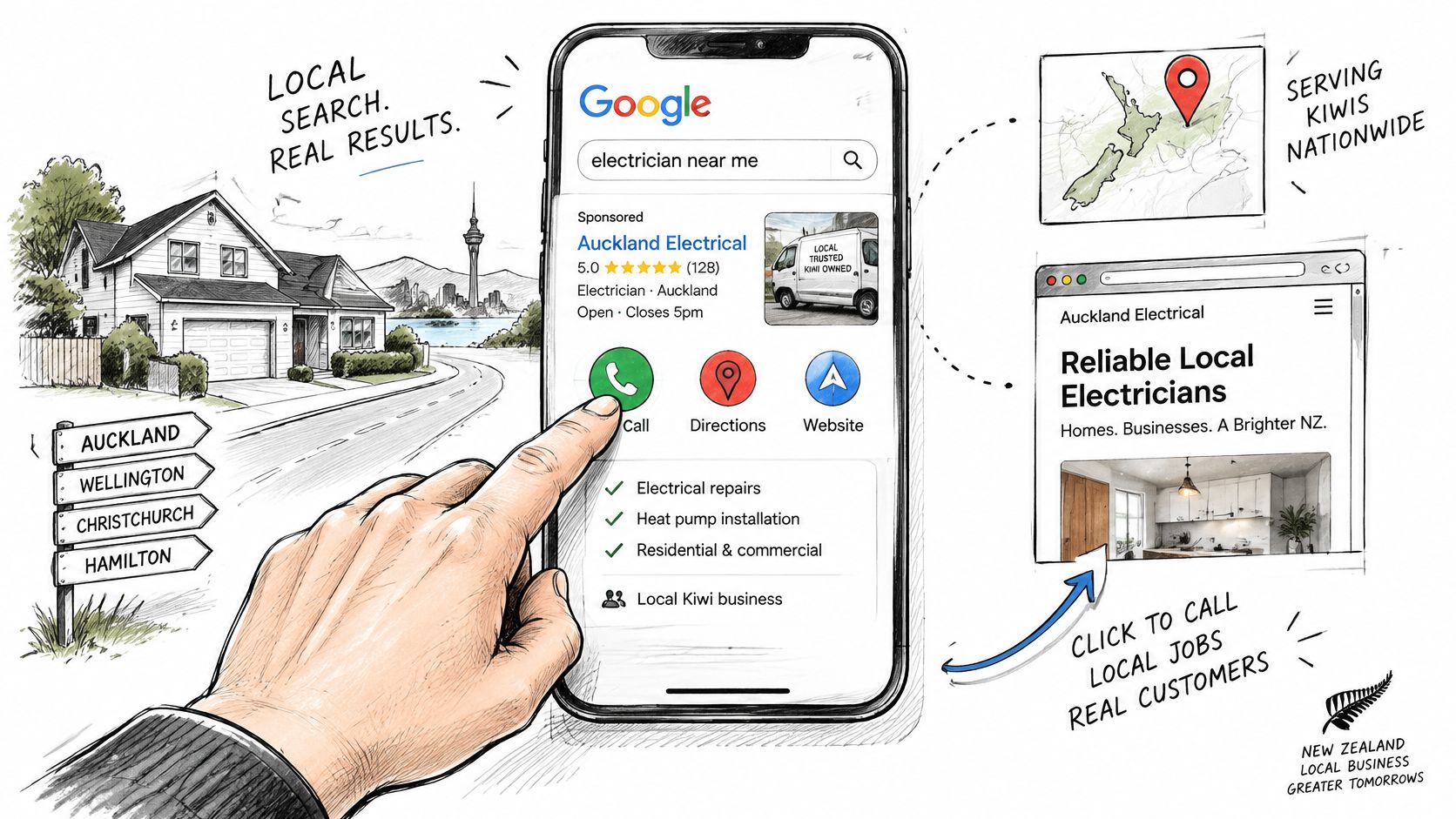
A better bid can’t make a vague roofing page convincing. Google’s New Zealand mobile research found that 22% of smartphone users had searched for local information, and 80% of those users took an action afterwards, including calling, checking a map, getting directions or visiting a website.
The practical test is what a local visitor can verify on their phone.
Check the visitor’s path
- Message match. Open the destination from each ad preview. A Hamilton leak-repair ad should reach a page about that service in that area, not a generic homepage.
- Visible phone number. View the page on mobile and tap the number. Confirm it starts a call without requiring visitors to copy or remember it.
- Local proof. Show genuine project photographs and useful details from named suburbs. Check that captions explain the work, rather than merely naming a location.
- Credentials and guarantees. State relevant qualifications, memberships and guarantees accurately. Make any limitations accessible instead of relying on unexplained badges.
- Consistent service areas. Compare your Google Business Profile, website and ad targeting. Remove contradictory coverage claims.
- A clear next step. Test the quote form yourself, including its confirmation message, and keep a phone option available.
A focused Google Ads landing page should answer the questions a caller needs resolved before getting in touch. If different jobs require different questions, you can build quizzes with conditional logic using Kiwiform, but don’t turn a simple repair enquiry into a lengthy assessment.
Use the video alongside a hands-on check of your own mobile page.
Call your own advertised number during working hours and time how long it takes to reach a person.
Confirm who handles missed calls and whether form notifications reach someone responsible for replying. When relevant clicks are healthy but enquiries are weak, investigate this page-and-response experience before paying more for the same traffic.
What Management Costs and How to Start
There are two separate costs: your advertising budget and the management fee. The advertising budget buys traffic from Google; the fee pays for building, monitoring and improving the system.
At Bluelight, the ad budget is paid directly to Google, separately from the management fee. You own the ad account and control the spend, rather than receiving an unexplained combined advertising bill.
Compare the charging model with the work
A fee comparison is only useful when the scope is comparable. A lower quote that excludes tracking repairs, page edits or meaningful reporting isn’t necessarily a cheaper way to acquire roofing work.
Common management fee models
| Fee model | How it is charged | What to check before signing |
|---|---|---|
| Flat monthly fee | Same fee each month, regardless of spend | Scope and reporting listed in writing |
| Percentage of ad spend | Fee rises as the budget rises | Higher fees with no extra work attached |
| Setup plus monthly retainer | One-off build fee, then a monthly fee | What the setup covers and when the monthly work starts |
A flat fee makes management costs easier to plan, but the included work still needs boundaries. Confirm whether new service pages, additional locations and major tracking rebuilds are included.
With percentage pricing, the fee grows when the budget grows, even if the workload doesn’t. That model can still support a clear arrangement, but a larger invoice should have an intelligible connection to responsibility or additional work.
Setup fees deserve the same scrutiny. Distinguish a genuine build, including testing and documentation, from merely opening an account and importing a keyword list.
Set expectations around your economics
Bluelight clients see an average ad spend of $560 per booked job. That’s an average, not a promise, and it excludes the separate management fee.
Your service mix, margins, competition and ability to convert enquiries into accepted quotes determine whether a campaign works financially. A booked repair and a booked commercial replacement don’t have interchangeable value.
Allow several weeks to assess an emerging trend, while correcting obvious targeting or tracking faults immediately. A manager shouldn’t use a learning period as an excuse for unexplained spending.
Buying rule: A fee purchases defined management work. It doesn’t guarantee leads, inspections or profitable jobs.
Get the scope, reporting frequency and exit terms in writing. The agreement should explain what happens to account access, tracking assets and unfinished work when management ends.
Run these checks this week
- Inspect search terms. Pull the last 90 days and classify visible searches by service relevance. Compare their spend, not just the number of phrases, and remember the report may not expose every query.
- Compare geographic coverage. Check Google Business Profile service areas against the locations your ads target. Identify places the crew can’t serve economically.
- Test attribution. Confirm calls and forms connect to campaigns and, where available, keywords. Record attribution gaps rather than pretending every individual search is visible.
- Put the commercial arrangement on paper. Obtain the fee model and a written scope showing exactly what the ongoing work includes.
Bring last month’s search terms report and your current monthly budget to an account review. Those give the discussion a practical starting point beyond dashboard totals.
Bluelight offers a free 30-minute ad account review covering what’s working, what’s leaking budget, and the two or three moves most likely to change the numbers fastest. Visit Bluelight to arrange your review, and bring last month’s search terms report and your monthly budget so we can examine the account you’re paying for.
Related service Google Ads for Roofers