Remarketing Google Search Ads for Roofers
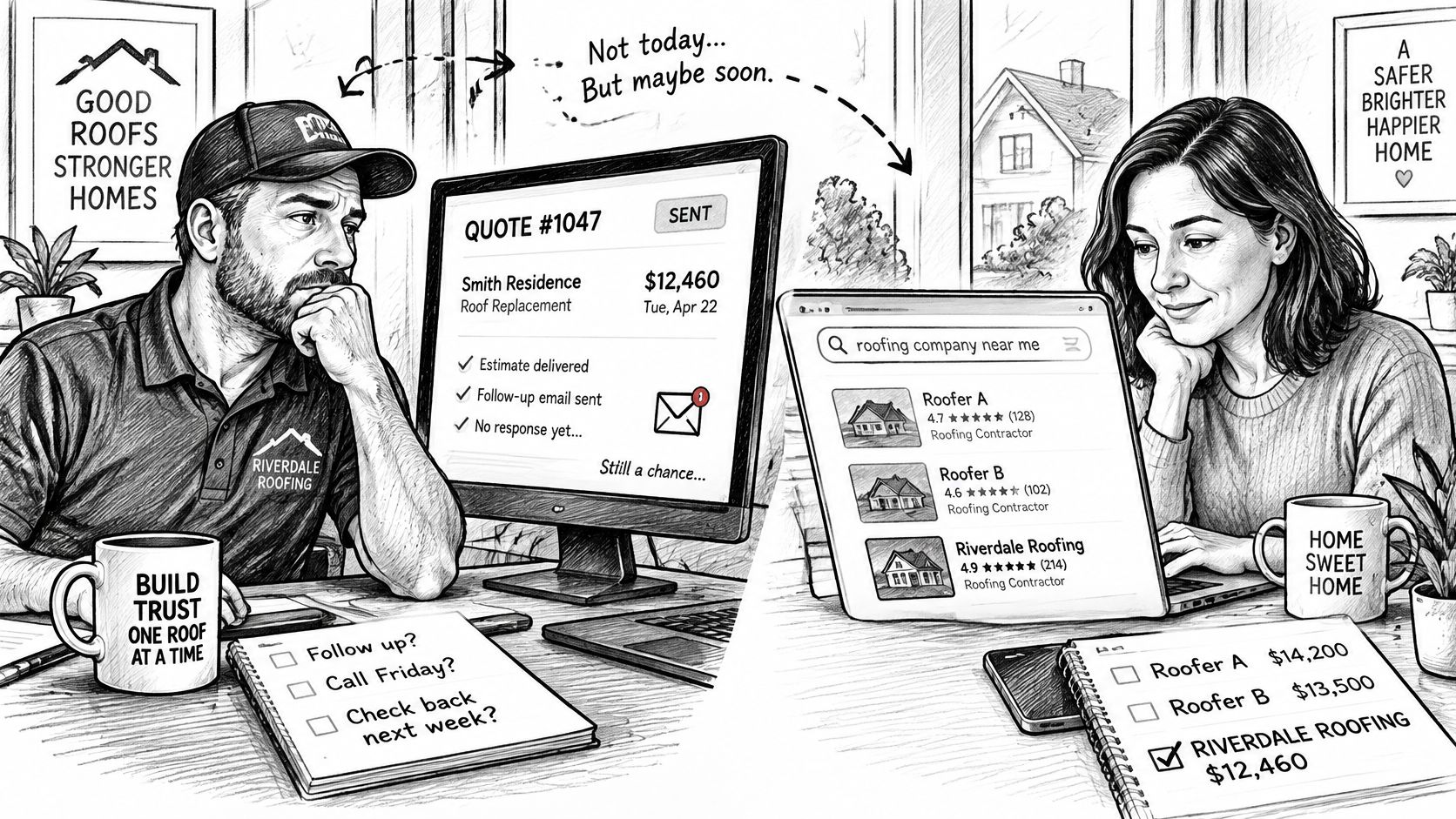
You sent a re-roof quote on Monday, followed up, and heard nothing. Say the homeowner then compares other roofing companies and searches again on Thursday for a roofer in the same suburb. You want to be there for that search, without paying to follow every website visitor around the internet.
That’s where remarketing Google Search Ads can help. The catch is that a leaking roof, a planned replacement and a commercial maintenance contract need different follow-up. Put them in the same audience with the same offer, and you’ll pay more without learning which jobs you added.
Table of Contents
- What Search Remarketing Does for a Roofing Quote
- Roofing Audiences Worth Bidding On Again
- Guardrails for Consent and Fair Return Ads
- How to Set Up Search Remarketing Lists
- How to Tell If Remarketing Added Jobs
- Choose the Two Lists or Book a Review
What Search Remarketing Does for a Roofing Quote
The unanswered quote isn’t automatically a lost job. The homeowner might be discussing the cost with their partner, comparing materials or checking whether another contractor can start sooner.
Remarketing lists for search ads, often shortened to RLSA, let you treat eligible previous visitors differently when they search again. Their earlier visit supplies context. Their new roofing query supplies the immediate intent.
You can use that combination to inform bidding or run a more relevant search-ad strategy. You’re not paying to chase them across news sites just because they looked at your replacement page.
Search lists aren’t display banners
Display remarketing shows visual ads while people browse other websites or apps. Search remarketing works inside a search campaign, when an audience member makes a relevant search. Those are separate jobs, with separate budget decisions.
This distinction matters when someone promises to bring back your website visitors. Ask what will trigger the next ad: another roofing search, or ordinary browsing? A banner impression doesn’t mean the homeowner is comparing roofers at that moment.
The difference between sales follow-up and customer research is easy to miss from the office.
According to IAB NZ figures reported by The New Zealand Herald, Google held 96.8% of New Zealand’s search market in 2024. For a roofer building a return-search strategy, Google Ads is the practical place to start.
Use familiarity without making assumptions
Nick’s point is straightforward: many people don’t say yes the first time. Remarketing gives you a way to stay in the conversation instead of getting forgotten. It doesn’t tell you why someone hesitated, so don’t assume every returning visitor needs a discount.
A homeowner comparing replacements might need a clear inspection process. A commercial prospect might need information about maintenance, access and warranties. For useful background on those differences, JA Edwards of America Roofing explains how commercial roofing works.
Practical rule: Add search remarketing to a campaign that already produces worthwhile enquiries. Don’t use it to rescue weak keywords or a confusing landing page.
The useful outcome is a set of job-specific membership windows, a controlled setup order and a test for extra booked work, not extra views.
Roofing Audiences Worth Bidding On Again
Search remarketing windows for roofing visitors
| Visitor type | Membership window | Bid versus cold search | Message | Stop when |
|---|---|---|---|---|
| Emergency leak or storm repair | Test 3–7 days | Stronger only when qualified-lead economics support it | Same-week crew, suburb named, only when available | Call or form is logged |
| Planned re-roof or replacement | Test 30–90 days | Test a 10–30% raise with compatible bidding | Inspection and written quote | Quote visit is booked |
| Gutters and maintenance | Test 14–30 days | Start flat, raise only after qualification | Gutter or maintenance check | Enquiry is logged |
| Commercial or body corporate | Test 60–180 days | Observe first, then assess against job margin | Maintenance programme and warranty | Existing customer or tender submitted |
| New-build or builder traffic | Match the known procurement cycle | Observe first, bid flat | Trade or new-roof page | They are an existing account |
| DIY, how-to and job seekers | Do not add | Exclude | None | Always excluded |
Copy a relevant row before touching campaign settings. These are illustrative starting tests, not measured New Zealand roofing benchmarks or automatic bid instructions. Choose the window around how quickly that customer needs a contractor, then shorten it when your own enquiry records show interest has gone stale.
Urgent repairs need a quick stop
A leak visitor needs a different follow-up from someone budgeting for a replacement. If you can take repair work, show the suburb, the service and the next available action. Don’t advertise same-week attendance when your repair crew is already committed.
The longer replacement window gives households room to compare scope, materials and timing. A calm offer for an inspection and written quote is more useful than carrying emergency language into a planned purchase.
Gutters and maintenance sit between those jobs. Keep the offer specific enough that the office can recognise what the caller wants, rather than fielding a vague request for anything roof-related.
Commercial work needs its own decision
Stats NZ’s September building-consent release recorded 34,882 new dwellings consented in the year ended September 2025, up 3.6%, while non-residential building consent values reached NZ$8.7 billion in the year ended August 2025, down 5.4%.
Those are construction-planning signals, not forecasts of your leads. They reinforce the need to assess residential and commercial opportunities separately, rather than attaching a residential special to every returning visitor.
A commercial prospect may need scope documentation, maintenance scheduling and warranty terms. A builder may need capacity and trade coordination. Neither should enter the emergency-repair follow-up because they visited the same website.
Apply clear exclusions:
- Qualified enquiries: Stop acquisition remarketing when the office logs a genuine enquiry. Continue quote follow-up through the appropriate sales process.
- Existing customers: Keep warranty and customer-service visits out of prospect acquisition.
- Research-only traffic: Exclude identifiable DIY, how-to and employment interest rather than paying extra for familiarity.
- Overlapping services: Give the clearest recent service interest priority, so one visitor doesn’t receive conflicting offers.
Small sites should start in Observation, which preserves ordinary search reach while allowing audience reporting. Treat roughly 1,000 eligible members as a planning checkpoint, not a guarantee of service eligibility; confirm the current Search eligibility status in Audience manager before building an audience-only campaign.
Choose the two rows that match this month’s crew capacity. More lists aren’t useful if the office can’t classify the resulting calls.
Guardrails for Consent and Fair Return Ads
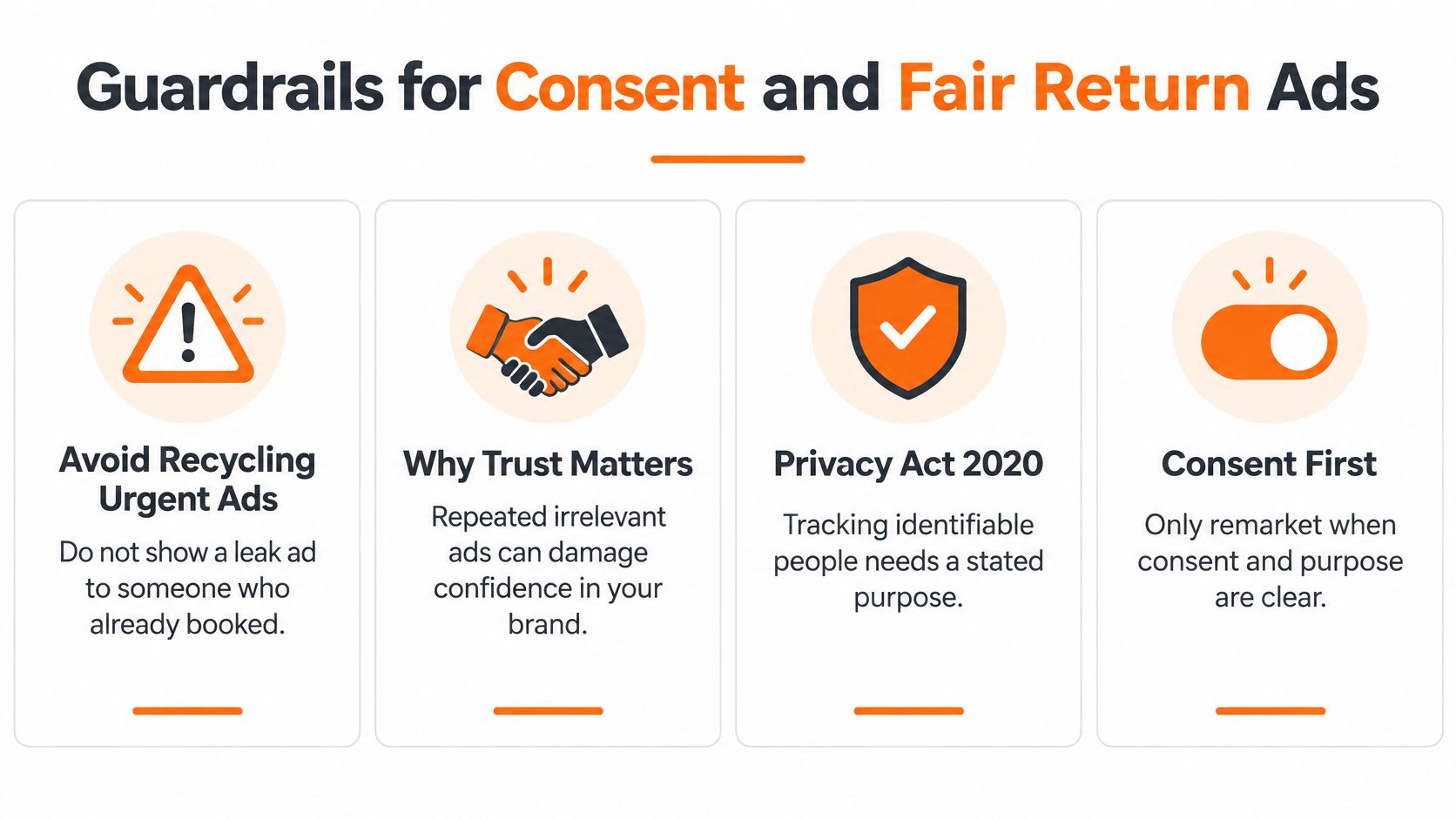
A homeowner books a leak investigation, then keeps seeing urgent repair advertising from your company. That makes your follow-up look disconnected from your office, especially if the ad promises availability you no longer have.
Privacy and suppression rules belong before audience creation. Supermedia’s guidance discussing the Privacy Act 2020 explains that tracking identifiable individuals can fall within the Act, collection should serve a necessary lawful purpose, and materially different advertising reuse of analytics information may require consent.
Make the purpose clear before collecting
Write Google Ads remarketing into your privacy notice in plain language. Explain what information you collect, why you collect it and how people can exercise their choices. Don’t hide advertising use inside a vague statement about improving the website.
Use a consent-aware tag configuration where practical. Consent Mode communicates consent choices to tags; it doesn’t replace a proper notice, a lawful basis or a functioning consent interface.
Use this checklist before anyone builds the audiences.
- Customer uploads: Don’t upload identifiable customer lists unless the business has a lawful basis and appropriate disclosures.
- Separate purposes: Keep prospect acquisition apart from warranty, service and existing-account activity.
- Test choices: Check accepted and declined consent states, not just whether a tag appears in the browser.
Make the return visit useful
Search doesn’t offer the same frequency controls as display advertising. Manage repeated exposure through sensible membership windows, exclusions and relevant query targeting, rather than looking for a Search frequency-cap setting.
Send people to the service they were considering. A replacement visitor should land on a replacement page with inspection details, not a homepage that makes them start again.
Keep advertising aligned with what the business can deliver:
- Seasonal offers: Refresh the copy when the offer or service conditions change.
- Storm capacity: Pause urgent storm messaging once your backlog makes the promise unrealistic.
- Mobile enquiries: Check the ad, landing page and tap-to-call function on a phone.
- Completion signals: Test enquiry exclusions so a booked customer doesn’t remain in acquisition follow-up.
Relevant follow-up should make the next step easier. It shouldn’t remind customers that your advertising doesn’t know they’ve already called.
How to Set Up Search Remarketing Lists
Build the tracking and exclusions before making any bid changes. If this is a new account, get ordinary keyword search producing useful enquiries first. At Bluelight, we start new accounts with keyword-based search and add remarketing as the second campaign type.
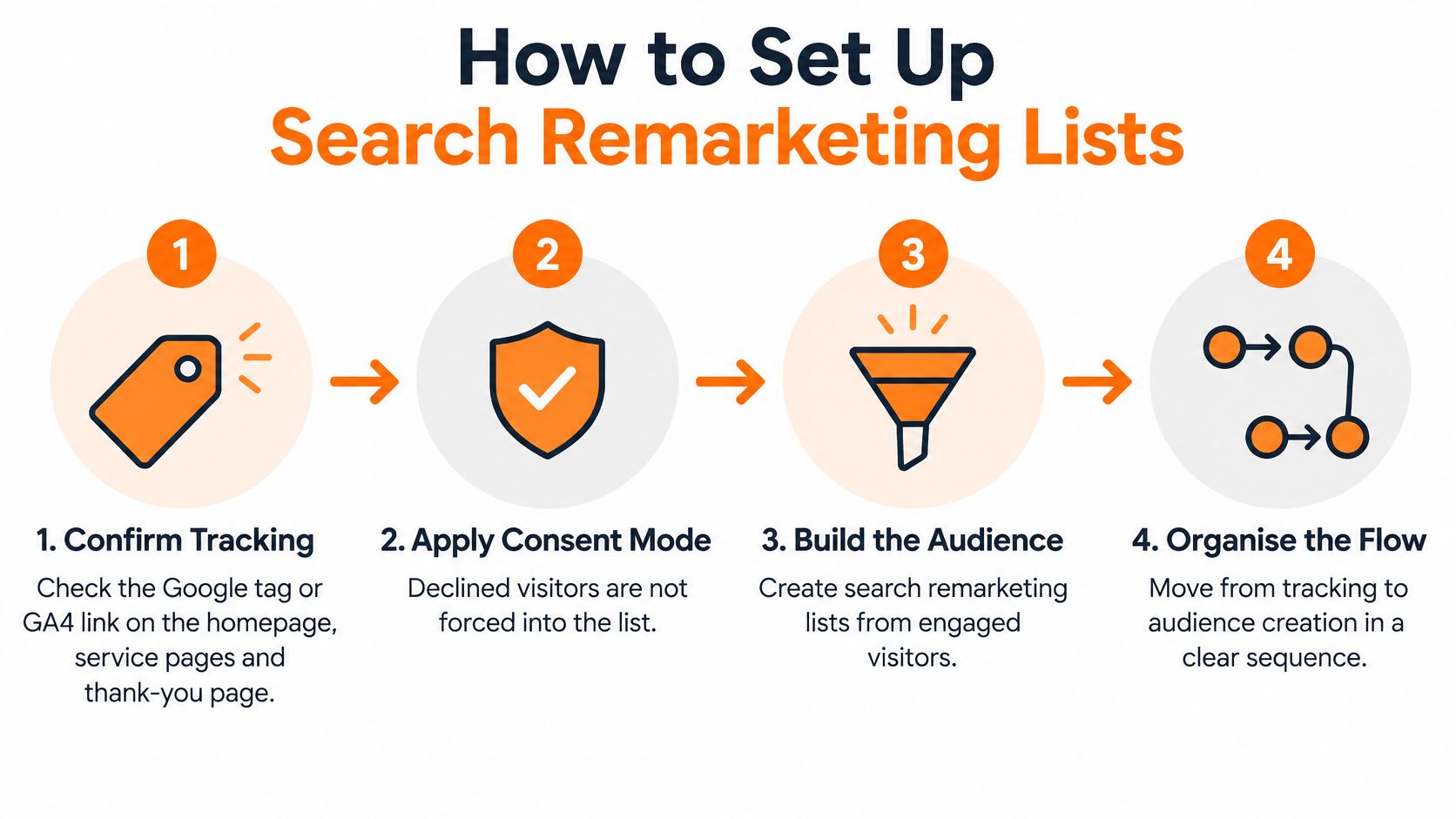
The build needs a clear sequence, rather than a collection of tags installed independently.
Build the signals before changing delivery
-
Confirm the Google tag or GA4 connection. Check the homepage, each relevant service page and the thank-you page. Confirm that the correct Google Ads account is connected and test consent behaviour on an actual visit. A tag firing isn’t proof that audience collection and advertising permissions are configured correctly.
-
Build service-based audiences in Audience manager. Use service URLs or suitable GA4 events to distinguish repairs, replacements, gutters and commercial interest. Apply the membership rules you chose for each job. Avoid making every audience a lightly renamed copy of all visitors.
-
Create the converter exclusion. Use successful form submissions and tracked, qualified calls, not clicks on a submit button or a phone number alone. Check that a form event fires only after successful submission. If these distinctions aren’t clear, fix conversion tracking before asking Google to optimise around them.
-
Add the audiences in Observation first. Leave the proven campaign’s keywords, locations and basic reach intact. Observation lets you inspect audience performance without restricting the campaign to previous visitors. Observation comes before bid raises, not after them.
Turn audience evidence into a controlled test
-
Check eligibility and bidding compatibility. Wait until Google Ads shows that the list is eligible and you have enough qualified outcomes to judge it. With compatible manual bidding, test the table’s bid stance only when the economics support it. With Smart Bidding, don’t assume a manual audience percentage will control bids in the same way; use the audience signal and assess the strategy’s actual results.
Set an affordable click ceiling from your own lead and job economics. A returning visitor isn’t permission to exceed what a profitable cold-search click already justifies.
-
Create a controlled return-visitor ad test. Write responsive search ad copy around the relevant next action: inspection timing, the suburb served and a direct contact route. Don’t imply that you know the person visited. Adding an ad to an Observation ad group won’t reserve it for that audience, so use an intentionally audience-targeted structure when eligibility and volume justify audience-specific delivery.
-
Clean up search terms. Review negatives for jobs, apprenticeships and DIY intent. Assess terms such as free and cheap against the actual query before excluding them broadly, particularly if you offer free quotes. Audience membership doesn’t make an irrelevant search worth buying.
-
Validate the complete journey. Use Google Tag Assistant and Google Ads diagnostics to check audience membership, consent signals, exclusions and conversion events. Submit a test enquiry, verify that it reaches the office, and confirm that the converter becomes ineligible for acquisition follow-up.
A visual walkthrough can help you recognise the workflow in the interface.
For an initial controlled test, I would leave unrelated settings unchanged for a fortnight. Fix broken tracking or misleading copy immediately, but don’t simultaneously rewrite landing pages, broaden keywords and change bidding, then credit the audience list for whatever happens.
Record the launch conditions in the account notes. Include the audience rules, exclusions, bidding strategy and the outcome you expect the office to qualify.
How to Tell If Remarketing Added Jobs
View-through conversions aren’t proof of booked roofing work. They can be a secondary diagnostic in broader remarketing reporting, but an impression followed by an enquiry doesn’t establish that the ad caused the job.
Judge search remarketing through qualified enquiries and won work. Separate the question of whether returning visitors convert from the harder question of whether your extra advertising changed their decision.
What to trust when judging search remarketing
| Signal | Use it for | Do not use it for | If it looks wrong |
|---|---|---|---|
| Click-assisted qualified leads | Primary success check | Vanity traffic | Fix the query or the landing page |
| Quote-ready calls and forms | Crew capacity | Raw click volume | Tighten the window or the offer |
| Cost per won job | Keep or cut the list | Weekly mood checks | Lower the bid raise or pause the row |
| View-through conversions | Secondary hint only | Booked-work claims | Remove them from booked-work reporting |
| Holdout lift | Extra jobs versus no ads | Small accounts | Skip it until return volume is steady |
| Membership size | Whether Search can serve | Proof the ads work | Stay in Observation while the list is ineligible |
Diagnose the result before cutting the list
Compare returning and cold visitors on equivalent keywords, locations and service types. Use a stable review period that allows enquiries to progress to quotes, rather than comparing a repair-heavy week with a replacement-heavy one.
If returning visitors convert more often but cost more per qualified lead, reduce the bid premium before abandoning the audience. You may be paying too much for a useful group.
If an eligible audience produces little response, inspect the actual queries and offer. Familiarity won’t help if the search is irrelevant or the ad gives a returning homeowner no useful reason to choose you.
When calls arrive but the office reports tyre-kickers, listen to the enquiries. An overlong window, a weak offer or a failed exclusion can each create poor results, but so can loose keyword matching.
Connect mobile research to office outcomes
The 2026 New Zealand digital marketing industry report says 94% of New Zealanders access the internet via mobile, and estimates that Local Pack ads appeared in about 1% of mobile searches in 2025 versus 22% in 2026. That Local Pack comparison is one industry report’s estimate, not a verified New Zealand benchmark, and shouldn’t justify budget moves on its own.
Keep call tracking, Google Business Profile activity and location-level reporting alongside audience reporting. Consent declines, device changes and telephone enquiries mean you won’t observe every step.
Good marketing attribution connects the enquiry to its commercial outcome without pretending the visible path is complete. Have the office mark qualified enquiries, inspections, quotes and won jobs, then import suitable offline outcomes into Google Ads using a lawful, appropriately disclosed process.
Decision test: A better conversion rate describes the audience. A controlled comparison helps establish whether the extra advertising added work.
Use a holdout only when return-search volume supports a meaningful split. Keep ordinary search available to the control group and withhold the remarketing treatment, rather than comparing advertising against no business visibility at all.
There’s no validated New Zealand roofing remarketing success rate to use as your target. Review cost per won job monthly, allowing for delayed decisions, and keep a table row only when it lowers that cost or fills a crew gap cold search missed.
Choose the Two Lists or Book a Review
If your search campaign already produces quote-ready calls, choose the short leak list and the longer re-roof list this week. Put both in Observation, confirm the converter exclusions and give the office a clear way to identify which service each enquiry needs.
Leave other campaign types alone while you establish whether those audiences deserve different treatment. You don’t need a wider advertising mix to answer a narrow question about returning searchers.
Choose according to the account you have
- The calls are worthwhile: Build the audiences and preserve the campaign that’s already working. Make any later bid or messaging test specific enough to evaluate.
- The calls are mostly how-to questions: Fix search terms, negatives and landing-page expectations before paying more for returning visitors.
- The office can’t identify won jobs: Repair the outcome tracking first. Otherwise you’ll optimise towards whichever form submission is easiest to generate.
The most expensive mistake is mistaking activity for progress. A growing list, more repeat clicks and a busier dashboard can all coexist with an unprofitable quoting workload.
Keep control of the decision
You should be able to inspect the account, understand the spend and retain the information your advertising generates. Our clients keep full ownership of their Google Ads account and data at all times. Ad spend is paid directly to Google, separately from the management fee.
That separation makes the decision clearer: assess the advertising cost against the jobs won, then assess management against the work required to improve it. Don’t let a combined invoice hide either question.
If you’re comfortable making the changes, create the two Observation lists today and record the test conditions before touching return-visitor bids. If you’re not sure whether the foundation is sound, get the account reviewed first. There’s little value in building careful follow-up around search traffic you shouldn’t have bought.
Bluelight offers a free 30-minute ad account review covering what’s working, what’s leaking budget and the two or three moves most likely to change the numbers fastest. Visit Bluelight to book a review and check whether search remarketing is your next useful move, or whether keywords and tracking need attention first.
Related service Google Ads for Roofers