How to Set Up Remarketing Search Ads for Roofers
A homeowner notices a drip under the gutter at lunch, searches “roof leak repair”, and opens two local sites before heading back to work. That evening the stain is still on the ceiling, so they search again, this time with a suburb and a clearer job type. If your business isn’t in that second result, the call often goes to whoever is.
Remarketing search ads exist for that moment. They don’t spray banners across random websites. They let you bid and write differently when someone who already visited your site types a related query on Google.
Table of Contents
- Why Remarketing Search Ads Fit the Roofing Buying Journey
- Building Audiences From Your Website Visitors
- Privacy and Consent Rules for Remarketing Lists
- Bid Adjustments Versus Separate Campaigns
- Writing Ad Copy for Returning Searchers
- Measuring Results and Pacing Bids to Crew Capacity
- Your Next Step Before Spending on Remarketing
Why Remarketing Search Ads Fit the Roofing Buying Journey
That lunchtime visitor rarely books on the spot. They compare a repair with a partial replacement, ask a partner, and check whether the leak can wait until payday. Nick puts it plainly: customers don’t say yes the first time, and remarketing lets you stay in the conversation instead of getting forgotten.
Search is the right place to do that in New Zealand. It is the country’s largest digital advertising category. The IAB New Zealand digital advertising revenue report put total digital advertising revenue at NZ$2.967 billion in calendar year 2025, up 12% on 2024. Search generated about NZ$1.44 billion, also up 12%, and accounted for roughly 48.5% to 49% of all digital advertising revenue, more than twice the share of any single video or display category. That figure is an industry estimate. Google doesn’t publish revenue by country or product, so the market is built from company reports, research estimates and publisher data.
Why the second search is worth more
The same report’s longer view shows this isn’t a one-year spike. Quarterly interactive ad measurement has run here since 2007. In the second quarter of 2013 the combined Search and Directories category was NZ$52.42 million, a 28% lift on the quarter before. By the third quarter of 2023, total digital advertising revenue was NZ$534.8 million, up 7.3% year on year, with search up 11.3% and social up 20%, as covered in New Zealand’s Q3 2023 digital advertising results. Categories aren’t identical across those years, but the direction is obvious. Search is where expensive, considered roofing decisions keep returning.
A past visitor searching “metal roof replacement North Shore” is not a cold click. They already know your name, and the query tells you which job is still open.
Staying useful across that gap is the same discipline teams use when they improve engagement throughout the customer lifecycle: match the message to where the person is, not where you wish they were.
This channel suits a pipeline that already gets site visits and can answer the phone. It does not suit a crew with no capacity, or a site with no tracking. If those two are in place, the work is to reconnect with repair, replacement, gutter and commercial visitors when they search again, then judge the ads on accepted quotes and booked inspections, not on clicks.
Building Audiences From Your Website Visitors
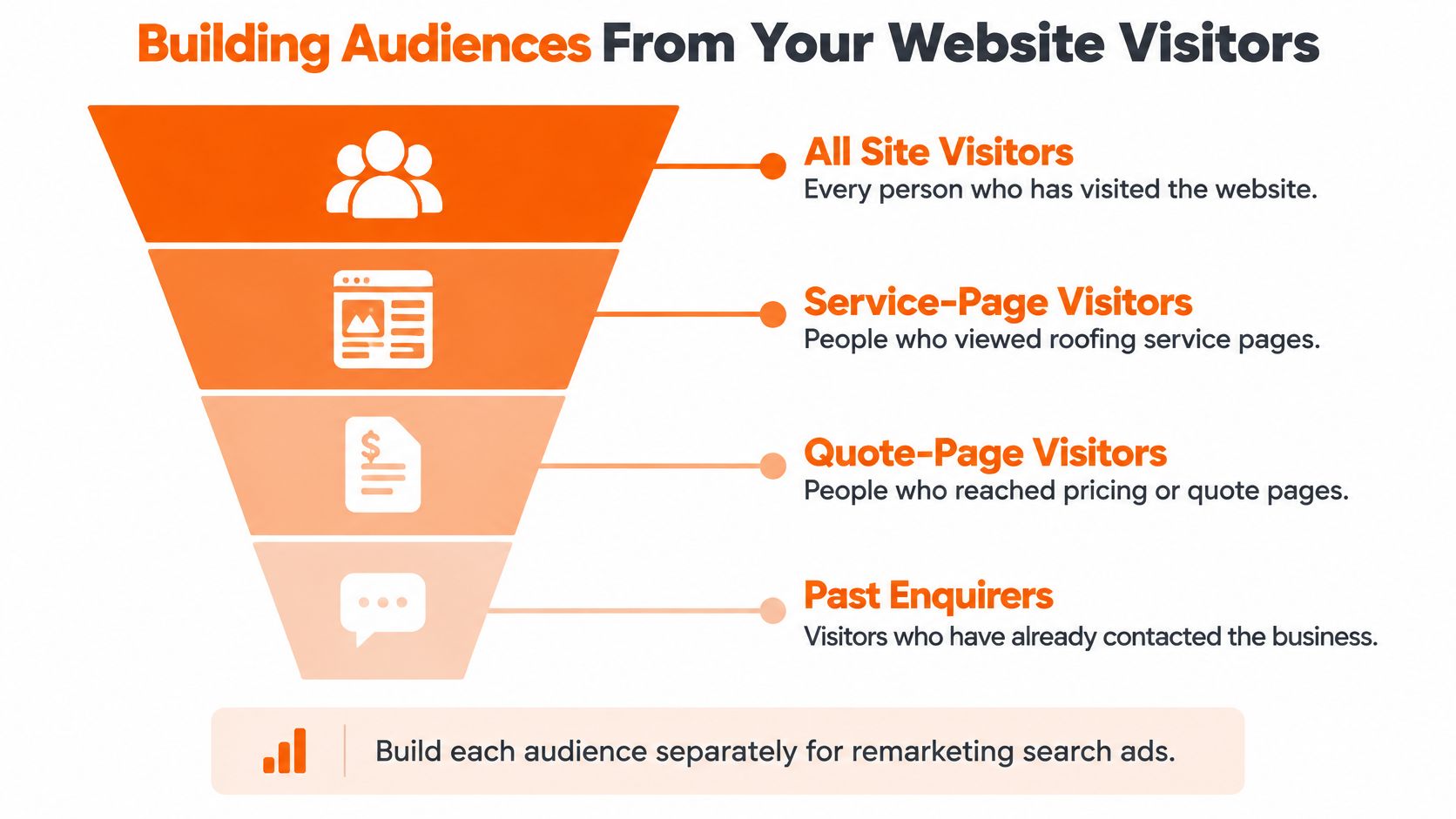
Treat remarketing search ads as a controlled bid-and-message layer. They don’t invent extra reach on their own. The lists only work if the tag fires first and each list matches a real job type.
Tracking before lists
Install Google Ads conversion tracking, Google Analytics and Google Tag Manager, and confirm calls and quote forms are recorded. Bluelight follows up with everyone who visits the website, not only people who arrived from Google Ads. That includes visitors from SEO, blog posts, Facebook and Instagram. If the tag only sits on the ad landing page, you miss the rest.
Google allows pixels to build remarketing lists, but collection and use sit under Google Ads policies, with extra limits on where remarketing can run. Keep ordinary service pages (repairs, reroofing, gutters, metal roofing) separate from anything sensitive, and check that Google accepts each list. A clear walk-through of how retargeting ads on Google differ from display banners helps the person running the account avoid mixing the two.
Four lists, in this order
- All site visitors. Everyone with a recent visit. Use it as a baseline, not as your only list. A blog reader and a quote-page visitor don’t deserve the same bid.
- Service-page visitors. Split repairs, metal or long-run roofing, gutters and commercial. A leak page visit is a different job from a reroof guide.
- Quote-form starters. People who opened the form or the pricing page and didn’t finish. They’ve shown intent and a hesitation.
- Previous converters. Completed enquiries and confirmed customers. Keep them off generic “get a quote” ads when you want new jobs. Build a separate maintenance or upsell list only if repeat work is worth the crew time.
Windows and Observation mode
Keep the membership window short for urgent leak visitors, often days rather than months, because the job is either booked or patched. Stretch it for replacement and commercial research, where comparing quotes takes longer.
Apply the lists to your high-intent Search campaigns in Observation mode first. Observation doesn’t limit who can see the ads or which queries can trigger them. It reports how visitors perform against everyone else. After a useful stretch of data, compare audience and non-audience results by search term, device, location, lead type and qualified-lead rate, not click-through rate alone. Only then raise a bid or split a campaign.
Practical rule: If you can’t name the page someone viewed and how recent that visit was, you don’t have an audience yet. You have a blob of traffic.
Privacy and Consent Rules for Remarketing Lists
A roofing enquiry can sit unanswered for weeks while the homeowner rings two or three other companies and weighs up quotes. Remarketing keeps you visible across that gap, but only if the list behind it is defensible. New Zealand’s Privacy Act 2020 can apply when personal information is collected, matched, uploaded or reused for targeted advertising, including remarketing audiences. The Privacy Commissioner’s guidance on the Privacy Act gives the working test: use personal information for the purpose it was collected for, protect it from loss or unauthorised access, and let people ask for access to what you hold.
Anonymous visits versus enquiry records
A cookie dropped on a service page is not the same as a customer list. Anonymous visitors can sit in a remarketing audience when your privacy notice covers cookies, advertising identifiers, analytics and audience creation, and when your setup honours whatever consent choices it offers. Google’s own ad policies also carry conditions for remarketing lists and personalised advertising, so read the current policy text before you build or upload a list rather than assuming the website notice covers everything.
Uploading emails or phone numbers from old quote forms is a different decision. The same purpose test applies: a record gathered to price a leak was collected for pricing, not advertising. If the form said nothing about marketing use, the safe move is a fresh opt-in or leaving that file out of the upload.
New Zealand privacy guidance says collect personal information only for a lawful purpose, only when it’s necessary, and in a way that’s lawful, fair and not unreasonably intrusive. People should be told why you collect it and what you’ll do with it. The quick tour of the privacy principles supports a tight form: name, contact details, property location and job description. Every extra field is another thing you have to justify and protect.
Filters that keep the list honest
- Match the notice to the tags. If your privacy notice doesn’t mention advertising cookies or audience building, fix the notice before the list grows, not after a complaint.
- Strip what you don’t need. Remove records collected for another purpose and any unsuitable rows before an upload. When in doubt, leave it out.
- Separate direct messages. The Unsolicited Electronic Messages Act 2007 bans unsolicited commercial electronic messages with a New Zealand link. A commercial email or text needs consent and a free, working unsubscribe that should keep working for at least 30 days. An unsubscribe withdraws consent five working days later. Those rules hit email and SMS, not an ordinary Search ad, but they apply the moment you follow an enquiry list with a promo text.
Recency has a consent angle too. A visitor cookied last week agreed to your current notice. A customer row from two years ago may predate it entirely. Audit the audience weekly by landing page, device and traffic source, document retention and deletion, limit who can export lists, and use secure uploads. If the notice, the form and the tag disagree, fix that before you touch a bid. A list built on shaky consent is budget a stretched crew never gets back.
Bid Adjustments Versus Separate Campaigns
Once a list is legal and large enough to learn from, the next choice is structure. Three levers matter: a bid adjustment on an existing campaign, a separate remarketing-only campaign, and exclusions that stop converters seeing acquisition ads.
Bluelight starts every new Google Ads account with a keyword-based search campaign, then adds remarketing as the second campaign type. Roofers are better off staying with those two types before experimenting with anything else. The search campaign stays the clean baseline. Remarketing is the layer you judge against it.
What each lever is for
A bid adjustment on a high-intent Search campaign is the lightest change. Observation stays on, reach stays wide, and you pay more only for a named audience, such as quote-page visitors on replacement terms. Use it when the audience converts to qualified leads at a better rate than cold traffic and the extra cost still leaves a job worth taking.
A separate campaign uses Targeting, so ads can show only to people on the list who also match your keywords. That’s useful when you want broader queries, a different headline, or a commercial landing page that you’d never fund for a stranger. It’s a poor default. A thin list, or Targeting switched on by accident, starves the campaign.
Exclusions are the control most accounts skip. If you want new jobs, keep recent converters off acquisition ads. If maintenance, gutter cleans or a second building is profitable, give those people their own list and their own message. Don’t mix “book a new reroof” with “you’re already a customer” in one ad group.
| Approach | Best used when | Main risk |
|---|---|---|
| Bid adjustments | You want new jobs and a clean read on whether past visitors beat cold search | Raising bids before qualified-lead data exists, so you pay more for tyre-kickers |
| Separate campaigns | Repeat or commercial work needs its own copy, keywords or landing page | Reach collapses because the list is small or Targeting was unintentional |
| Exclusions | Converters would otherwise keep seeing “get a quote” ads | Cutting a maintenance opportunity if you have no second list for repeat work |
Raise the bid only when the extra cost still produces accepted quotes or booked inspections you can actually crew. A higher click-through rate on its own doesn’t pay wages.
Compare audience and non-audience performance on lead type and qualified-lead rate. Keep the adjustment, or the second campaign, only while that incremental cost stays sustainable after you’ve checked call quality and duplicate leads.
Writing Ad Copy for Returning Searchers
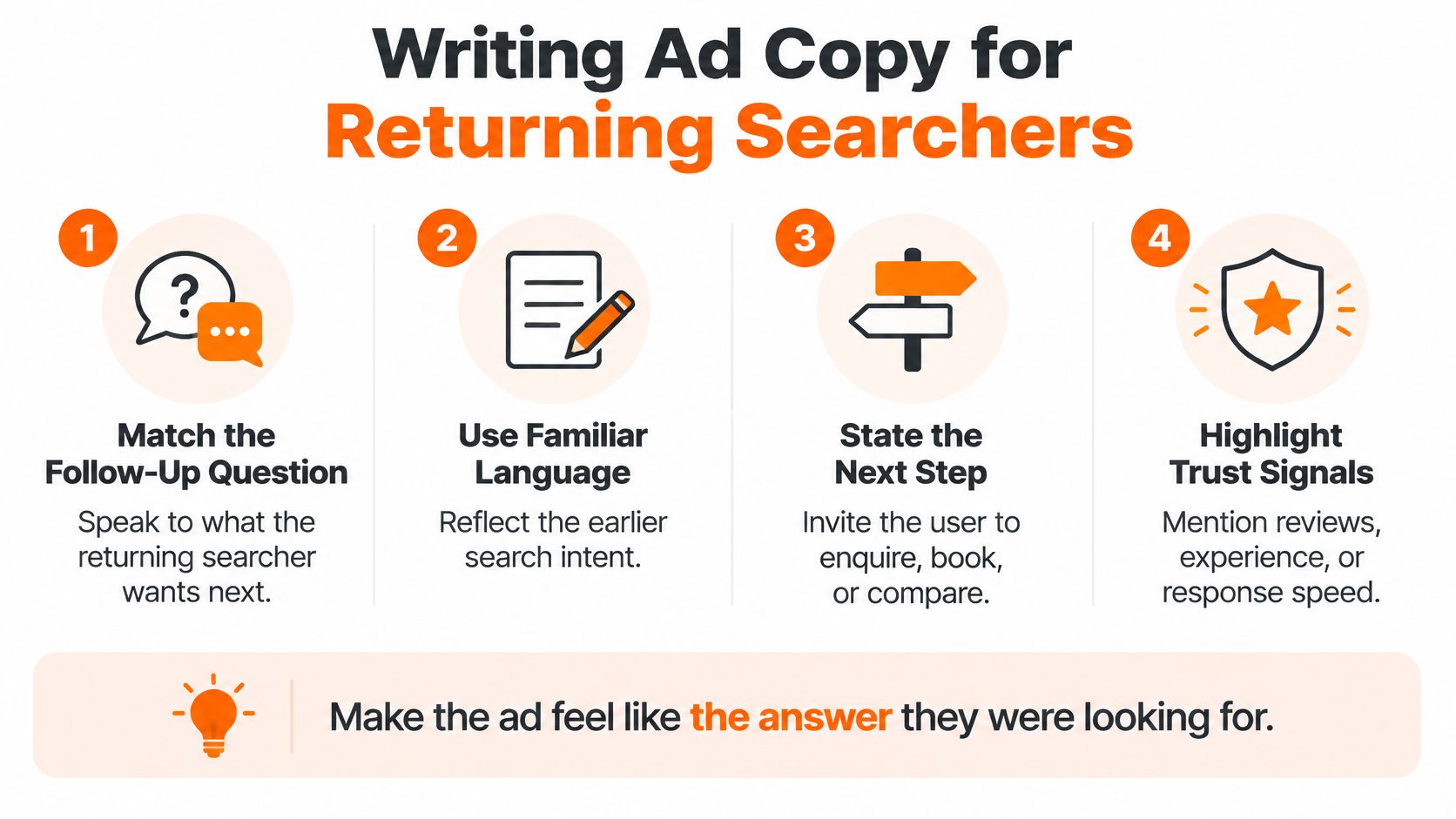
A returning searcher usually isn’t asking “what is a roof”. They already saw your service. They want to know if you’re the crew to call, how fast you respond, and whether you do their specific job in their suburb.
A 2025 IAB New Zealand poll shows why that second search isn’t always a typed Google query. 82.4% of respondents used a search engine several times a day, and 96.8% named Google as their main engine. 48.4% had used voice search, 33.2% had tried visual search, and 39.2% had used an AI chatbot instead of a traditional search engine at least once. Someone may start with “roof leak repair Auckland”, later ask a phone about urgency, and come back on a branded or service-specific query. Headlines still have to answer in plain words, because voice and chat don’t reward clever phrasing.
Copy by the job they already looked at
Leak and repair visitors need speed and scope. “Roof leak repair today, Auckland crews” beats a generic “quality roofing solutions”. Say whether you handle emergency callouts, and send them to the repair page, not the homepage.
Quote starters looking at replacement already know the category. Talk about the decision they stalled on: metal versus tile, what’s included in the quote, how soon an estimator can visit. “Reroof quotes with a site visit, not a guess” is more useful than another discount line.
Commercial visitors are often comparing contractors for a building, not a bungalow. Name commercial roofing, access and a project conversation. Don’t reuse the residential “free quote in 60 seconds” line if the job needs a site measure and a programme of work.
The valuable test is a second search that reveals a different job or suburb from the first visit. A repair visitor who later searches “long-run roof replacement” should see replacement copy and a replacement page. Location-qualified lines matter more than a slogan.
A short copy check before you launch
- Match the follow-up question: Answer urgency, price clarity or fit, whichever they didn’t get on the first visit.
- Use their words: Repairs, gutters, metal, commercial. Don’t invent a new name for the service.
- State the next step: Call, book an inspection, or request a quote. One action.
- Put the proof in the asset: Reviews, years on local roofs, or how quickly you answer. One proof, not a pile.
- Align the page: The headline’s promise must be the first thing on the landing page.
If the ad says emergency repair and the page opens with a reroof gallery, you’ve paid for a mismatch.
Measuring Results and Pacing Bids to Crew Capacity
The usual advice is to bid up for anyone who has visited. That’s how you fill a diary you can’t service, then burn the margin on jobs you have to turn away.
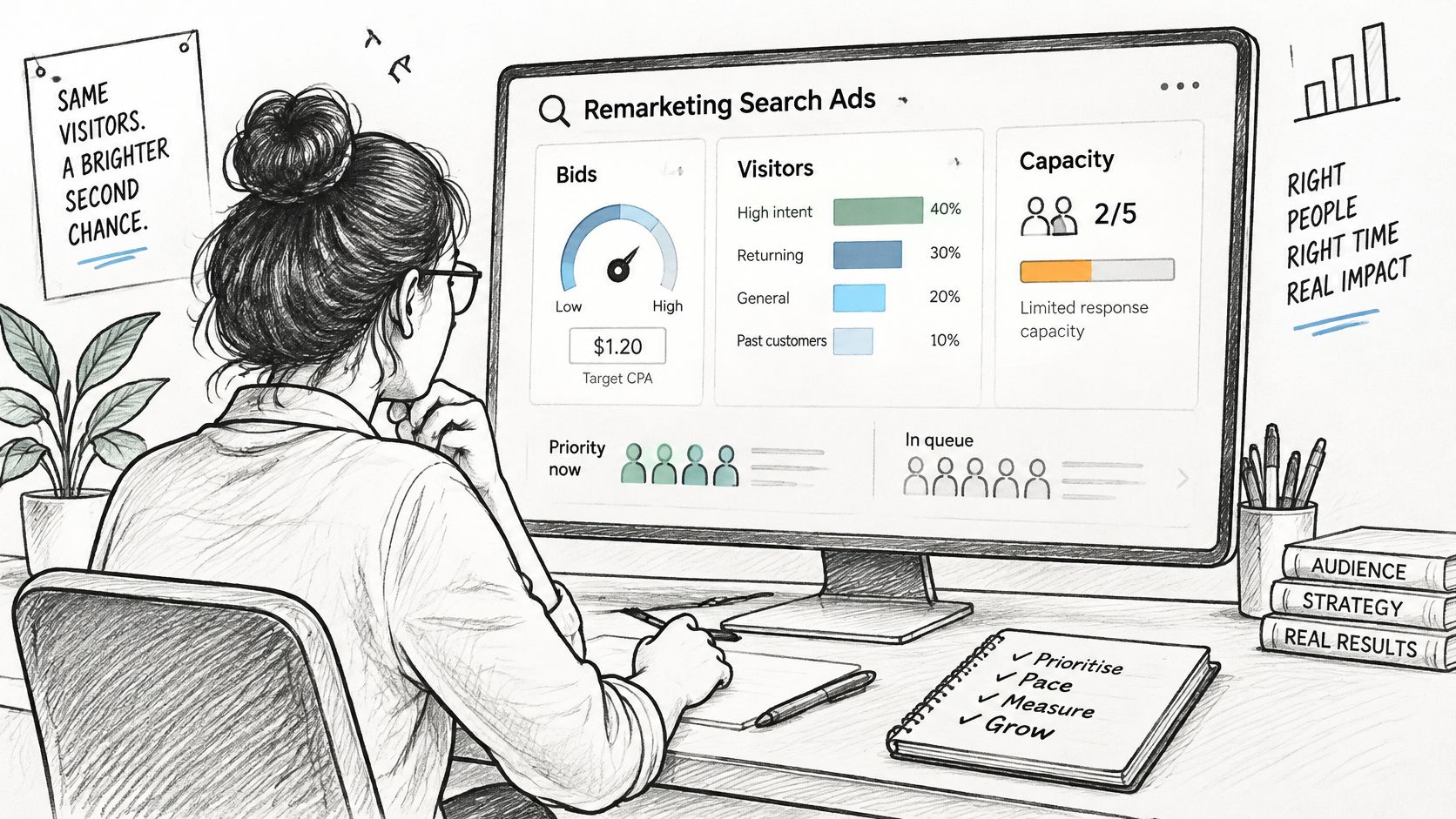
Remarketing search ads work when the pressure matches crew capacity and the buying cycle. Urgent leak visitors need a short window and a fast answer. Replacement and commercial prospects can sit longer, with a calmer message and a project page. When estimators are booked out, cap frequency or pause the acquisition lists. Point high-value commercial traffic at a project page only if someone can take the call.
Consent activity is context, not a lead forecast
Building-consent volumes are a planning signal, not a count of reroofs. MBIE’s building consent monitoring to June 2025 recorded 60,383 residential applications and 12,448 commercial applications processed in the year ended June 2025. In the second quarter of 2025, 19,186 applications were processed, with a median of 12.6 working days, and 93.9% of residential applications were processed within statutory timeframes. Consent-linked work often has a longer consideration period than an urgent leak search. Use that to set different windows. Don’t use it to predict next month’s quote volume.
What to count each week
Benchmark tables that average every industry together won’t tell you whether a roofing remarketing list is paying. Your test is simpler: more accepted quotes or booked inspections at a cost you can live with, after call-quality and duplicate checks.
One number beats a dashboard here: cost per accepted quote.
Look past last-click conversions. Compare assisted conversions, qualified calls, site visits and booked inspections. If you don’t yet trust the numbers, start with what conversion tracking has to capture before any bid moves. A quick Expressify AI website traffic check is a useful outside view of whether the site even has the volume for short, service-specific lists.
Each week, before you change a bid, check three things: audience eligibility, consent rate, and whether the leads were real roofing opportunities. Raise bids in small steps, and only while estimators can still see a new enquiry within a day or two. If eligibility or consent drops, fixing the tag beats raising the bid.
Your Next Step Before Spending on Remarketing
Don’t open a remarketing search campaign because a setting is available. Run a short sequence and stop if a step fails.
Confirm call and form tracking, and make the privacy notice, the quote form and the tag say the same thing about cookies and advertising use. Build two or three lists only: all visitors, one service-page split (repairs versus replacement is enough), and quote-form starters. Launch them in Observation on the search campaigns you already trust. Leave bids alone until you’ve reviewed qualified leads over a period long enough to see repair jobs and at least a few replacement enquiries. Then adjust, split or exclude.
Clients retain full ownership of their Google Ads account and data at all times. Confirm that before you hand any agency access. You should be able to see every list, every exclusion and every dollar.
If you’d rather have someone read the account with you, Bluelight offers a free 30-minute ad account review. It covers what’s working, what’s leaking budget, and the two or three moves that would change the numbers fastest. Bring your current search campaigns and a rough sense of crew capacity. The useful outcome is a yes or no on remarketing search ads for the next month, not a longer slide deck.
Bluelight builds and manages Google Ads for roofing companies, including search campaigns and remarketing aimed at quote-ready enquiries. If you want a clear read on whether remarketing search ads fit your crew and your current account, book a free 30-minute review and see the two or three changes that would move the numbers. Visit Bluelight to set that up.
Related service Google Ads for Roofers