Retargeting Search Ads for Roofers That Actually Convert
You’re paying for roofing enquiries, but your quote book still has gaps. Homeowners visit your reroofing page, look at your work, start comparing options, then disappear before calling. You’ve bought their attention without giving them a useful reason to come back.
I’d build retargeting search ads around that unfinished roofing pipeline, not around a giant list of everyone who’s visited your website. The job is to reconnect with suitable homeowners when they search again, answer their next question, and get them into an inspection you can quote.
Table of Contents
- What Retargeting Search Ads Actually Do for a Roofing Business
- Building the Retargeting Audiences a Roofer Should Actually Use
- Bidding and Budget Mechanics for Retargeting Search Campaigns
- Matching Creative and Keywords to Where the Prospect Is Now
- Measuring What Retargeting Is Actually Worth
- Common Retargeting Mistakes Roofers Make and How to Dodge Them
- Your 30-Day Retargeting Rollout Plan
What Retargeting Search Ads Actually Do for a Roofing Business
Retargeting isn’t just chasing website visitors with display banners. For a roofer, its more useful role is a second-chance search layer: recognising a previous visitor when they return to Google and matching your advertising to their current roofing need.
A homeowner might visit your replacement page, leave to discuss the project with their partner, then search for roof replacement costs. Another might return using your business name after comparing contractors. Those searches deserve different treatment from someone who’s never encountered your company.
Build around the next search
If your front-end campaigns are unclear, start with how Google Search ads work for roofers. Retargeting should strengthen a sound search campaign, not compensate for irrelevant keywords or a poor landing page.
Search is a substantial competitive environment in New Zealand: it generated NZ$1.44 billion in 2025, grew 12% from 2024, and represented approximately 49% of digital advertising revenue, according to the IAB New Zealand digital advertising revenue report. My recommendation is to protect the useful attention you’ve already paid to acquire before expanding into broader traffic.
The practical journey looks like this:
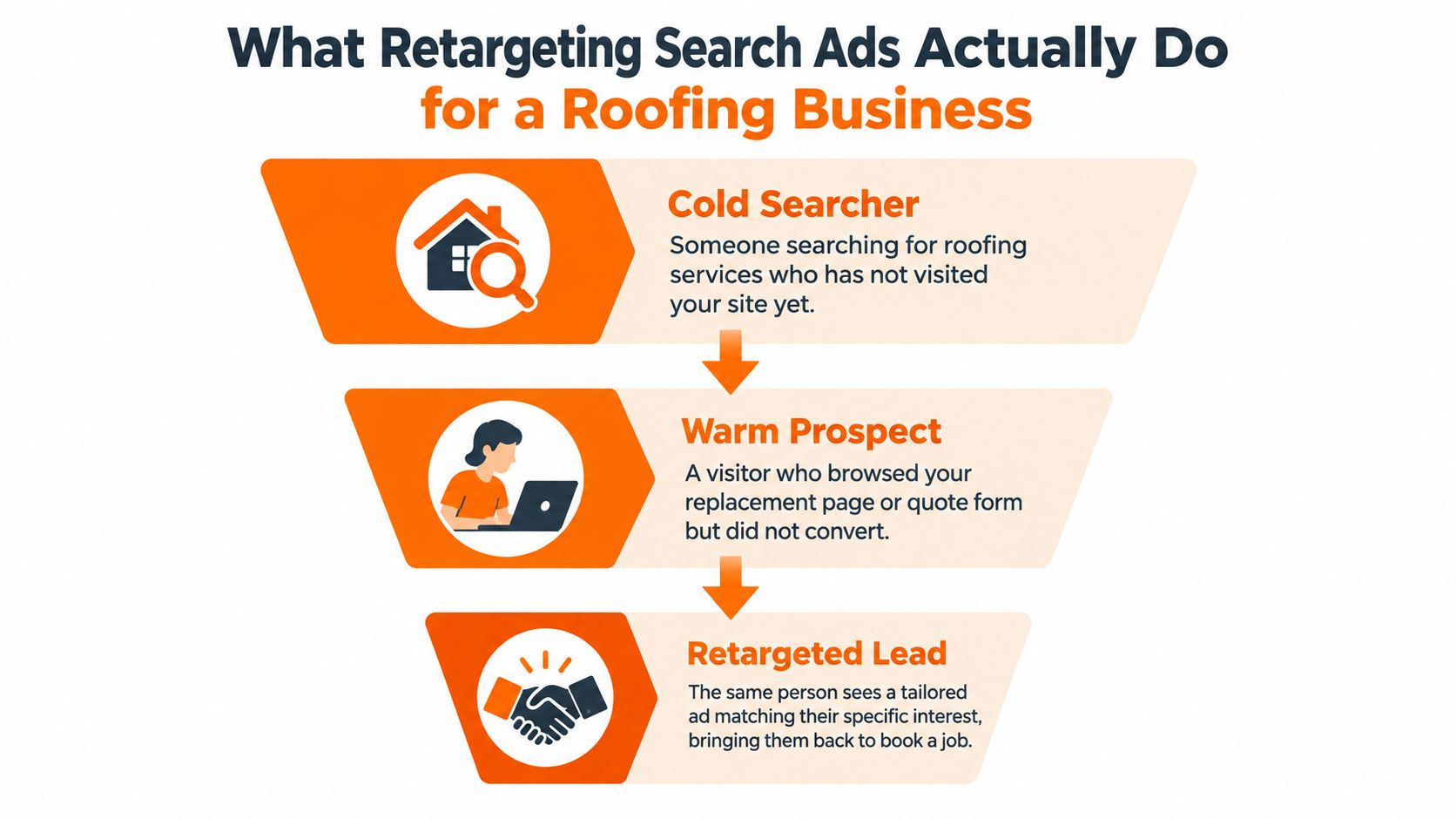
Familiarity isn’t a booked job
A returning visitor isn’t automatically a better lead. Someone repeatedly checking prices may still be unsuitable; someone returning to inspect your workmanship and service coverage may be much closer to requesting an inspection.
- Brand searches should make contacting your business straightforward.
- Service searches should connect the homeowner with the roofing work they previously explored.
- Cost searches should explain what affects the quote and why an inspection matters.
For a broader pipeline perspective, Cometly’s B2B retargeting campaign insights are a useful companion resource. Keep your own implementation roofing-specific, rather than copying another industry’s audience structure.
A previous visit gives you context, not permission to assume the homeowner is ready to buy.
Judge the returning search by its intent. Your ad should help the homeowner take the next sensible step, not just announce that your roofing company still exists.
Building the Retargeting Audiences a Roofer Should Actually Use
I’d start with service interest, unfinished enquiries, and location relevance. An all-visitors audience mixes homeowners with jobseekers, suppliers, employees, and people outside your working area. That’s not a useful quoting pipeline.
Keep the starting roster manageable
For acquisition, my recommended starting windows are 30 days for high-intent visitors and 7 days for emergency-repair visitors. Treat those as working settings to review against your enquiry cycle, not universal rules.
Retargeting audiences for roofers
| Audience | Source | Window | Key exclusion |
|---|---|---|---|
| High-intent service visitors | Replacement, reroofing, repair, or quote pages | Recommended service-interest window, shorter for urgent repairs | Submitted enquiries and booked customers |
| Quote-form starters | Recorded form-start event without a completed enquiry | While the enquiry is still relevant | Successful submissions and duplicate enquiries |
| Past customers | Consented customer records with job dates | Maintenance or follow-up interval appropriate to the completed work | Active jobs and customers without a relevant follow-up need |
| Service-area prospects | Contact or location pages, combined with service interest | Current service-interest window | Out-of-area enquiries and employee traffic |
Quote-form starters are my first choice when the event is trustworthy. Test whether the form-start event records genuine interaction rather than firing whenever the form appears. Send these visitors back to a working quote page, not the homepage.
Contact-page visitors need more scrutiny. A homeowner checking whether you cover their suburb is useful; a supplier looking for your office address isn’t. Combine location-page activity with roofing-service interest wherever the setup allows.
Separate customer follow-up from acquisition
For past customers, a 12-to-24-month follow-up interval can be a proposed maintenance campaign, but it shouldn’t imply that a recently replaced roof needs replacing again. Match the offer to work you provide, such as an inspection or gutter assessment, and keep this audience outside your new-customer acquisition reporting.
Customer uploads also need an eligibility check. Google’s Customer Match policy states that active targeting requires at least 90 days of account history and more than USD $50,000 in lifetime spend; compliant advertisers can use observation and exclusions without assuming they have full targeting access.
The same policy sets a 540-day maximum membership duration and requires at least 100 members added or refreshed within that period to maintain eligibility. Those are platform limits, not recommended roofing follow-up windows.
- Exclude employees wherever you can reliably identify them.
- Remove converted prospects from acquisition audiences promptly.
- Separate urgent repairs from planned replacements.
- Check eligibility before building a campaign that depends on customer-list targeting.
Bidding and Budget Mechanics for Retargeting Search Campaigns
My default for a smaller roofing account is audience observation on existing Search campaigns. Keep your acquisition engine intact, inspect how returning visitors behave, and avoid splitting a limited budget into campaigns that can barely serve.
Observation is a reporting layer, not a retargeting-only campaign. If you want ads restricted to eligible previous visitors, you need the appropriate audience targeting setting and a campaign structure that supports it.
Choose the structure before the bid strategy
For a roofer spending under NZD $3,000 a month, I’d use that amount as a planning boundary, not a platform rule: start with observation unless the account already has enough eligible returning traffic to justify separation. Don’t carve out a dedicated budget because remarketing appears on an agency checklist.
| Approach | What I’d use it for | Main caution |
|---|---|---|
| Existing Search campaigns with observation | Learning whether returning prospects produce better enquiries | It doesn’t restrict advertising to previous visitors |
| Dedicated audience-targeted Search campaign | Distinct messages and tighter control over warm-prospect spend | Eligible audience demand may be too limited |
| Separate customer follow-up campaign | Relevant work for previous customers | Don’t mix retention results with new-customer acquisition |
A dedicated campaign earns its place when you need different landing pages, different keyword boundaries, or clearer spending control. Give it tight service and brand themes, maintain service-area targeting, and prevent avoidable overlap with your existing campaigns.
Match bidding to the evidence you have
Target CPA, or tCPA, aims at a chosen cost per acquisition. I’d consider it when the conversion actions reflect qualified enquiries and the campaign has a useful outcome history. Feeding it duplicate forms or irrelevant calls is a measurement problem, not a bidding strategy.
Maximise Clicks pursues traffic within the budget. I wouldn’t choose it as the default for a quote-focused retargeting campaign, because another website visit isn’t the business outcome you need.
Manual CPC with supported audience bid adjustments can provide hands-on control. Check which adjustments your selected strategy supports; don’t assume an audience modifier will override automated bidding.
Budget rule: Set the initial daily allowance from what you can afford to test against qualified enquiries, then increase it only when the lead records justify doing so.
An audience of under five thousand users is a useful planning example of constrained demand, not a guarantee of eligibility or volume. Watch delivery across the week, search-term relevance, and actual enquiry quality. Don’t broaden keywords just to spend the allocation.
Matching Creative and Keywords to Where the Prospect Is Now
Consider a hypothetical homeowner planning a roof replacement. They visit your service page from Google, watch roofing content on YouTube, ask an AI tool about materials, then search your business name. Your advertising shouldn’t restart the conversation at every visit.
That cross-channel journey matters. The IAB New Zealand discussion of changing search habits examines discovery and trust across traditional search and AI tools. For your roofing account, the practical response is consistent answers across touchpoints, not a claim that you can identify every step.
This is the kind of household research your advertising needs to support:

Early research needs useful answers
On a roof replacement cost search, don’t invent an attractive starting price. Explain the factors your estimator needs to assess: roof condition, access, material choice, and the actual scope of work.
The ad can promise an explanation of the quoting process. A sitelink can lead to material options, while the landing page shows what happens during an inspection. That’s more useful than repeating a generic quality-and-service headline.
For the wider strategy behind matching a search to a commercial next step, Polish’s guide to turning intent into revenue is a relevant companion resource. The roofing execution still depends on answering the homeowner’s specific concern.
Comparison needs proof, then a clear booking route
When the homeowner searches roofer near me, show that you actually serve their area. Use real project photographs, accurate service coverage, and a clear description of how you manage the work.
- Workmanship proof should show completed roofing work you can substantiate.
- Warranty information should describe actual terms, not an unsupported blanket promise.
- Finance information belongs in the ad journey only if you offer it and explain the conditions.
When that homeowner returns through a brand search, remove unnecessary friction. Put the inspection action, phone number, and relevant service information where they’re easy to find. Use sitelinks such as completed projects, service areas, and request an inspection.
The sequence is straightforward: answer the research question, demonstrate suitability, then make booking easy. Don’t imply you know what someone asked an AI tool, and don’t write intrusive copy suggesting you’ve watched their browsing. Use the service context you legitimately have.
Measuring What Retargeting Is Actually Worth
Measure retargeting against qualified roofing opportunities and won work, not a colourful dashboard of clicks. A campaign can produce cheap forms while sending your estimator to unsuitable jobs. That’s wasted quoting capacity.
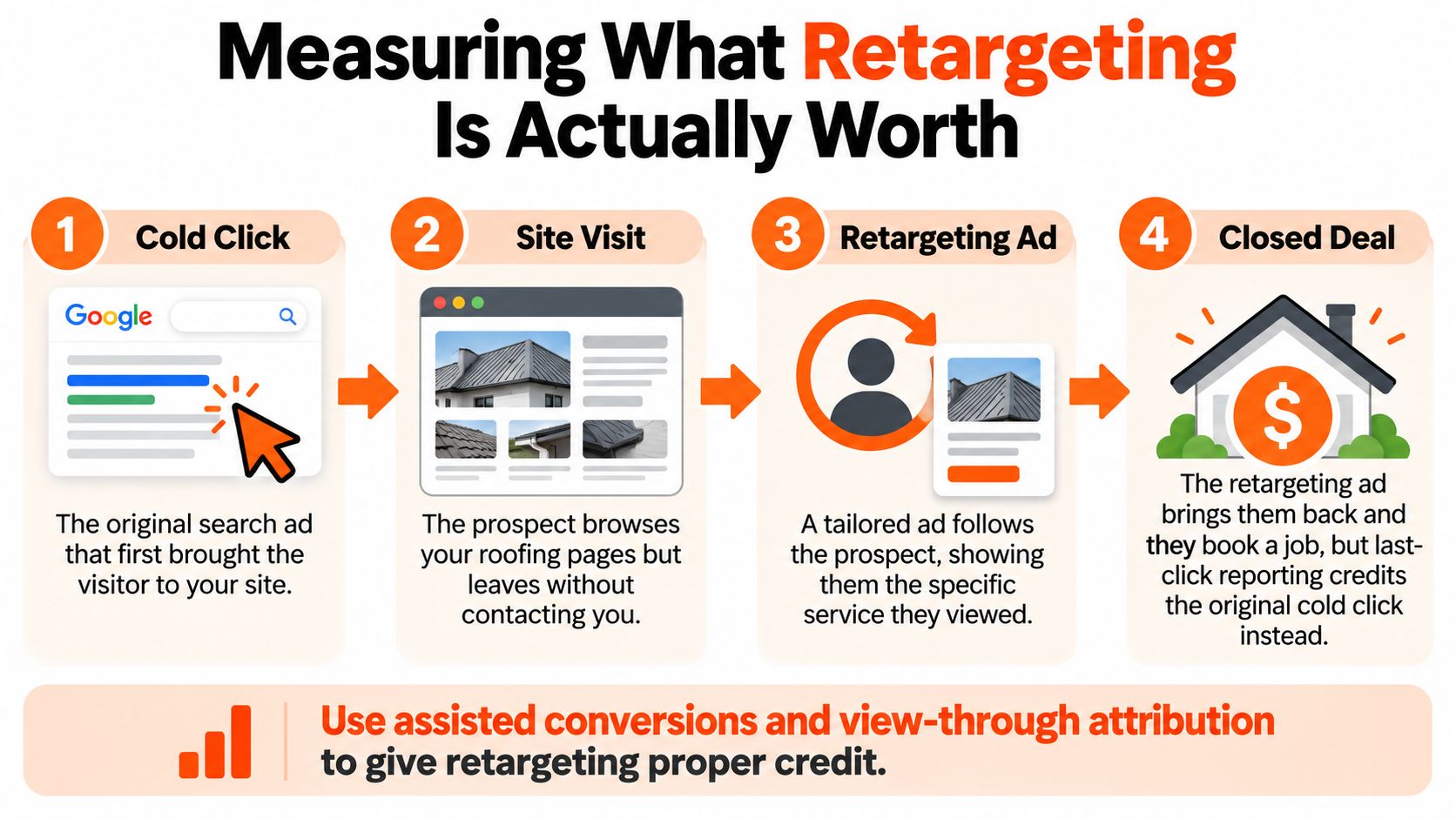
The useful measurement journey connects advertising activity with the eventual roofing outcome:
Record leads your team can assess
Start with sitewide Google tagging, Google Ads conversion tracking, enhanced conversions for web, and Consent Mode. Google’s advertising privacy solutions explain enhanced conversion signals and conversion modelling; a practical initial phone qualification threshold is 60–90 seconds, followed by an assessment of whether the caller needs work you provide.
Duration alone doesn’t qualify a lead. Your team should record service requested, location, suitability, and whether an inspection was booked.
- Phone enquiries need call tracking and a meaningful qualification rule.
- Completed quote forms need duplicate checks and service-area screening.
- Booked inspections need to connect back to the original enquiry.
- Quoted, won, and lost jobs should return from your customer records into outcome reporting.
Track these stages separately, but don’t count every stage as a separate new customer. Choose bidding goals deliberately so one homeowner progressing through the pipeline doesn’t become several apparently independent acquisitions.
For the underlying implementation, use this explanation of conversion tracking for roofing campaigns. HomeProBadge’s discussion of lower CAC for home services is also useful context for reviewing acquisition cost against real customers rather than raw enquiries.
Read attribution without claiming credit twice
Last-click reporting credits the final eligible click, not automatically the original acquisition campaign. If retargeting closes the tracked journey, it may receive that credit; if the homeowner later returns through another channel, the earlier retargeting interaction may disappear from a last-click view.
Inspect assisted paths alongside final conversions. Where a display or video campaign provides view-through reporting, treat it as supporting evidence, not proof that the impression caused the job. Search clicks, video views, and customer records won’t necessarily join into a perfect individual history.
Use the walkthrough below alongside your account’s actual settings and lead records.
Before activating measurement, make sure your privacy notice explains the collection and advertising uses. Technical tracking capability doesn’t establish permission to use identifiable information.
Common Retargeting Mistakes Roofers Make and How to Dodge Them
The worst roofing retargeting setups look busy while giving the owner little useful information. They show generic messages, count weak activity as success, and keep advertising to people already handled by the sales team.
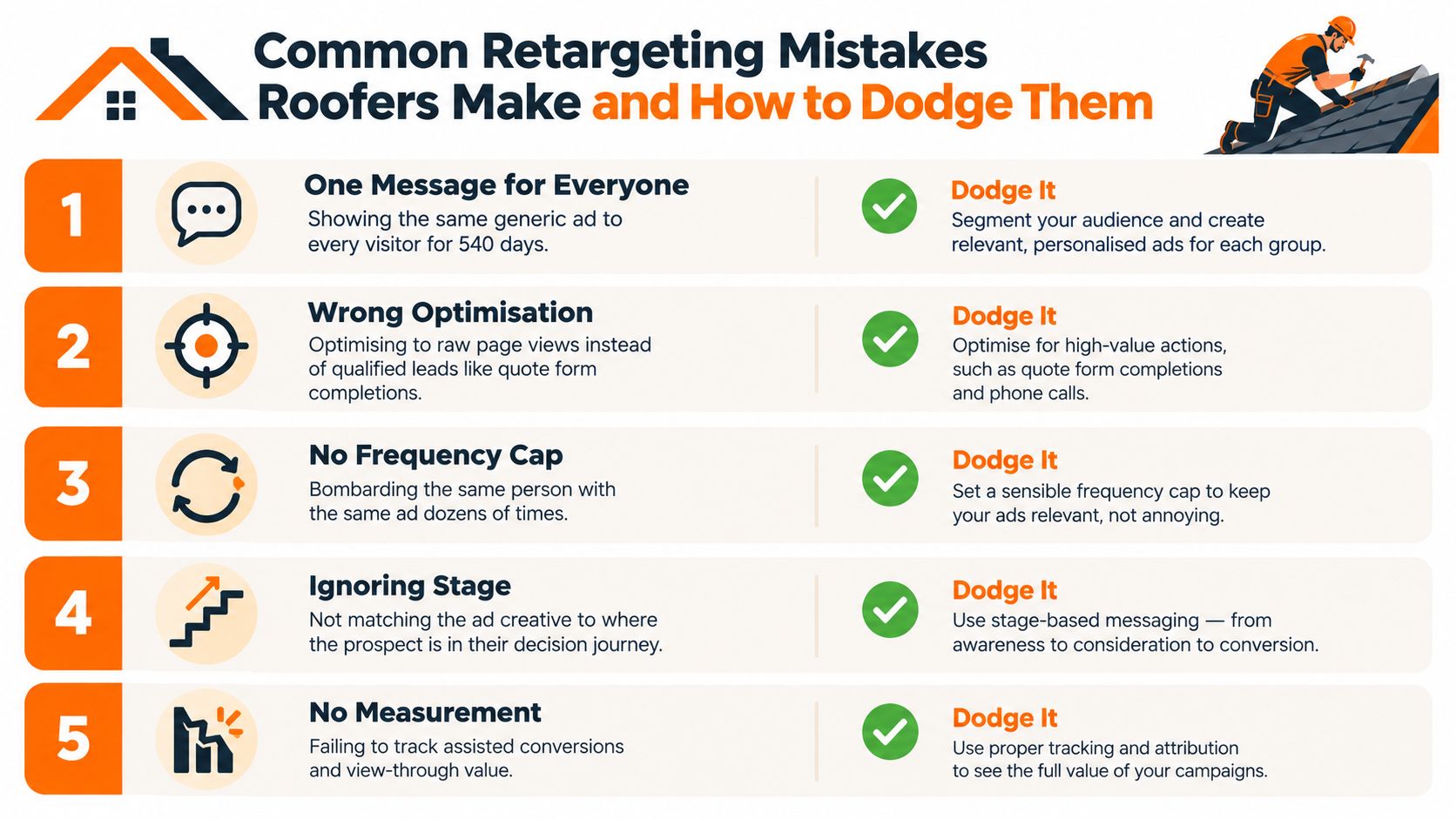
Use this checklist to inspect the account, with placement-specific controls rather than assuming Search, Display, and YouTube work identically:
Fix the mismatch you can see
The symptom is plenty of engagement but poor enquiries. Check the conversion actions before changing bids. If page activity counts as a primary success, the account’s reporting isn’t answering your commercial question.
The symptom is irrelevant follow-up. Inspect which service pages admitted the visitor and which ad group served the return message. An urgent leak enquiry shouldn’t enter a leisurely replacement-comparison journey.
Consent statistics won’t resolve that urgency question. Stats NZ’s building-consents methodology excludes some work, including emergency repairs that don’t require consent. Build repair audiences from actual customer behaviour rather than interpreting construction-consent activity as the whole repair market.
- Repeated display or video exposure needs frequency controls where the campaign supports them. Search doesn’t use the same frequency-cap approach.
- Duplicate channel credit needs a shared lead record, not separate customer totals added together.
- Stale messaging needs a review of audience relevance and the current service offer.
Don’t treat analytics collection as advertising permission
New Zealand’s Privacy Act 2020 applies when tracking collects or generates information about an identifiable individual. Chambers’ New Zealand privacy guidance explains that Information Privacy Principle 3 requires reasonable steps to disclose collection, purpose, intended recipients, and the collecting agency; Principle 10 restricts materially different uses of personal information.
That means a generic statement about improving the website may not adequately explain targeted advertising. Identify your business, describe the relevant tracking and advertising purposes, explain recipients, and provide accessible privacy information and appropriate consent practices.
Fix first: Get lawful collection, genuine lead measurement, and service relevance right before adding more audiences.
The country’s lack of a dedicated general cookie-consent model isn’t a free pass to repurpose identifiable data. Get qualified privacy advice when your intended advertising use differs from what you originally disclosed.
Your 30-Day Retargeting Rollout Plan
Run this as a controlled build, not a campaign explosion. Each week should produce something your roofing business can inspect: a tested event, an eligible audience, a relevant ad, or a reconciled lead record.
Build, launch, then verify
- Week one is for tagging and audience preparation. Test calls and forms, inspect the quote-start event, check privacy disclosures, and select the service audience closest to requesting an inspection.
- Week two is for the search launch. Build a dedicated audience-targeted campaign only if eligibility and demand support it; otherwise use observation on the existing campaign. Keep keywords, locations, and exclusions tight.
- Week three is for message alignment. Review the search terms that appeared, then improve the ad, sitelinks, and landing page together. Adjust bids only where the strategy supports it and the enquiry evidence warrants it.
- Week four is for reconciliation. Compare advertising conversions with your enquiry register, booked inspections, quotes, and outcomes. Remove duplicate records, trim irrelevant searches, and investigate gaps before increasing spend.
Make the next decision from roofing outcomes
An early review might show that the audience is relevant but too small for a separate campaign. That’s useful information, not a reason to admit unrelated visitors. It might also show that homeowners return but abandon a difficult form, in which case the landing page needs attention before the bids do.
Pick the audience most likely to contain quote-ready homeowners this month and launch that first. Keep the front-end search campaign doing its acquisition job, and use retargeting as a focused follow-up layer. Expand only when your enquiry records show what deserves more investment.
Bluelight builds and manages roofing-only Google Ads campaigns, including remarketing, landing pages, call tracking, and lead attribution. Visit Bluelight to discuss a retargeting setup that connects returning homeowners with inspections and measures what happens after the enquiry.
Related service Google Ads for Roofers