8 Roofing Ads Examples to Win Better Jobs in 2026
It’s 8pm on a Tuesday. You open the Google Ads account, the spend graph is climbing, and the phone hasn’t rung since lunch. Three enquiries landed this week: one wanted a price for a garden shed roof, one asked if you “do insurance”, and one was a homeowner who’d already hired someone else and wanted a free second opinion.
That gap between clicks and calls is the whole game. Search Ads are the foundation for roofing companies, and the fancier campaign types earn their place later, once the search base is solid. What separates a wasted budget from a full calendar comes down to three things: whether the ad says what the homeowner is already thinking, whether it reaches the right people in the right suburb, and whether the next step is obvious.
The roofing ads examples below are grouped by the job they do, not ranked. Some fill a storm week, some build value on re-roofs, some protect your margin by filtering out tyre-kickers. Each one gives you the headline, the offer, the targeting and the call to action, then a plain copy-this-or-avoid-this note you can act on this week.
Table of Contents
- 1. Problem-Led Headline Ads
- 2. Click-to-Call Ads with Call Tracking
- 3. Free Inspection Offer Ads
- 4. Storm and Emergency Response Ads
- 5. Material-Specific Ads
- 6. Trust-Led Ads with Reviews and Credentials
- 7. Suburb and Service-Area Ads
- 8. Financing and Payment Plan Ads
- How the eight roofing ad formats compare by job type and lead urgency
- Turn These Roofing Ad Examples Into a Steady Pipeline
1. Problem-Led Headline Ads
The highest-intent search on a wet Monday is rarely “roof replacement”. It’s a sentence about a problem, typed in a hurry, often with the suburb attached. Problem-led ads answer that sentence in the headline and shrink the next step to something a worried homeowner will do.

Here’s the anatomy of one that works.
Headline: Roof Leaking? Free Repair Quote in 24 Hours Offer: a no-charge repair quote within one business day Targeting: phrase and exact match on leak, ceiling stain, missing tile and flashing terms, inside a tight radius of suburbs you actually service Call to action: a tracked phone number plus a four-field form (name, suburb, roof type, what’s happening)
The gutter version runs the same structure with a different symptom: “Gutters Overflowing? Book a Roof Check”. Both name something the homeowner can see from the driveway.
Copy this. Pull the last twenty enquiries and use the exact wording customers typed. If several said “water coming through the ceiling” and none said “roof remediation”, the ads should say the first thing.
Avoid this. Problem-led copy tempts you into promises. If a headline says “guaranteed leak-free”, New Zealand’s Fair Trading Act guidance applies from the moment the ad is published, and the business needs reasonable grounds for the claim then, not after the job’s finished. Warranty terms and dated job records are the evidence.
Two operational rules. Send each problem-led ad group to its own page, never the homepage, because a leak click that lands on a gallery of finished roofs will bounce. Add negatives for “DIY”, “free roof” and “jobs” in week one, then review the search terms report weekly and promote the profitable queries to exact match.
2. Click-to-Call Ads with Call Tracking
Urgent roofing work closes on the phone far more often than on a form, and the phone is also where budget leaks. A missed call at 7pm on a Sunday is a job your competitor books before you check voicemail.
- Headline: Call Now for Emergency Roof Repairs
- Offer: straight to a person, no form, no quote fee
- Targeting: mobile-first, one campaign per service area, ad schedule matched to hours someone answers
- Call to action: tap-to-call on a tracked number
Running proper call tracking software on top of that separates the campaigns, keywords and time slots that produce conversations from the ones producing silence.
Before the word “24/7” goes anywhere near an ad, confirm overnight phone cover, technician availability and the locations you’re claiming. The Commerce Commission’s fact sheet on unsubstantiated representations is clear that the evidence must exist when the claim is published, dated and filed, not assembled after a complaint.
What call ads actually moved for one NZ roofer
Web Genius reported that LHG Roofing grew organic enquiries from roughly 5 to 10 a month to 39 a month, and lead-to-sale conversion from about 10% to 15% up to 25% to 30%, per the LHG Roofing case study. The lesson transfers to paid search: judge a campaign on qualified leads, booked measure-ups and closed jobs, not call counts.
Copy this. A minimum call duration of 45 to 60 seconds to strip out misdials and hang-ups, and a separate number for every campaign so attribution stays honest.
Avoid this. Running call ads during hours nobody answers. Pause the schedule instead. Then compare call volume against booked jobs each month, because a rising call count with flat bookings means the ads are selling the wrong thing.
3. Free Inspection Offer Ads
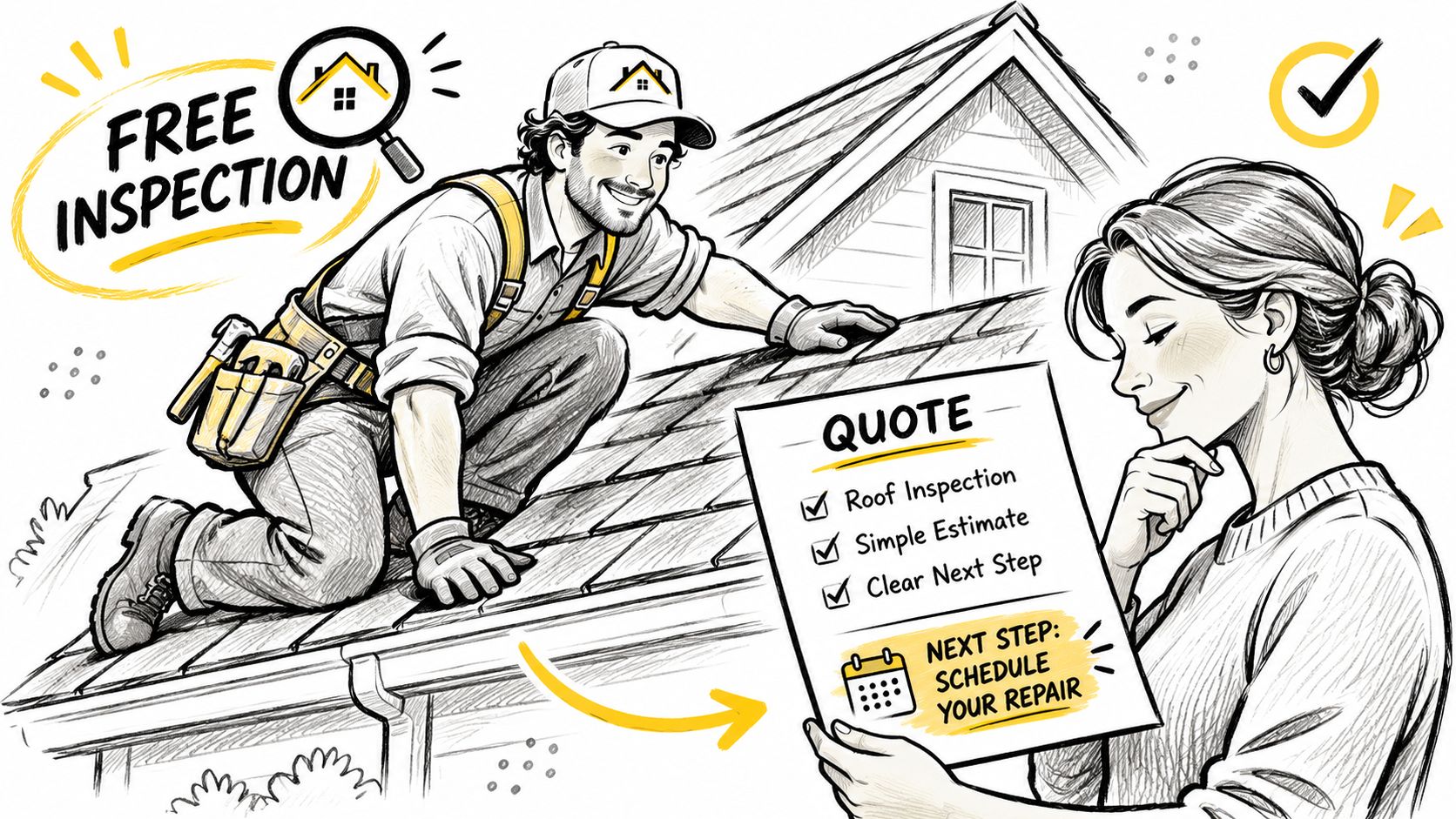
Free inspections are the standard roofing offer for a reason. Nobody buys a roof from an ad. They accept a look. The trade-off is capacity: a free inspection costs a ladder hour and travel, and a hundred unqualified bookings will bury a two-crew operation inside a fortnight.
Headline: Free Roof Inspection and Written Quote Offer: on-site inspection, photos, written scope, no obligation Targeting: re-roof, roof replacement and roof-age queries inside your service suburbs Call to action: book a slot, with the next available time visible on the landing page
The Roof Guru case study reported more than 200% revenue growth over 18 months, doubled lead volume and a 20% increase in the share of leads considered qualified, with booked measure-ups as the central success measure rather than clicks. The qualification arithmetic is worth carrying into your own account: at 100 monthly enquiries, a 20% improvement in qualification adds 20 leads that meet your standard without a cent more spend. That case study was multi-channel, so it can’t isolate Google Ads, but it sets a fair benchmark for the whole funnel.
Copy this. Decide the weekly inspection cap before launch, state on the page exactly what the visit includes, and respond to every form within a time you publish (“we reply within 2 business hours”).
Avoid this. Free offers with hidden geography. If the free inspection only covers certain postcodes, say so in the ad. Also avoid counting “inspections booked” as success when half never convert, so track inspection-to-signed-job rate by ad group and kill the weak ones quarterly.
4. Storm and Emergency Response Ads
A homeowner with storm damage needs a response, not a replacement consultation. Keep emergency enquiries separate from planned re-roofs so urgent calls reach someone who can act.
Google’s New Zealand 2025 Year in Search listed “wind warning” and “rainfall warning” among the country’s leading local moments. That attention is a reason to prepare, not proof that every weather search will become roofing work.
When planned work slows, storm campaigns can capture urgent repair demand. They cannot create storm damage, and extra enquiries only help if you have capacity.

Build the campaign before storm season. The guide to storm damage roofing leads covers campaign structure and routing emergency enquiries separately.
- Headline: Storm Damage? Free Roof Check Today
- Offer: same-day or next-day damage assessment with photo report, only when capacity allows
- Targeting: affected suburbs, with a radius around known hail paths where relevant
- Call to action: call now for urgent damage, with a separate form for insurance paperwork
Copy this. Pre-build the ads, cap the daily budget and assign after-hours calls before launch. Use the example headline only when you can honour both “free” and “today”. Publish your response coverage so callers know whether you serve their area.
Avoid this. Claims such as “last night’s hailstorm damaged your roof” unless accurate and current. Keep emergency tarp work from filling the calendar at low margin. After each event, review which areas produced booked work before spending more.
5. Material-Specific Ads
Material searches come from people who already know what they want, which is the cheapest qualification you’ll get. The construction mix backs that up. Stats NZ building consents for the year ended September 2025 recorded 3,747 new dwellings consented nationally in September alone, made up of 1,634 townhouses, flats and units, 1,601 stand-alone houses and 436 apartments, with the monthly total 27% higher than in September 2024.
Read that mix from a roofer’s side of the fence: stand-alone houses pull long-run metal and tile, while the townhouse and apartment share pulls membrane and low-pitch work. Those are different crews, different margins and different landing pages.
Watch how a specialist frames the same offer.
Build one ad group per material
- Headline: Long-Run Metal Roofing Specialists
- Offer: fixed-scope quote with material samples and colour options
- Targeting: exact and phrase match on “long run metal”, “coloursteel roofing”, plus a commercial variant aimed at property managers
- Call to action: request a sample pack and a site visit
Copy this. Only advertise materials you install well and often. Put eight to ten real project photos on the matching page, because material buyers are choosing a look as much as a product.
Avoid this. One generic “all roofing” ad group that hides which material earns its keep. Compare cost per enquiry and average job value by material every month, and drop the ones that produce enquiries without signed work.
6. Trust-Led Ads with Reviews and Credentials
The trust line is the most legally exposed sentence in a roofing ad. The Commerce Commission treats claims about a business’s success, skills, test results and third-party backing as subject to the same accuracy rule as product claims, per the fact sheet on claiming you’re something you’re not. So “trusted by thousands”, “award-winning”, “10-year workmanship warranty”, “qualified roofers” and any star rating need the number, the name, the year and the terms behind them.

- Headline: Licensed, Insured and Backed by a 5.0 Google Rating
- Offer: itemised written quote, workmanship warranty in plain English
- Targeting: replacement and re-roof searches, plus remarketing to page visitors who didn’t enquire
- Call to action: book a measure-up with a named person, not a generic “team”
The landlord segment nobody writes good ads for
Compliance-driven rental work has serious search intent and almost no good creative. New Zealand’s Healthy Homes Standards became fully enforceable for rental properties on 1 July 2025, covering insulation, ventilation, moisture ingress, drainage, heating and draught stopping, per the 2025 amendment regulations. Ceiling and underfloor insulation is compulsory in rentals, and existing ceiling insulation generally must be at least 120 mm thick and free from mould, dampness, damage and gaps.
Don’t imply your roofer certifies overall compliance unless they’re qualified to. “Roof moisture and insulation-access assessment” is accurate and still sells. Be honest, too, that low-pitch roofs or restricted ceiling cavities can block the insulation fix and force compensating measures elsewhere.
Copy this. Keep a dated evidence file per recurring claim: review count and source, award name and year, warranty wording, staff qualifications.
Avoid this. Stale ratings and warranty copy that doesn’t match the contract. If the warranty is 10 years on materials and 5 on labour, the ad says so.
7. Suburb and Service-Area Ads
Roofing is local, and the consent data shows where the new work sits. In the year ended December 2025, Auckland recorded 15,617 new-home consents, the highest of any New Zealand region and a 12% increase on the previous year. The same release shows total floor area of new homes consented rising from 4,697,026 square metres in 2024 to 5,156,439 square metres in 2025, an increase of 9.8%.
Treat those numbers as market context, not a lead forecast. Consents measure planned new dwellings, while most of your suburb-level search volume comes from existing homes needing repair and replacement. The commercial signal and the maintenance opportunity are two different campaigns.
Headline: Roof Repairs in Ponsonby and Surrounds Offer: local crew, free assessment, photo report Targeting: suburb and city names in phrase match, radius targeting around your depot rather than the whole metro Call to action: call the local number, with a map and recent nearby jobs on the page
The Australian equivalent runs the same logic: “Re-Roofs in Western Sydney” pointed at a page covering specific council areas, not a generic state-wide page.
A location page with no local job on it is a doorway page with a map screenshot. Homeowners check whether you’ve worked on their street.
Copy this. Build pages only for suburbs your crews can reach consistently, use the exact suburb spellings people search, and add one short project example with photos per page.
Avoid this. A page for every postcode in the region. Review lead quality by location monthly, and cut the areas where enquiries never become jobs.
8. Financing and Payment Plan Ads
Price-led creative is where careful roofers and careless ones part ways. Consumer Protection’s guidance for businesses on Fair Trading Act obligations requires prices, products and services to be described clearly and accurately across online, print, television and social advertising. An ad saying “reroof from $X” cannot imply the figure covers every roof when it covers one specification.
- Headline: Re-Roof Now, Pay Over Time
- Offer: deposit plus instalments, or staged payments tied to job milestones
- Targeting: replacement searches, plus retargeting to quote-page visitors who didn’t book
- Call to action: “Check payment options on your quote”, linked to a page with a worked example
Where the price claim breaks
Show the basis of the number on the landing page: roof size, material, pitch, access, disposal, flashings, scaffolding, and whether repairs are excluded. Any discount, “free inspection” or limited-time promotion needs its conditions visible in the ad and on the page, not buried in the footer.
Financing is regulated differently in each market you advertise in. Take the lender’s approved wording and disclosure and use it verbatim, rather than writing your own version of “approved in minutes”.
Copy this. Use finance as a supporting point under a strong headline, not the headline itself, and track whether finance-led enquiries close at the same rate as other replacement leads.
Avoid this. “From $X per week” with no total and no terms. It attracts price shoppers who never sign, and it can mislead the ones who would have.
How the eight roofing ad formats compare by job type and lead urgency
| Item | Best For | Key Strength | Main Drawback |
|---|---|---|---|
| Problem-Led Headline Ads | High-intent repair and replacement searches | Matches customer problems and encourages enquiries | Broad symptom terms may attract low-value searches |
| Click-to-Call Ads with Call Tracking | Urgent leads who prefer to call | Tracks which ads and keywords generate calls and bookings | Calls may be missed outside staffed hours |
| Free Inspection Offer Ads | Homeowners considering inspections or roof replacements | Clear, low-barrier offer that can lead to larger jobs | Can attract people who are not ready to buy |
| Storm and Emergency Response Ads | Homeowners needing help after severe weather | Reaches motivated customers during demand spikes | Demand fluctuates and competition can raise costs |
| Material-Specific Ads (Metal, Tile, Membrane) | Buyers with a preferred roofing material | Attracts well-defined projects and supports specialist positioning | Niche search volumes may be limited |
| Trust-Led Ads with Reviews and Credentials | Higher-value jobs where reassurance matters | Builds confidence with reviews, credentials, and warranties | Claims must be accurate and verifiable |
| Suburb and Service-Area Ads | Local searches within the company’s service area | Targets nearby customers and keeps leads geographically relevant | Location pages require ongoing work |
| Financing and Payment Plan Ads | Homeowners concerned about roof replacement costs | Reduces cost-related hesitation on larger jobs | Financing claims must meet local requirements |
Turn These Roofing Ad Examples Into a Steady Pipeline
Eight formats, one account, and no reason to launch them all at once. Pick two or three that match your highest-value work. For most established firms that means problem-led repair ads, a re-roof campaign with the free inspection offer, plus one seasonal or segment format, either storm response or a material ad group that feeds your best margin.
Build the matching landing page before the ad goes live, not after. A page that repeats the ad’s headline, shows local jobs and asks four or five qualifying questions will out-convert a homepage every time. Then wire the tracking properly: a separate number per campaign, form source and keyword recorded, and booked measure-ups imported back into the platform so bidding learns from commercial value rather than clicks.
Review booked jobs monthly, not daily. Clicks and calls move week to week; signed contracts are what tells you whether the account is working. Compare formats by job type and urgency. Repair and storm creative should convert fast on smaller tickets with tight geography. Inspection, material and finance creative carries slower replacement decisions and needs remarketing behind it. If a format can’t show booked jobs after a fair run, pause it and redirect the budget to the one that can.
One more discipline, and it’s the one most accounts skip: an evidence file. Every recurring claim in your creative, from review counts to response times to warranty length, gets a dated source. It keeps you compliant, and it forces your team to define what an enquiry, an inspection and a completed job mean.
Bluelight’s Roofing Ads Report sets out 25 findings drawn from $336,000 of roofing Google Ads, and the ROI calculator and sample leads on the same site let you model what a steadier flow of enquiries is worth against your average job value. Use them to sanity-check your plan before you spend another month guessing.
The next step is small and specific. This month, open the account, take each of the eight formats above, and mark it as either running, worth testing, or not for your business. Fix the gaps that matter most: the ad that promises what the page doesn’t, the campaign with no call tracking, the location page with no local job on it.
Bluelight runs Google Ads exclusively for roofing companies, building search campaigns, roofing-specific landing pages and call tracking with its Roof Flow system so every enquiry traces back to the ad that produced it. If this list has shown you a gap in your own account, that’s the work the team does every day for roofers in New Zealand, Australia, the US and Canada. Visit Bluelight to read the Roofing Ads Report and book a look at your current campaigns.
Related service Google Ads for Roofers