Roof Repair Quotes: What Your Quote Should Include
Only 47% of surveyed New Zealand homes had roofs assessed as being in excellent or good condition, requiring no repairs or maintenance at assessment, according to Stats NZ’s Housing in Aotearoa 2020 report. That makes roof condition a substantial maintenance issue, but it doesn’t make every repair quote comparable.
For roofing company owners, the challenge is showing customers what they’re buying. Good roof repair quotes explain the diagnosis, define the work and say who pays if opening the roof reveals something unexpected. The total matters only after those assumptions line up.
Table of Contents
- What a Complete Roof Repair Quote Includes
- How to Compare Roof Repair Quotes Side by Side
- What Drives the Price of a Roof Repair
- Consent and Roof Age Rules That Change Your Quote
- Why the Cheapest Roof Repair Quote Is Often the Least Comparable
- Accept the Right Quote Before Work Starts
What a Complete Roof Repair Quote Includes
A quote earns the name only when a customer can read it and reconstruct the job. The rows below are the items that let two prices be compared on the same assumptions; where a contractor leaves one blank, the gap usually sits in risk allocation rather than in arithmetic.
Roof repair quote line items to check
| Quote item | What to check | Why it matters |
|---|---|---|
| Inspection and diagnosis | Written findings, photos and likely cause | Separates confirmed damage from what still needs investigation, so a patch doesn’t only hide the symptom. |
| Access and safety equipment | Scaffold, ladders or edge protection listed | Access can change the price of a small job substantially; the allowance should state what it covers. |
| Materials | Named product, quantity and whether it’s like-for-like or an upgrade | Lets customers compare the same job, including flashings, fixings and underlay where affected. |
| Labour | Hours or a fixed labour price | Shows how the job price was built; bundled labour should be explained rather than left opaque. |
| Temporary weatherproofing | Tarping or sealing if rain is forecast | Protects the interior while work is pending and states who maintains the protection. |
| Waste removal | Disposal of old roofing material included | Often left out of low headline prices; should cover transport, disposal and site clean-up. |
| GST | Whether the price includes or excludes GST | Moves the total by 15 percent in NZ, so the final payable amount should be shown clearly. |
| Exclusions and variations | What isn’t covered and how extra work is approved | Prevents disputes over later charges, including concealed damage and interior reinstatement. |
| Consent and compliance | Whether consent is needed and who is responsible | Avoids delays and unexpected costs by naming who confirms the pathway before work starts. |
| Workmanship warranty | Length and terms of the warranty | Sets out protection if the repair fails, distinguishing workmanship cover from product cover and unrelated leaks. |
Define the service before pricing it
Cleaning, temporary sealing and permanent repair aren’t interchangeable services, and a low figure for one can’t be read against a higher figure for another. Pine Country Window Cleaning’s guide to soft washing for Flagstaff roofs shows what a cleaning scope covers, which helps separate maintenance from repair work rather than standing in for a diagnosis of water entry.
The same discipline applies on the contractor’s side. Roofing firms standardising proposals get more consistent results from a repeatable template than from whichever details the estimator remembers on the day. Review the roofing software used to build, store and send those proposals so the full checklist survives from quote to invoice.
Record the proposed start window, expected duration and payment stages as well. Customers need to know whether they’re accepting immediate protection, a scheduled permanent repair or separate prices for both.
Practical rule: A quote missing several checklist rows isn’t ready to compare. Request the missing information before discussing whether the total is competitive.
How to Compare Roof Repair Quotes Side by Side
Start with the price type, because it determines how the parties handle uncertainty. A fixed quote, an estimate and an allowance for concealed damage don’t give the customer the same commitment.
Fixed quote, estimate and provisional sum compared
| Quote type | What it means | Can the price change? | What to ask for |
|---|---|---|---|
| Fixed quote | Agreed price for a defined scope | Generally only if you request extra work or agree to added services | Written scope and variation threshold |
| Estimate | Provider’s best prediction of cost | Yes, it can go higher or lower | Basis of the estimate and a stated range |
| Provisional sum | Allowance for undefined work such as concealed timber damage | Adjusted once the actual cost is known | Cap, agreed rate and an approval step before work proceeds |
| Contingency | Overall buffer for unknowns in a leak or membrane repair | Used only if needed | Stated amount and how it is released |
For suspected concealed leak damage, an unexplained all-inclusive price deserves scrutiny. MBIE’s weathertightness remediation guidance says an accurate cost estimate is impossible until the full extent of damage is known and recommends provisional sums for undefined work plus an overall contingency.
Water entry can affect the roof substrate, framing, insulation, flashings, junctions and drainage connections. A contractor can fix the price of a defined investigation or visible repair without pretending that unseen damage has already been measured.
Put every quote through the same routine
-
Gather at least three written quotes for the same scope. Give each contractor the same inspection photographs and location details, then let each verify the diagnosis. The common mistake is comparing a temporary seal with replacement flashing as though they’re competing prices for identical work.
-
Mark missing checklist rows. Use included, excluded and not stated as separate labels. Silence isn’t inclusion, especially for disposal, ceiling repairs or removing and reinstalling surrounding materials.
-
Confirm the price type and contingency. Ask the estimator to identify which work is fixed and which remains an allowance. Don’t treat an estimate as a promise or assume that a contingency automatically belongs to the contractor.
-
Put GST on the same basis. Compare final payable totals, not one inclusive figure against another exclusive figure. Keep the tax treatment visible beside each total rather than buried in the terms.
-
Compare the assumptions. Record the area to be opened, the condition assumed beneath it, access arrangements and consent coverage. If one roofer assumes sound timber and another allows for investigation, the difference isn’t just their labour rate.
-
Set a written variation threshold. Agree when the crew must stop and seek approval, how additional work will be priced and what evidence the customer receives. A phone conversation should be followed by written confirmation before the extra work proceeds.
-
Choose the clearest complete offer. Ask each contractor to resolve outstanding differences before selecting the preferred quote. Efficiency can justify a lower price, but missing work cannot demonstrate better value.
Check the details that control the outcome
For membrane roofs, require the substrate specification, its support and fixing, roof falls, ventilation beneath the roof, the membrane system and downpipe connections to stormwater. Replacing the visible membrane without addressing poor drainage or trapped moisture can leave the underlying failure unresolved.
Western Bathroom Renovations’ Melbourne bathroom quote checklist offers a useful cross-trade comparison for organising scope questions. Use it as a prompt for clearer documentation, not as authority on New Zealand roofing compliance.
Compare who carries each unknown, not just how much each contractor has allowed for it.
Before choosing, read the scopes without looking at the totals. If they still describe different jobs, they aren’t yet comparable roof repair quotes.
What Drives the Price of a Roof Repair
Damage, access and the proposed repair method explain more than the size of the ceiling stain. A sound inspection separates visible defects from the parts the roofer cannot assess without opening the roof, then prices each risk explicitly.
Ask the estimator to mark those boundaries in the inspection record: what was seen, what was inferred, and what stays provisional until the roof is opened.
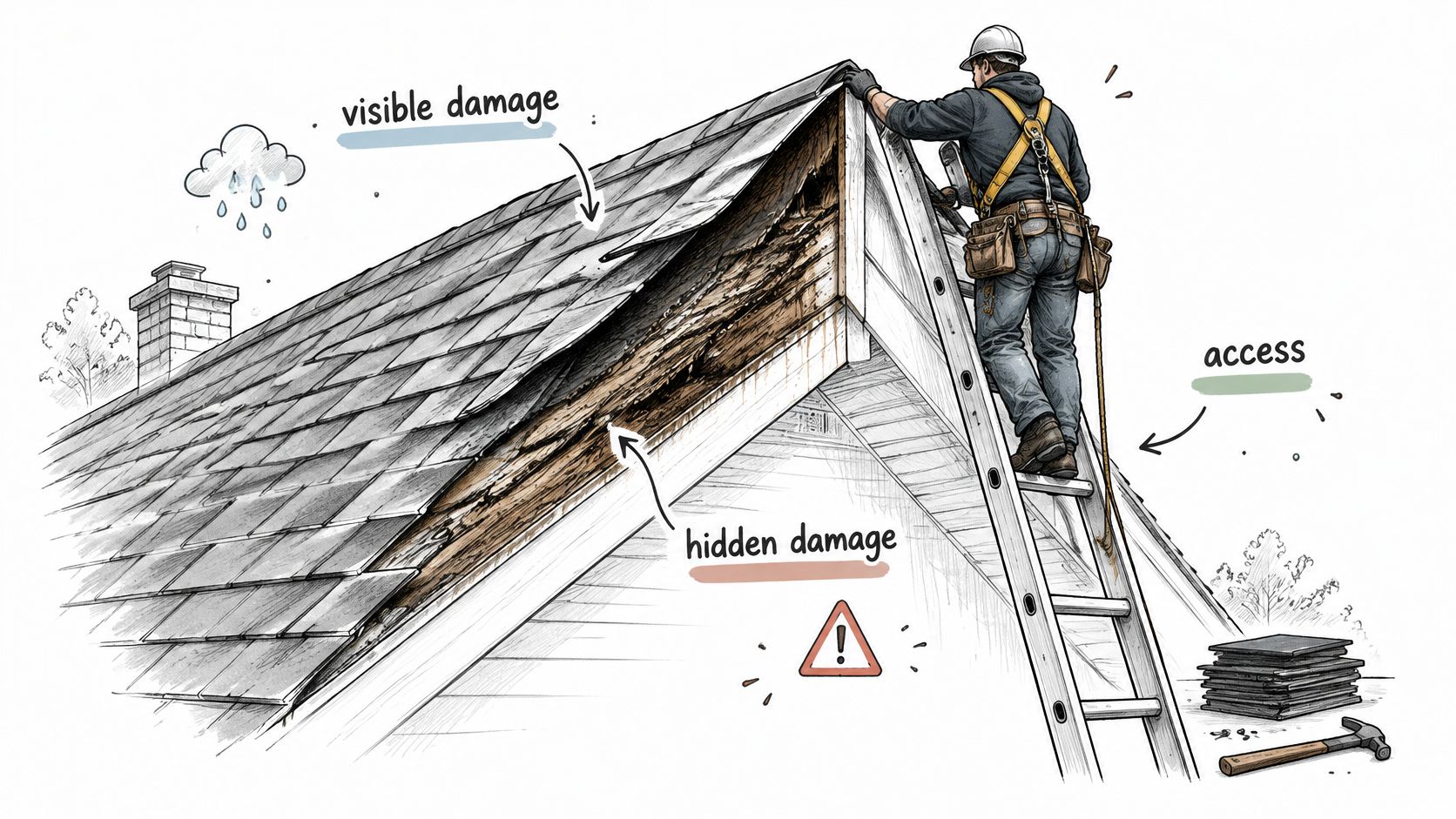
A lower price can reflect a narrower assumption, not a better method. Material changes the repair method. Replacing damaged tiles means checking surrounding tiles, supporting components and whether matching replacements are available; repairing metal roofing means checking sheet condition, fixings and how new flashings integrate with the existing profile.
The same symptom can require different work
Consider a flashing defect on an accessible single-storey house. If surrounding roofing and timber are sound, the contractor may define a contained repair with straightforward access.
Now consider a leak on a two-storey house with suspected timber deterioration. Scaffold, opening-up work, a concealed-damage allowance and potentially a consent step create a different project, even if the customer reports the same drip.
For newer installations, a guide to new roof leaks in heavy rain can help frame the diagnostic questions before anyone assumes the visible sheet needs replacing.
Use the video alongside the written inspection explanation, rather than instead of property-specific findings.
Ask the roofer to answer these questions directly:
- Hidden damage: What remains uninspected beneath the roofing?
- Access: What equipment and site access does the price assume?
- Affected components: Does the repair touch structure or weatherproofing beyond the visible defect?
- Allowances: Which concealed-damage, access or consent costs are included, excluded or provisional?
Consent and Roof Age Rules That Change Your Quote
Consent requirements by roof repair case
| Repair case | Consent likely needed? | What the quote must state |
|---|---|---|
| Like-for-like maintenance on a roof over 15 years old | Generally no, if the exemption applies | Materials and confirmation the work is like-for-like |
| Repair to a roof that fails within its first 15 years | Yes, where failure means the durability requirement wasn’t met | Approximate installation age and a finding on whether the failure is premature |
| Work affecting primary structure or weathertightness | Where consent is required, residential work is generally restricted building work | Named licensed building practitioner responsible |
| Substantial structural or fire-safety replacement | Likely outside the exemption | Affected building elements and the consent pathway |
| Membrane roof leak repair | Assess durability failure and extent of damage | Substrate, falls, ventilation and stormwater connection |
MBIE’s roof recladding clarification states that a roof is generally required to achieve 15 years of durability from first installation, and that repair or replacement following failure within that period requires consent. Normal repair or comparable reroofing beyond that period generally doesn’t require consent if the exemption applies.
Age isn’t a blanket permission to repair without checking anything else. MBIE’s general repair, maintenance and replacement guidance explains that comparable replacement exemptions have limits, including substantial structural or fire-safety replacement and certain external-moisture failures.
Record the pathway before starting
All building work must comply with the Building Code even when exempt from consent, and consented residential work affecting primary structure or weathertightness requires appropriately licensed practitioners under MBIE’s building-consent guidance. Affecting weathertightness doesn’t, by itself, mean every maintenance task requires consent.
For a newer leaking roof, investigate the failure mechanism before specifying replacement sheets. Incorrect flashing, underlay or installation detailing may need a different remedy from deteriorated roof cladding.
Separate the physical repair price from consent-related investigation, documentation and inspections. If responsibility remains unresolved, identify that as an outstanding decision rather than hiding it in a broad exclusion.
The quote should leave the owner with the approximate roof age, the consent pathway and the responsible licensed professional where required. Roofing firms should make these standard fields in their estimating process, with uncertain installation dates clearly identified as estimates rather than facts.
Why the Cheapest Roof Repair Quote Is Often the Least Comparable
Unpriced access equipment is a practical hidden-cost trap. A customer may think they’ve accepted a complete repair when the contractor has priced only the work at roof level.
Say the lower offer for a two-storey roof excludes scaffold, while the dearer offer includes supply, erection and removal. Once access is added, the apparent saving may disappear. The problem wasn’t necessarily an excessive final charge; it was an incomplete comparison before acceptance.
Separate a low price from an unclear offer
A roofer with an efficient crew, nearby work and suitable equipment may legitimately quote less. A higher price isn’t proof of better diagnosis or workmanship, either.
What matters is whether the contractor explains the saving. Fewer materials, a smaller repair area or a temporary solution can all lower the total, but each changes what the customer receives.
Check for these warning signs:
- No inspection evidence: The proposal gives no findings or photographs supporting the repair.
- Unresolved responsibility: Nobody is identified to confirm consent requirements.
- No change-control process: The terms allow extra charges without a clear approval step.
- Vague scope: The description names the roof but not the defect, location or repair method.
- Unclear completion standard: Interior reinstatement, clean-up or weatherproof completion is left unstated.
A clear low quote can be good value. An unclear low quote is an unanswered question.
For roofing business owners, the useful response to price pressure is a scope comparison, not a warning that every cheaper competitor cuts corners. Show the customer exactly which items differ and why your proposed method addresses the diagnosed cause.
Ask the cheaper provider to match the more complete scope in writing. If they propose a narrower repair instead, have them explain its limits and intended outcome. Only then can the customer decide whether the saving is worth the trade-off.
Accept the Right Quote Before Work Starts
Accept only a written, complete and comparable quote. Check that the proposed work addresses the inspection findings, that the price type is unmistakable and that any unresolved investigation has an agreed next step.
Under New Zealand Consumer Protection’s services guidance, an accepted quote generally can’t be exceeded unless the customer requests extra work or agrees to additional services; an estimate can finish higher or lower. The same guidance says that where no price was agreed, the customer is required to pay a reasonable price, which can be assessed against comparable local providers.
Make acceptance a controlled handover
For roofing companies, the accepted proposal should become the crew’s work instruction. Give the supervisor the inspection photographs, agreed scope, exclusions and customer approval contact, not just the job address and invoice value.
Before mobilisation, resolve anything that would leave the crew making a commercial decision on the roof. That includes whether to stop after opening up, who can authorise concealed-damage work and how the property will remain protected during an approval delay.
- Confirm the terms: Record payment stages, scheduling assumptions and the agreed completion standard.
- Preserve the record: Keep the accepted version and every subsequent variation approval together.
- Control changes: Confirm the revised scope and price in writing before additional work continues.
Sign only once the written variation process and approval threshold are in place. A clear acceptance record protects the customer from surprises and gives the roofer a sound basis for delivering and charging for the agreed work.
We help roofing companies generate high-intent enquiries through roofing-focused Google Ads, landing pages and call tracking. Visit Bluelight to book a free intro call about attracting repair enquiries that fit your service area and turning them into clearly scoped quote opportunities.
Related service Google Ads for Roofers