Replace Roof Tiles Cost in NZ: A 2026 Budget Guide
A tile-only rate can leave thousands of dollars out of a New Zealand roof replacement budget. The total depends on what the quote includes, the consent position, disposal charges and the condition of the substrate beneath the tiles.
Many quotes look low because they cover tiles and labour but omit underlay, battens, flashings, ridge bedding, consent, waste levies and scaffolding. Ask for each item to be listed separately, with any allowance for hidden substrate damage clearly stated.
Budget for the compliance-adjusted project cost, not just the tile work. That gives you a clearer basis for comparing quotes and accounting for what the roof may reveal once stripped.
Table of Contents
- Typical Replacement Costs for Tile Roofs in New Zealand
- What Drives the Price of a Tile Roof
- Deciding Between Targeted Repair and Full Replacement
- Consent and Council Fees That Change the Total
- Hidden Costs and Quote Traps to Avoid
- Build Your Replacement Budget, Step by Step
Typical Replacement Costs for Tile Roofs in New Zealand
A concrete-tile re-roof on a typical 150-200 m² New Zealand home was published at NZ$22,000-38,000 in 2025, including GST, scaffolding, removal, materials and labour, in Delta Roofing’s replacement cost guide. Treat this as a comparison point, not a fixed price. Consent requirements, disposal charges and damage beneath the tiles can change the total.
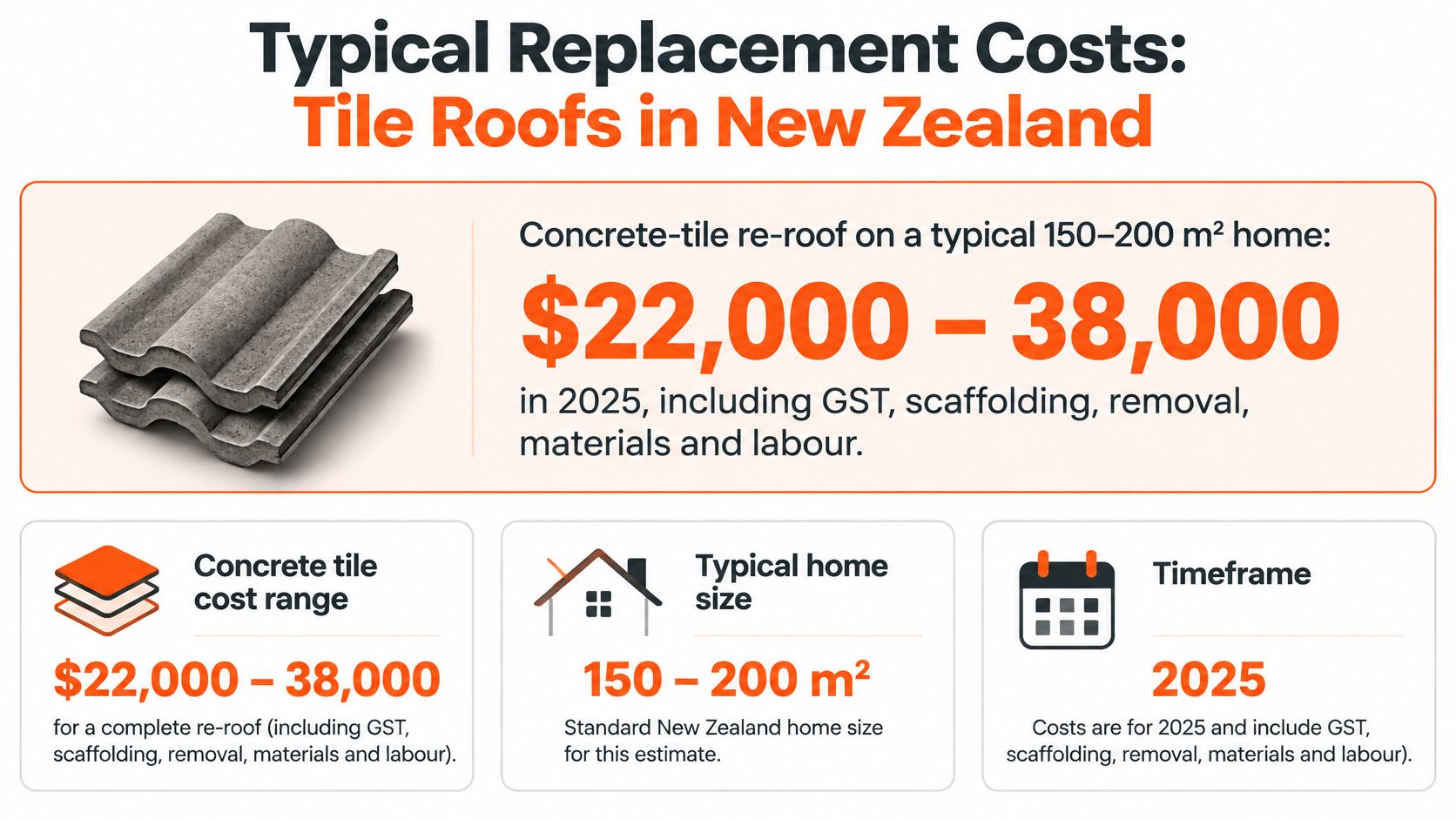
The table applies the published concrete-tile rate to common roof areas. Its whole-job figures are the published range for a 150-200 m² home, not separate quotes for each roof size.
Concrete tile replacement budget by roof area
| Roof area | Estimate at NZ$120-160 per m² | Published whole-job range |
|---|---|---|
| 100 m² | NZ$12,000-16,000 | Not separately published |
| 150 m² | NZ$18,000-24,000 | NZ$22,000-38,000 (150-200 m² home) |
| 200 m² | NZ$24,000-32,000 | NZ$22,000-38,000 (150-200 m² home) |
| 250 m² | NZ$30,000-40,000 | Not separately published |
Roof Area Is Not Floor Area
A roof is measured over its pitched surfaces, not across the floor plan. A 150 m² footprint can have well over 200 m² of roof when the pitch is steep or the design has several planes. Eaves add area too.
Use the building plans if they show roof area, or ask the supplier to measure it. For a manual check, multiply each plane’s eave length by its slope length and add the results. Don’t estimate from floor area alone.
Read the Two Numbers Together
Multiply measured roof area by the rate for a quick estimate, then compare it with the whole-job range. For example, on a 210 m² roof with moderate complexity, a NZ$24,000 quote deserves a close scope check, as does one at NZ$55,000. The figures alone don’t explain what’s included.
Ask for the quote to identify tile removal and disposal, scaffolding, consent costs, and any allowance for damaged underlay or battens. Confirm whether that allowance is a fixed amount or charged by the metre once the roof is stripped. Keep smaller jobs, such as a slipped tile on a garage or flashing above a window, on a separate scope; HoneyDo Crew handyman services may be an option for those tasks.
What Drives the Price of a Tile Roof
Roof area is the base fare. Complexity is the detours, and detours cost time, access gear and material offcuts. In 2025, Roofing Whangarei’s per-square-metre cost guide published a New Zealand concrete-tile range of NZ$120-160 per m². Within that band, the roof in front of you sets the point: a plain gable sits near the bottom, a roof full of junctions sits at the top or past it.
Pitch, Height and Access
Steep pitches slow everything down and force proper edge protection, harness anchors and staging rather than a ladder and a rope. Height does the same vertically. A two-storey home means every tile, every bundle and every offcut travels further, and the scaffold bill is priced on perimeter and height rather than roof area.
Tight sites add more. A pool in the drop zone, a glass balustrade, a carport that has to come down before the scaffold goes up, or a shared driveway with no room for a bin: all of it is real money and none of it appears in a per-metre rate.
Tiles, Profiles and Matching
Concrete tile is the volume product in New Zealand, with clay and pressed profiles above it. If the job is a repair-and-relay, matching a discontinued profile can mean sourcing, blending and accepting a visible patch. If the job is a full renewal, the profile you choose sets the tile cost and the weight, and weight can pull framing and fixings into scope.
The Count of Awkward Details
Hips, valleys, dormers, skylights, flues, aerials, solar arrays that must be removed and reset, and parapets all slow the crew and consume flashing material. Two roofs of identical area can price far apart on this count alone. A 160 m² gable with two penetrations might sit at the low end of the band. A 160 m² hipped roof with a main valley, two skylights and a dormer sits at the top and can exceed it.
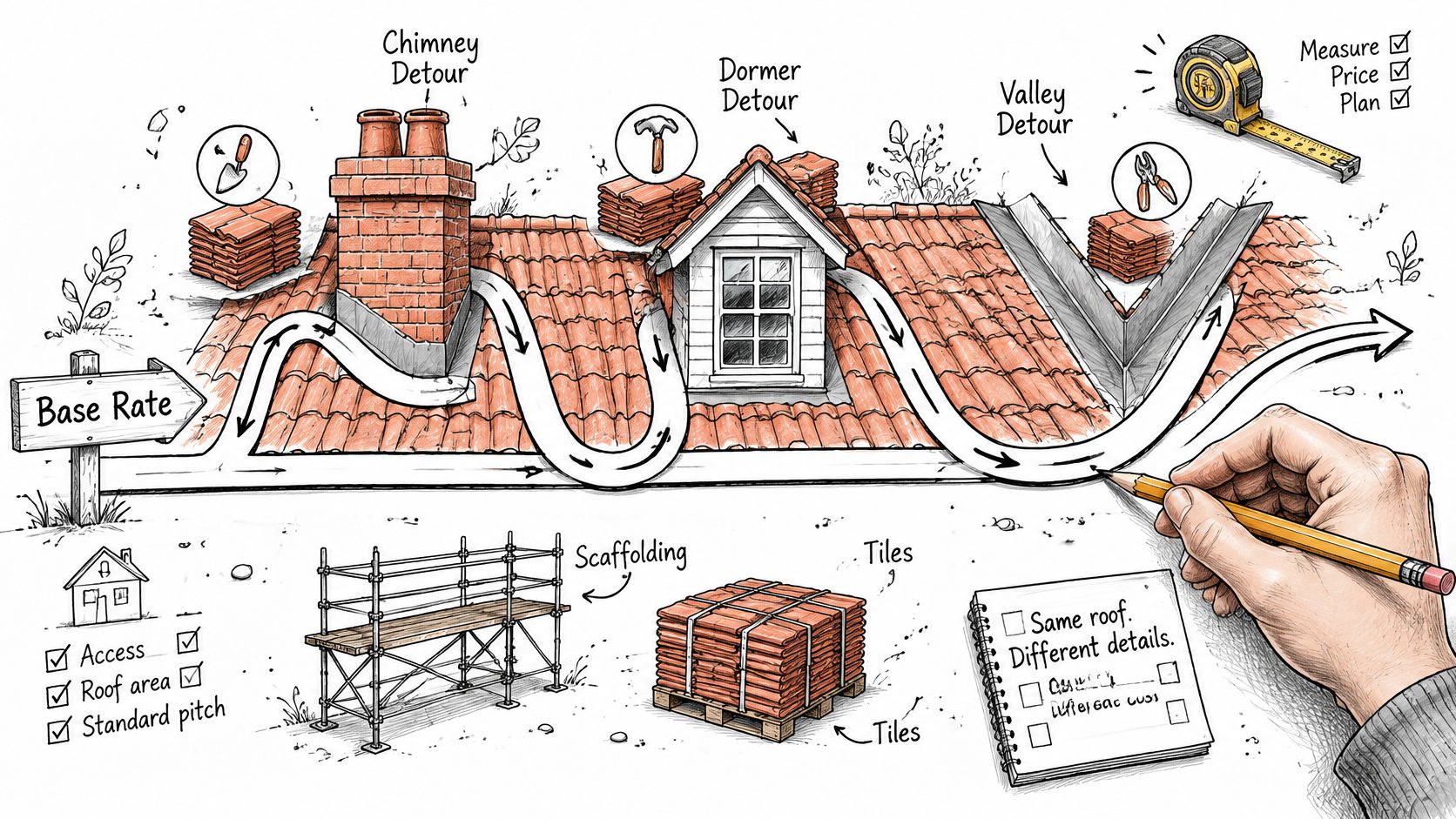
The per-metre price also assumes sound battens and underlay underneath. It’s a surfacing rate. Anything the strip uncovers later is a separate conversation, and it should be a separate line in the quote from the start.
Two roofs can measure the same and price nothing alike. Count the details before you compare dollars.
Rate Your Own Roof Before You Call Anyone
- Simple: one or two planes, single storey, easy truck access, no skylights. Expect the bottom of the band.
- Moderate: a hip or two, a valley, one or two penetrations, standard suburban access. Middle of the band.
- Complex: steep pitch, two storeys, multiple valleys and dormers, solar to remove and refit, or restricted access. Top of the band or above.
Deciding Between Targeted Repair and Full Replacement
The cheaper option isn’t always repair, and it isn’t always replacement. It’s whichever one removes the cause of the water. Four conditions cover most of the calls.
Repair or replacement by roof condition
| Roof condition | Typical scope | Budget approach |
|---|---|---|
| Isolated broken or slipped tiles, younger roof | Replace individual tiles and check fixings | Repair quote only |
| Widespread slipping, roof near 50-60 year life | Strip and relay tiles, renew underlay | Full replacement budget |
| Leaks at flashings or valleys, tiles mostly sound | Flashing and junction repair, reuse sound tiles | Mid-range repair, check underlay |
| Failed underlay or structure | Strip to substrate, repair framing | Full replacement plus assessment |
Age Sets the Frame
In New Zealand, clay and concrete roof tiles generally have an expected service life of about 50-60 years before full replacement becomes necessary, according to BRANZ’s good repair guide for clay and concrete roof tiles. That makes age and remaining service life a cost variable, not a curiosity. A roof near the end of that window with failures across several slopes usually justifies complete replacement. A younger roof with isolated failures is more economically repaired.
The same guide draws a line that most quotes ignore. Deteriorated underlay, battens, ridge bedding, flashings and fixings can add substantial scope beyond the visible tile area, so tile-only renewal and a full roofing-system upgrade should be priced as two different jobs. BRANZ also stresses that regular inspection and maintenance preserve weather-tightness, because overlapping tiles rely on correctly functioning junctions and flashings, not on the tiles alone.
The Test That Tips the Decision
Price the repair first. If the repair quote starts to approach a replacement quote on a roof already near the end of its service life, replacement delivers more value, because the repaired section is only as good as the substrate and flashings around it.
Watch for the halfway trap. Patching over failed underlay buys a season, then the same leak returns through a different tile, and you pay twice for the same problem. A new roof that leaks in heavy rain a month after handover is usually a junction problem rather than a tile problem, and the causes behind new roof leaks in heavy rain are worth reading before you accept a repair as the final answer.
Label Every Defect Before You Decide
Have the roof walked and each item written down as essential (it stops water or holds the roof down), advisable (it will fail inside the next few years), or optional (cosmetic or an upgrade). That labelling is what lets you compare a repair quote against a replacement quote, instead of comparing one contractor’s pessimism with another’s optimism.
Consent and Council Fees That Change the Total
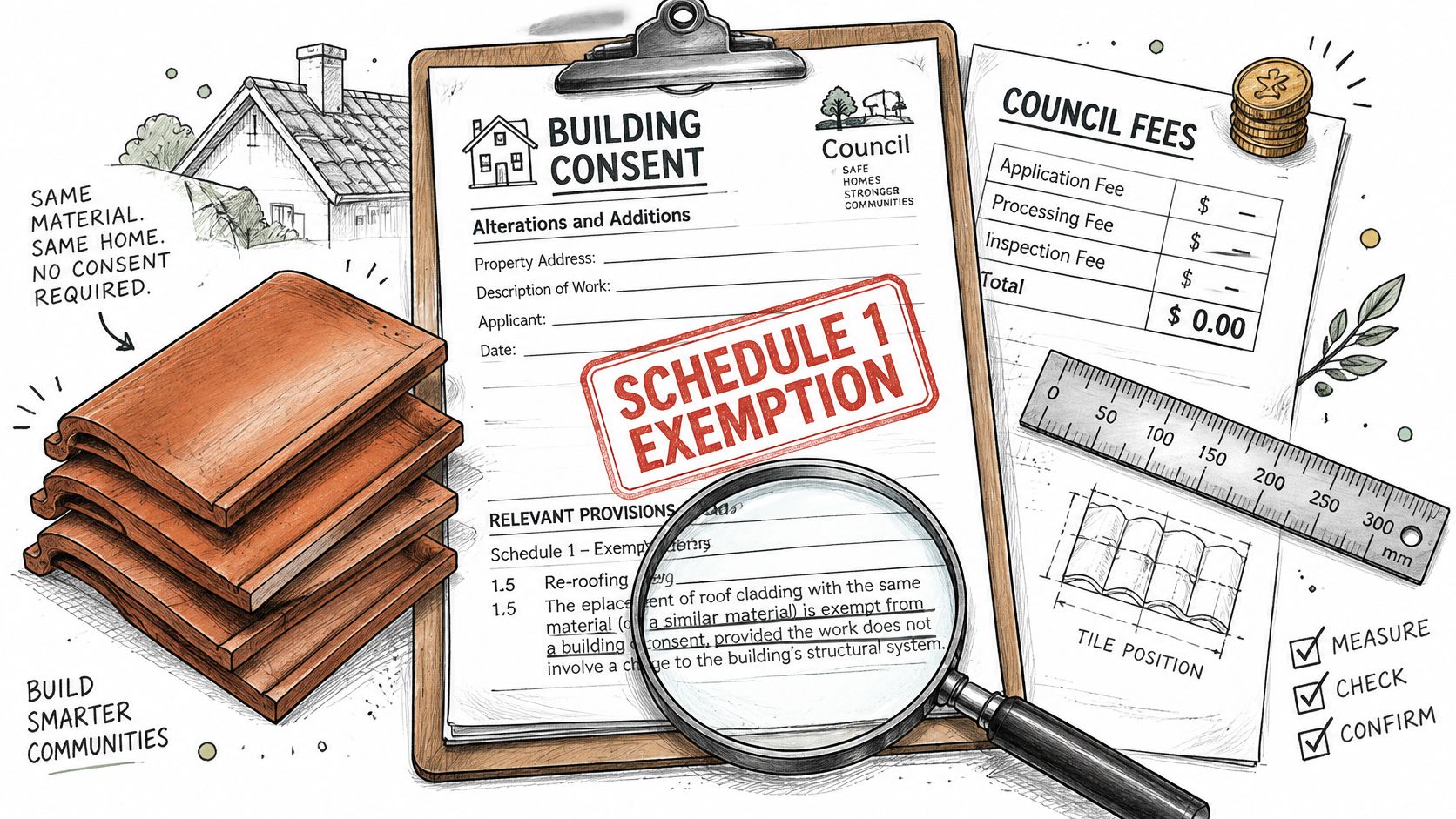
A like-for-like tile replacement may be exempt from building consent, but the exemption depends on the work and the building, not the age of the roof. Schedule 1 of the Building Act can cover lawful repair, maintenance or replacement with a comparable component in the same position, provided the work does not substantially affect the building’s structural behaviour and complies with the Building Code. See the MBIE guidance on building work that does not require consent.
Consent status affects more than council fees. If the scope changes the roof structure, materials or design, allow for any required design work, documentation, inspections and time. Confirm the position before accepting a quote.
Consent position by type of tile work
| Scenario | Likely consent position | Cost items to budget |
|---|---|---|
| Like-for-like tiles, same position and pitch | May be exempt if comparable and not structural | Tiles, labour and any structural repairs found |
| Tiles changed to long-run metal | Can trigger consent; confirm with council | Council fees, possible engineering |
| Change in roof pitch | Can trigger consent | Design, documentation and council fees |
| Structural repairs to framing | Usually requires consent | Engineer and inspection charges |
| Heritage or special planning area | Check council rules before pricing | Extra advice and longer timeline |
Fees Are Set Locally, Not Nationally
Council charges vary. Fees may include an application charge, inspections and levies, and some councils scale charges to project value. Northland District Council lists a NZ$237 residential PIM fee for a re-roof involving a change of pitch or a change from tiles to corrugated or long-run roofing in its planning and consents FAQ. Ask your council for its current fee schedule rather than using another district’s figure as your allowance.
The Building Code still applies to exempt work. The 2024 determination on weathertightness and durability explains that a lack of consent does not remove those obligations. If underlay or fixings are inadequate, the quote should address them rather than treating the exemption as permission to leave defects in place.
When Substrate Changes Turn It Into a Consent Job
The substrate can change both compliance and cost. In a 2024 determination about a proposed concrete-tile roof over an existing membrane, the initial plans proposed removing the membrane and plywood substrate. A later revision proposed leaving the membrane and building the new tile roof above it. The consent authority refused the proposal because Building Code compliance could not be demonstrated.
Ask the roofer to specify what will happen to the existing substrate, and what happens if hidden damage is found once tiles are lifted. Get the consent position, any required approvals and the process for agreeing extra work in writing before the job starts.
Practical rule: Confirm the consent position with the council before pricing, then have it recorded in the quote.
Hidden Costs and Quote Traps to Avoid
A tile-only price can leave out disposal, access equipment and the repairs needed once the roof is stripped. Those costs belong in the total budget from the start. Concrete tiles are heavy, so ask how the roofer will handle salvage, sorting, cartage and disposal, and whether gate charges and waste levies are included.
The applicable levy depends on where the waste goes. For the rates from 1 July 2025, BRANZ lists NZ$65 per tonne for Class 1 municipal landfill, NZ$35 per tonne for Class 2 construction-and-demolition fill, and NZ$15 per tonne for Class 3/4 managed or controlled fill in its construction waste guidance. Facilities may also charge their own fees.
The Add-Ons That Appear Mid-Job
- Salvage: State whether reusable tiles will be lifted and relaid, and who pays for sorting.
- Scaffolding and access: Specify edge protection, staging and hoarding. These costs depend on perimeter and height, not just roof area.
- Battens and underlay: Set out how newly discovered damage will be photographed, priced and approved before repairs proceed.
- Flashing and ridge bedding: Confirm whether valley flashing, ridge bedding and other leak-prone details are included or excluded.
- Ventilation and penetrations: Specify whether flues, vents and extraction ducts will be reflashed as part of the work.
- GST and variations: State whether the price includes GST and give the rates for work outside the agreed scope.
On a 170 m² strip-and-relay job, the roof may reveal soft battens across a third of the area, rusted valley flashing beneath an earlier repair, and crumbling ridge bedding. The quote should say how each item will be assessed and what rate applies if it needs replacing. Otherwise, the owner is asked to approve costs while the roof is open.
Estimate Versus Quote
An estimate is an indication of likely cost; a quote sets out the agreed price and scope. Before work starts, get the scope and price in writing, including how the roofer will seek approval for additional work. A clear variation process gives the owner a chance to decide before costs are added, while giving the roofer a way to price concealed damage fairly.
For the same reason, a quote should identify what the stated price covers and what it leaves out. The guide to comparing roof repair quotes line by line explains what to check when reviewing competing scopes.
Ask before signing: If stripping reveals rotten battens or a failed valley, what work is covered, what rate applies, and who must approve the variation?
Get exclusions in writing, including disposal and levies, scaffolding, repairs to battens and underlay, flashing, ridge bedding, ventilation, salvage and sorting, variation rates, warranty terms, GST, and the consent position. A lower price is only comparable when the scope is clear.
Build Your Replacement Budget, Step by Step
Run these eight steps on a 180 m² gable so you can see exactly where your own number comes from, and where it stops being reliable.
If you prefer the walkthrough in video form, it covers the same logic before you read the steps.
- Measure the roof area, not the floor plan. For the example, 180 m² of roof surface across both planes, eaves included. Write the number down; everything that follows multiplies it.
- Rate the roof as simple, moderate or complex. A plain gable with two penetrations and good access is simple, so it takes the low end of the concrete tile band, NZ$120 per m². Add a valley, a dormer and two skylights and you’d move toward NZ$160.
- Multiply area by rate. 180 × 120 gives NZ$21,600, and 180 × 160 gives NZ$28,800. That’s your base for tiles and labour only, and it’s the number most quotes stop at.
- Add disposal. Estimate the tonnage, apply the per-tonne levy for the facility class the tiles go to, then add gate charges and cartage. Confirm whether sound tiles are salvaged and who sorts them. Tile is heavy, so this step scales faster than people expect.
- Add scaffolding and access. Priced on perimeter and height, not area. A compact two-storey costs more per square metre than a long single-level roof of the same area, and no-scaffold quotes usually mean unanchored ladders.
- Confirm the consent position and add the fees. Ring the council, describe the work in their language (same material, changed material, changed pitch, structural repair), and budget their base fee, inspections and any engineering. Write the answer into the contract.
- Add a labelled hidden-damage allowance. Battens, underlay and flashings found on strip. Call it an allowance with a rate attached, never a fixed price, and require photos before it’s spent.
- Compare the total with the whole-job range. For a 150-200 m² home, that range is NZ$22,000-38,000 including GST, scaffolding, removal, materials and labour. If your total lands far outside it, the scope or the site needs explaining before you sign.
Here’s the four-step version on one page for when you’re standing in front of a quote.
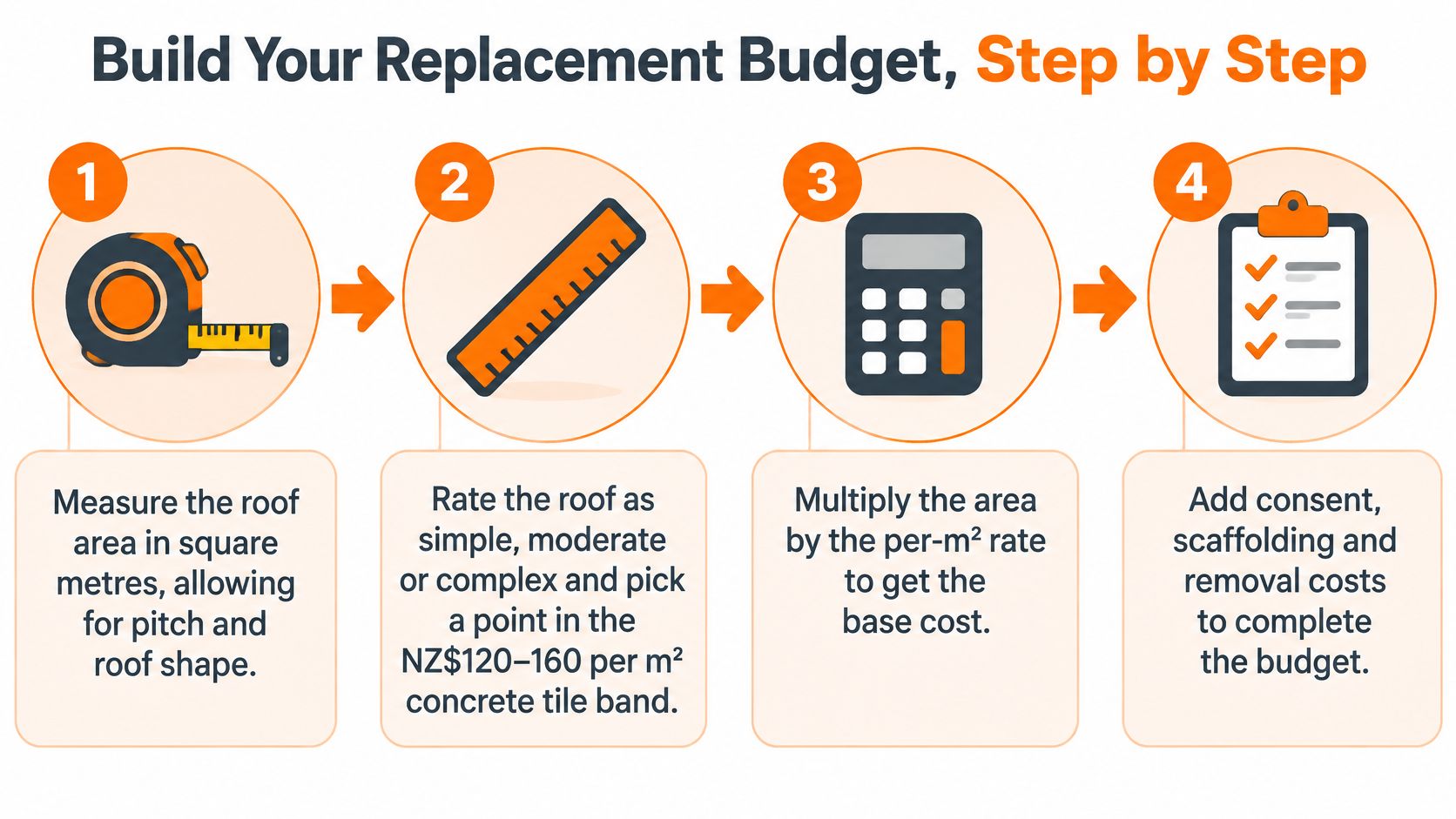
Before You Accept Any Quote
- Roof area in square metres, so you can check the rate against it.
- Complexity rating, with the junctions, penetrations and access constraints listed.
- Consent position, stated as fact after a council conversation, not as “probably exempt”.
- Salvage and disposal terms, including who pays the levy and gate charges.
- Substrate and flashing scope, with the rate for anything found on strip.
- GST and variation terms, so a verbal change can’t rewrite the price.
Carry three numbers into every conversation: the per-square-metre rate, the whole-job range, and the scope items that move the price. The roofer who can talk through all three usually turns out to be the one whose final invoice matches the quote.
If you run a roofing company and want those quote-ready enquiries arriving predictably instead of whenever a referral remembers you, Bluelight runs Google Ads for roofers. We offer a free 30-minute strategy call, along with an ROI calculator, sample leads and a roofing ads report you can review before committing to anything.
A roof quote that survives contact with an opened roof is built on three things: a measured area, a stated consent position, and a written allowance for what the strip might reveal. Bluelight builds the other half of that picture for roofing companies, using Google Ads campaigns, call tracking and roofing-specific landing pages so the owners who find you are the ones ready to talk scope and budget rather than the lowest rate. Visit Bluelight to book a free 30-minute strategy call and see what your pipeline looks like when it isn’t dependent on referrals.
Related service Google Ads for Roofers