Local Marketing for Roofers That Fills the Diary
Search advertising in New Zealand generated NZ$1.44 billion in 2025, up 12% on the year before, and that figure was about 49% of all digital advertising revenue. In the same year, total digital advertising revenue reached NZ$2.967 billion, also up 12%, and it made up 72.1% of total advertising turnover of NZ$4.115 billion, according to the IAB New Zealand digital advertising revenue report.
A homeowner typing roof repair in Auckland, or a re-roof in Christchurch, is already in that search market. They are not waiting on a directory or a mate’s referral. Local marketing for a roofing company only pays when those searches become quote-ready jobs inside the crew’s travel radius. A click from a suburb you will not drive to on a wet Tuesday is a cost, not a booking.
Table of Contents
- Where a Roofer Should Put Local Marketing First
- Spend by the Suburbs Your Crew Can Reach
- How to Set Up Local Marketing in Six Moves
- Make the Profile and Lead Quality Work Together
- Choose the Next Jobs Worth Chasing
Where a Roofer Should Put Local Marketing First
Because most advertising money has already moved online, the first dollar should follow the person who wants a quote this week. I would fund Google Search before anything that only builds awareness. The profile, a few honest pages, and reviews support that search demand. Remarketing waits until a real visitor has somewhere useful to land.

Search catches someone who has named a job and, often, a place. The Google Business Profile is the map result, the hours, and the phone number they decide to trust. Service-area pages exist so the ad does not dump that person on a generic homepage. Reviews are proof you ask for after the job is finished. Remarketing is a second chance to book, and it is wasted if the first visit had nothing specific to offer.
Fund channels in this order
| Channel | Job it does | Do this first | Leave until later |
|---|---|---|---|
| Google Search ads | Quote-ready local intent | Separate campaigns by service and suburb | Broad match with no negatives |
| Google Business Profile | Map pack calls and trust | Correct name, phone, hours, areas, photos | Treating profile views as revenue |
| Service-area pages | Real suburb and service queries | One page per area the crew covers | Mass template location pages |
| Reviews | Proof before the homeowner calls | Ask after completed jobs, then reply | Incentives or bought reviews |
| Remarketing | A second chance to book | Follow all site visitors after search works | Running it before search converts |
Read that table as this week’s funding order, not a wishlist.
Google Search ads should be split by service and by suburb before you lift the daily budget. A leak and a full replacement do not share a buyer, a margin, or a sensible bid. Leave broad match alone until you have negatives and you are reading the search terms.
Google Business Profile needs the trading name, phone, hours, service areas, and current photos fixed before you chase map position. A profile view is not a job. A view from across a harbour you will not cross is the same as a missed call.
Service-area pages should exist only where a crew will inspect. One page for repair work on the North Shore is useful. Forty pages that swap a suburb name and keep the same paragraph are not. Homeowners notice, and so does anyone comparing quotes.
Reviews follow finished work. Ask once, with no discount and no gift, then reply to every comment, including the awkward ones.
Remarketing follows people who already visited, including those who found you through search, a blog post, or social, but only after search is producing calls you would quote. We start a new account with search and add remarketing as the second campaign type, not the first.
What to leave unfunded
- Boosted posts: They buy attention from people who were not looking for a roofer. That is noise while the diary has gaps.
- One national campaign: Weather, housing stock, and drive time are not the same from Whangārei to Dunedin.
- Template suburb pages: Mass location pages do not say whether you will come to that street, and they pull enquiries you cannot serve.
Practical rule: If the enquiry cannot become a job inside this month’s travel radius, it is noise, not local marketing.
Spend by the Suburbs Your Crew Can Reach
A national budget can buy calls your crew cannot profitably take. In the year ended December 2025, New Zealand recorded 36,619 new-home consents, up 9.0% on the previous year. Auckland accounted for 15,617, more than 40% of the national total and 12% above 2024. Canterbury and Otago had the highest consent rates relative to population, at 10.5 and 10.4 new homes per 1,000 residents, respectively. (Statistics New Zealand’s construction figures)
Those differences should shape which jobs and suburbs you target. Auckland can justify a separate budget for new-build roofing and replacement. In Canterbury and Otago, set local coverage around the work and population in the places your crew can reach, rather than treating Dunedin like another Auckland suburb.
Outside Auckland, Wellington and Christchurch, dwelling-unit consents fell 18% in 2023 to 5,188, and were forecast to fall to 3,710 in 2026. The National Construction Pipeline Report 2024 also forecast residential building activity at NZ$28.9 billion in 2025 before recovering to NZ$35.4 billion later in the forecast period, with an average of just over 34,000 dwellings a year through 2029. In smaller towns, give repair, maintenance, reroofing and restoration room in the budget. New-build keywords may compete for a narrower pool of work.
Where the budget should sit
| Area | Demand signal | Budget choice |
|---|---|---|
| Auckland | 15,617 consents in the year ended December 2025, over 40% of NZ, up 12% | Separate budget for new-build roofing and replacement |
| Canterbury | 10.5 new homes per 1,000 residents | Local coverage sized to the work and population you can serve |
| Otago | 10.4 new homes per 1,000 residents | Local coverage sized to the work and population you can serve |
| Outside Auckland, Wellington and Christchurch | Consents fell 18% in 2023 to 5,188; forecast 3,710 in 2026 | Make room for repair, reroofing and restoration |
| National | 36,619 homes consented in the year ended December 2025, up 9%; activity forecast at NZ$28.9 billion in 2025 | Set local budgets instead of treating New Zealand as one market |
Cap the drive before you cap the bid
Set location targets around suburbs a crew can inspect without losing half a day to travel. Reduce spend where drive time or travel cost eats into the job margin, even if the suburb looks busy in the auction. A broad Auckland target can bring calls from places the crew will not reach, including areas across the harbour.
Publish a plain list of the suburbs you will attend, town by town, so customers know exactly where you work. Roofers can find central Ohio roofing coverage as an example of a town-by-town service-area list. Apply the same clear approach to the North Shore, the Hutt Valley or Selwyn. Name the suburbs you serve, not a whole region you cannot cover.
For city-level campaign setup, use this Google Ads guide for New Zealand roofers to plan separate location targets and budgets, rather than copying one ad into every city.
A suburb your crew will not drive to on a wet Tuesday does not belong in the campaign, however cheap the click looks.
How to Set Up Local Marketing in Six Moves
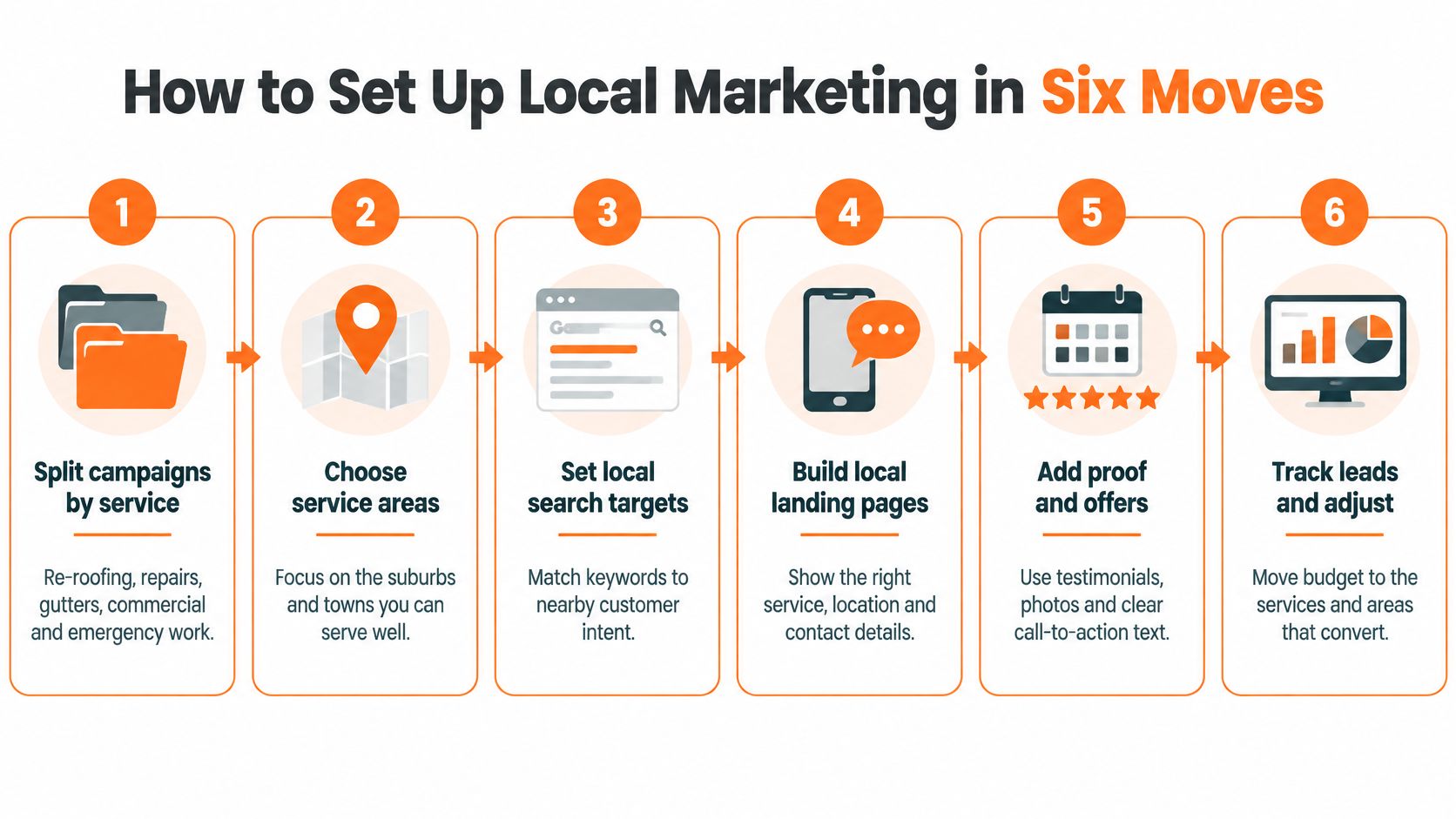
Brief the account as six moves, and attach the usual failure to each one so the build does not drift. Before the first campaign is live, agree what you will accept. Job type, a suburb inside the crew’s radius, property type, urgency, and a minimum project value. If those fields are blank, you cannot tell a good week from a busy one.
-
Split campaigns by service. Run separate campaigns for re-roofing, repairs, gutters, commercial work, and emergency callouts. A leaking iron roof should not share a budget with a full replacement, because the click price and the close rate are different. The failure here is one campaign for every service, which hides which job is paying for itself.
-
Give each real service area its own location target. Auckland, Christchurch, Wellington, and any other place you cover should be separate. Set the ads to people physically in that area, not people Google thinks are interested in it. The matching failure is a location setting that pulls enquiries from outside the ute’s range, including tourists and people researching a move.
-
Use phrase and exact themes. Build around terms such as “roof repair near me” and “roof replacement Auckland”. You want the job and the place in the query. Skip cute brand lines in the keyword list. The failure is broad match with no search-term check, which will buy materials shoppers, job seekers, and DIY questions by Friday.
-
Add negatives before spend runs. Block jobs, training, materials, DIY, and free advice on day one. Add the brand names of suppliers if those searches are wasting money. Waiting until “the data comes in” is how a week of budget disappears on people who want a course, not a quote.
-
Send each ad group to a matching page. That page should name the service, the area, the roof type, who the job is for, a phone call to action, and form tracking. A metal repair ad should not land on a tile gallery or a homepage slider. The failure is one URL for every ad, which forces the homeowner to guess whether you do their job.
-
Optimise to qualified calls and booked inspections. Raw form fills flatter the report. A form that says “roof” and nothing else is not a lead you can schedule. Judge the week on inspections you would send a qualified estimator to.
The usual wreckage shows up in that same order. Everything in one campaign. Broad match and no negatives. A report full of clicks. Location settings that include people merely interested in the city. Fix those before you add a third campaign type.
Google’s reported 76% same-day business-visit rate after local mobile searches is a useful directional benchmark only. As this 2026 New Zealand digital marketing statistics review makes clear, that rate is not roofing-specific and it is not a New Zealand conversion rate. Do not put it in a forecast.
After the first week, open the search terms and kill anything that is not a job. If the query is a supplier, a vacancy, or a suburb you will not attend, add the negative the same day. Leaving it “to see” is how the second week repeats the waste.
A short walk-through of the account structure is here if you want the moves in order before you brief them.
Make the Profile and Lead Quality Work Together
Treat the Google Business Profile and the ads as one conversion system. Industry analysis indicates Google held more than 94% of New Zealand’s search market in 2025-26, while about 22% of mobile searches displayed Local Pack ads in early 2026, up from about 1% in 2025, according to this New Zealand Google Ads agency review. Those are planning signals from industry analysis, not an official Google or Stats NZ series. Check them against your own impression and auction data before you move budget.
Profile checklist
Work through this once, then keep it current.
- Verify the basics. Business name, address or service areas, phone, hours, and primary category. A tracking number is fine on the ads if the published profile number stays the number customers already know.
- Upload original job photos. Use plain filenames and captions that say the suburb and the roof type. Stock drone shots of someone else’s street do not help.
- Ask for reviews after completed work. No incentive. Reply to every review, including the short ones and the complaints.
- Use the same service words on the profile, in the ads, and on the landing page. If the ad says leak repair, the profile should not only list “roofing contractor” and hope.
Profile actions, calls, direction requests, paid leads, qualified leads, and booked jobs are separate lines in the report. Views and clicks are not revenue.
What a qualified call includes
A qualified lead, before you spend, has a job type, a suburb inside the crew’s radius, a property type, an urgency, and a minimum project value. On the form or the call notes, also capture roof material and approximate scope so a repair is not booked as if it were a reroof. Then track how fast someone picked up. A qualified enquiry that sits until the next morning is often already with the roofer who answered.
Judge cost per qualified opportunity and close rate by suburb. Cost per click will congratulate you for cheap traffic you cannot roof.
The CPA Australia 2025-26 New Zealand small business survey found that only 32% of New Zealand small businesses generated more than 10% of revenue from online sales, the lowest result among surveyed markets, while only 38% reported business growth. Being visible is not the same as being booked. More local traffic can make the week worse if the crew cannot tell a profitable reroof from an enquiry you should decline.
Answer the comparison before the quote
The New Zealand Consumer Survey 2026 reported that 82% of consumers shop around to find the best deal, while 69% check labels or compare unit prices to assess value. For roofing, that does not mean winning on the lowest number. It means the page states whether the job is a repair, a partial replacement, or a full reroof, which materials and workmanship are included, any warranty or inspection you offer, photos of similar work, and the suburbs you cover.
A generic homepage makes that shopper do the comparison somewhere else, and it invites tyre-kickers who only wanted a price per square metre.
Consistent services, hours, reviews, and project proof also help when someone finds you through an AI-style summary rather than a classic results page. That consistency does not replace the Google foundation. Incomplete or contradictory details, a Monday hours set that is wrong on Thursday, or a service list that does not match the ads, make you harder to trust on every surface at once. Do not spin up pages of unsupported claims to chase that.
Quote the jobs you can reach and finish. Decline the rest in the form, not after an hour in the driveway.
Choose the Next Jobs Worth Chasing
Three decisions set the next month. Everything else is a report you can ignore.
Pick the services the crew wants more of this quarter. If the order book needs reroofs and you are buying gutter cleans, the account is doing the wrong job even when the phone feels busy. Name two or three services. Pause the rest until those are producing inspections.
Name the suburbs you will still drive to on a wet Tuesday. Write them down and match the location settings to that list. If the phone rings from the wrong side of the map, do not add budget. Add negatives, tighten the location setting, and state the job type and the suburbs on the page.
Write what a qualified enquiry must include before anyone quotes it. If the suburb, the job, and a rough scope are missing, it is not ready for an estimator. Staff should be allowed to say no.
If search, the profile, and one matching landing page are not producing qualified jobs, fix those before you add social or a third campaign type. Another channel will not repair a page that does not say what you do, or a radius that is wider than the crew.
Set a review 30 days out. Judge booked jobs, response time, and cost per qualified opportunity. Clicks are a diagnostic, not a result. How to tie calls and forms back to the campaign that paid for them is covered in our note on marketing attribution for roofers.
This article does not invent a pile of case studies. One client outcome we can stand behind is Modern Roofing, where the account produced $575K in revenue over 15 months, an 8x return on ad spend. Your suburbs and your margins will not copy that figure, which is why the 30-day review has to use your booked jobs.
If you want the system built rather than briefed internally, we can run it. The Roof Flow™ full management package includes full Google Ads setup in 5 business days, search campaigns, Performance Max, remarketing, landing page optimisation for roofing conversion, call tracking, lead attribution, monthly reporting, and ongoing optimisation. Leads sit in your own ad account, and you keep that account if you leave. A short intro call is enough to cover the service list, the suburbs, and the monthly ad budget you pay directly to Google.
Bluelight builds and manages Google Ads only for roofing companies, with the budget aimed at quote-ready local jobs inside a real travel radius. If you want search, landing pages, call tracking, and a monthly read on booked work rather than clicks, start with the service list and the suburbs your crew will drive. Visit Bluelight and book a short intro call when you are ready to put that budget against the jobs you want more of.
Related service Google Ads for Roofers