Google Ads NZ for Roofers That Want Better Leads
A roofing owner checks Google Ads between site visits. The dashboard shows clicks, calls and quote forms, but several enquiries are for work outside the service area, one caller wants a job the team doesn’t handle, and the replacement project the business needs hasn’t appeared. The account looks busy. The pipeline still feels thin.
That gap is the challenge with Google Ads in New Zealand. An ad account isn’t a stream of guaranteed jobs. It’s a route from a customer’s search to the right roofing service, in a location you can serve, with a clear next step. The useful measure isn’t how many people clicked. It’s whether the right enquiries progress to profitable, completed work.
Table of Contents
- Why Roofing Google Ads Often Underdelivers
- Why Search Matters for New Zealand Roofers
- Build a Roofing Campaign Around Intent
- Set Up Local Campaigns That Match Roofing Services
- Choose Bidding and Budget Controls
- Use New Zealand Regional Keyword Examples
- Measure Profitability Beyond Cost per Lead
- Build a Roofing Google Ads Operating Routine
Why Roofing Google Ads Often Underdelivers
A roofer launches one campaign for “roofing”, sends every click to the homepage and counts every phone call as a conversion. The calls come in, so the campaign appears to be working. But a homeowner looking for a small repair, a commercial property manager comparing contractors, and someone searching for roofing supplies have different needs. Treating them as one audience makes it harder to show a relevant ad, set the right budget or judge whether the campaign is attracting valuable work.
The problem often gets worse when bidding is optimised for the easiest action to record. A short call from outside the service area might count just as much as a serious reroofing enquiry. The system can then favour activity that looks successful in the account but doesn’t help fill the schedule with suitable jobs. A low cost per lead doesn’t mean a low cost per completed job.
Follow the enquiry to the work
A useful campaign connects four things: search intent, roofing service, reachable location and a measurable next step. If any link is wrong, clicks can turn into wasted calls or forms. Someone searching for emergency leak repair needs different ad copy and a different landing page from someone planning a full roof replacement.
Start by asking what a good enquiry looks like for your business. It might be a replacement project in a suburb your team covers, or a repair that fits your crew’s current capacity. Then make sure your ads and landing pages help those customers act, while setting clear expectations about the work and areas you serve.
Practical rule: Judge advertising by the quality and outcome of enquiries, not by the number of calls the platform records.
This guide brings the operating decisions together: why search matters in New Zealand, how to separate services and locations, where mobile lead capture fits, and how bidding and measurement should account for completed work. It also covers the practical safeguards that keep ads and offers accurate. The aim isn’t to promise a particular volume of jobs. It’s to make the account easier to manage against the work your business wants.
Why Search Matters for New Zealand Roofers
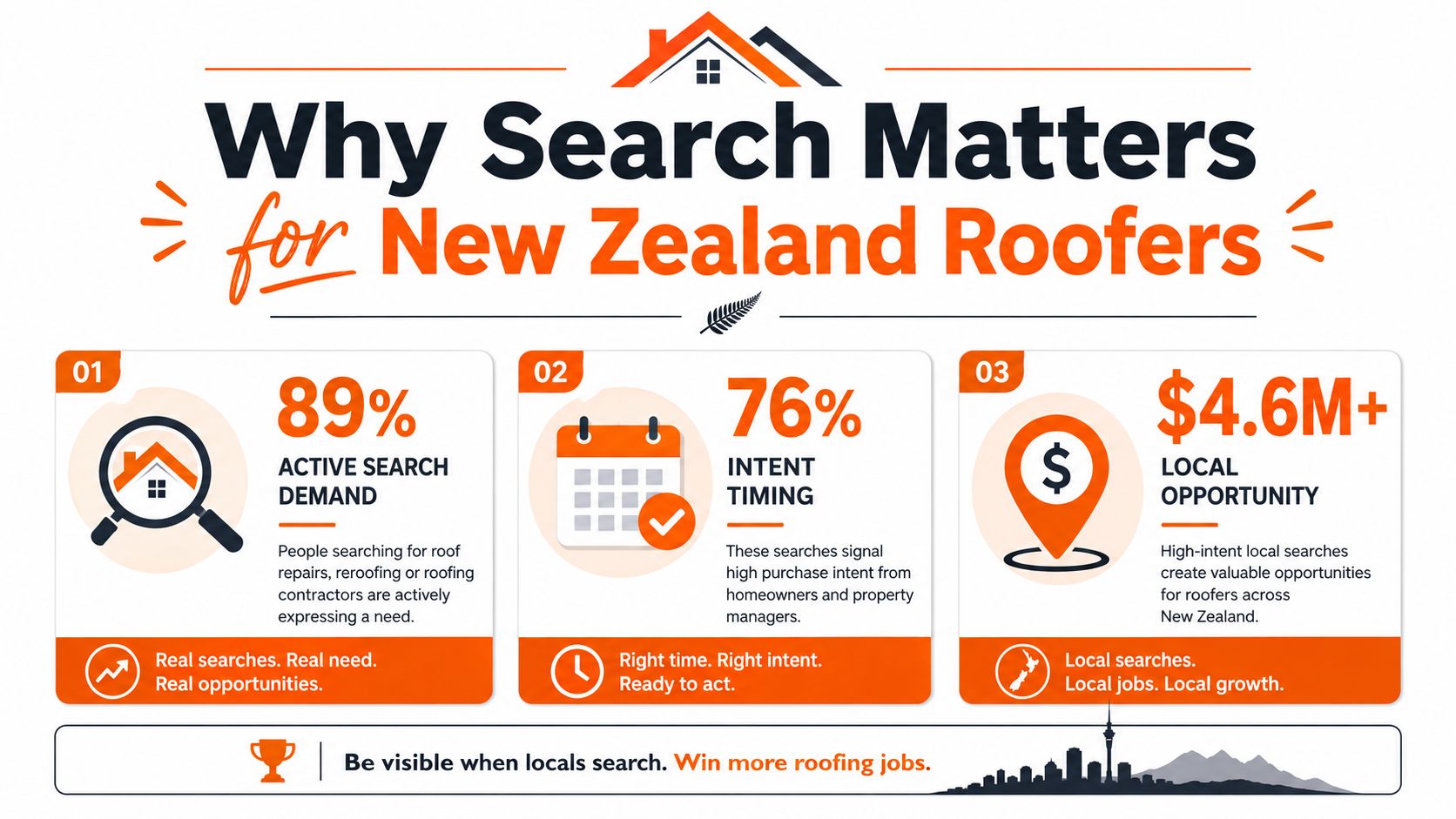
A person searching for “roof repair”, “reroofing” or “roofing contractor” is expressing a need or project. That’s different from showing an ad to a broad audience that may not be considering roofing at all. Search can put a business in front of customers who are actively looking, but a relevant ad and a serviceable location still have to turn that intent into an enquiry.
New Zealand’s digital advertising market reached NZ$2.967 billion in 2025, up 12% on 2024. Search was the largest digital advertising format, with approximately NZ$1.44 billion, about 49% of total digital advertising expenditure, and its revenue also grew 12% year on year. These are market-wide figures, not roofing revenue or a forecast of what an individual account will earn. They do, however, show that search is a substantial part of the country’s advertising arena, not a minor or experimental channel. (New Zealand digital advertising market coverage citing IAB New Zealand data)
Search behaviour has a long history
New Zealanders’ reliance on internet access and online search didn’t begin with today’s ad platforms. A 2013 World Internet Project survey found that 92% of New Zealanders aged 16 and over used the internet, while 73% said it was important in everyday life. Google was the country’s most popular website in that account, and searching for information was the second-most popular online activity after social networking. That’s historical context, not a current forecast of roofing demand, but it shows that online information-seeking was already mainstream. (Te Ara’s history of digital media and the internet in New Zealand)
For a roofer, the practical case for search is simple: when someone looks for help with a leak or a replacement, your business needs to communicate the right service, location and next step. National market growth can’t tell you whether a particular Christchurch or Auckland campaign will be profitable. Your own tracked enquiries and completed jobs have to answer that.
For a wider view of how search visibility fits alongside organic discovery for trades, see this SEO for tradesman guide. Paid search and organic visibility can support each other, but paid campaigns still need their own clear targeting and measurement.
Build a Roofing Campaign Around Intent
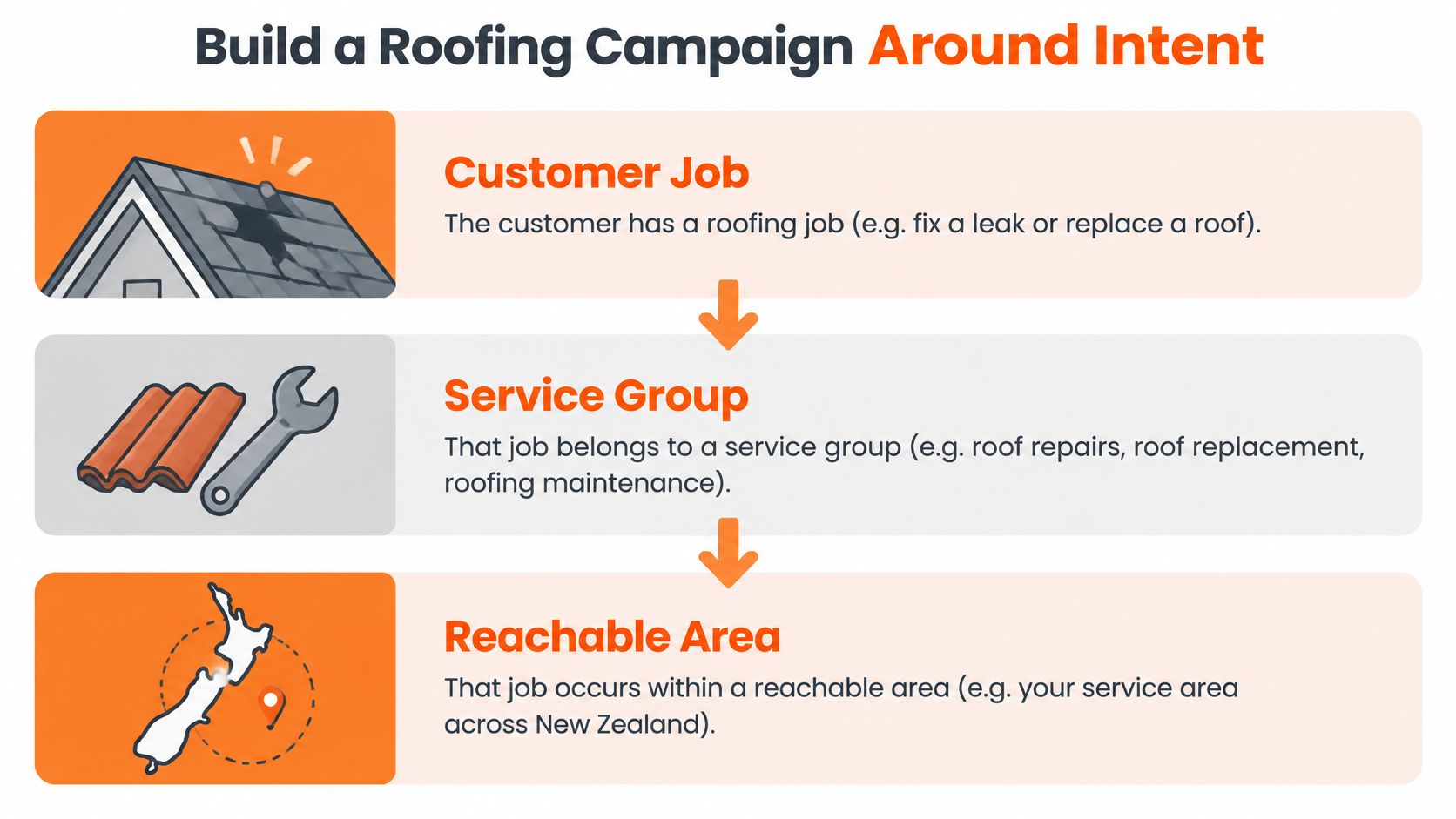
A roofing campaign is easiest to understand as a chain: the customer has a job, that job belongs to a service group, the work sits within a reachable area, and the ad should lead to a useful next step. Build the account around that chain, rather than starting with a long list of keywords and hoping the right people arrive.
Sort searches by the work customers need
Separate services when they have different buyers, economics or follow-up. A campaign might distinguish emergency leak or storm response from general roof repair, replacement and reroofing. Metal roofing, gutters, commercial roofing, restoration and relevant new construction can also deserve their own groups when your business wants and can deliver that work.
This isn’t about creating a separate campaign for every variation in wording. It’s about making sure that someone looking for commercial roofing doesn’t land on a page written only for homeowners, and that an urgent repair ad doesn’t promise a service your team can’t provide.
Keyword match types help control how closely a search needs to relate to the wording you choose. Exact match is the tightest control, phrase match allows more variation while keeping the central meaning, and broad match can reach a wider range of related searches. Wider reach can uncover useful demand, but it can also bring in searches that don’t match your services. Check the actual search terms and exclude irrelevant themes rather than assuming every click is useful.
Connect reach to an actual next step
Location targeting should reflect where your team can attend, not just the nearest large city name. A business that serves particular suburbs may need to exclude places that look close on a map but don’t work operationally. Then choose the next step the page should encourage: a call for urgent work, a quote request for planned replacement, or a clear route for commercial enquiries.
Impressions, clicks and raw lead totals describe platform activity. They don’t show whether the caller owns the property, whether the job fits your crew or whether the quote was accepted. Set up conversions so that phone and form enquiries are distinguishable, and make sure a useful enquiry is more meaningful to reporting than an accidental dial.
This short video gives a visual overview of how Google Ads works before you apply the campaign structure to roofing services.
Set Up Local Campaigns That Match Roofing Services
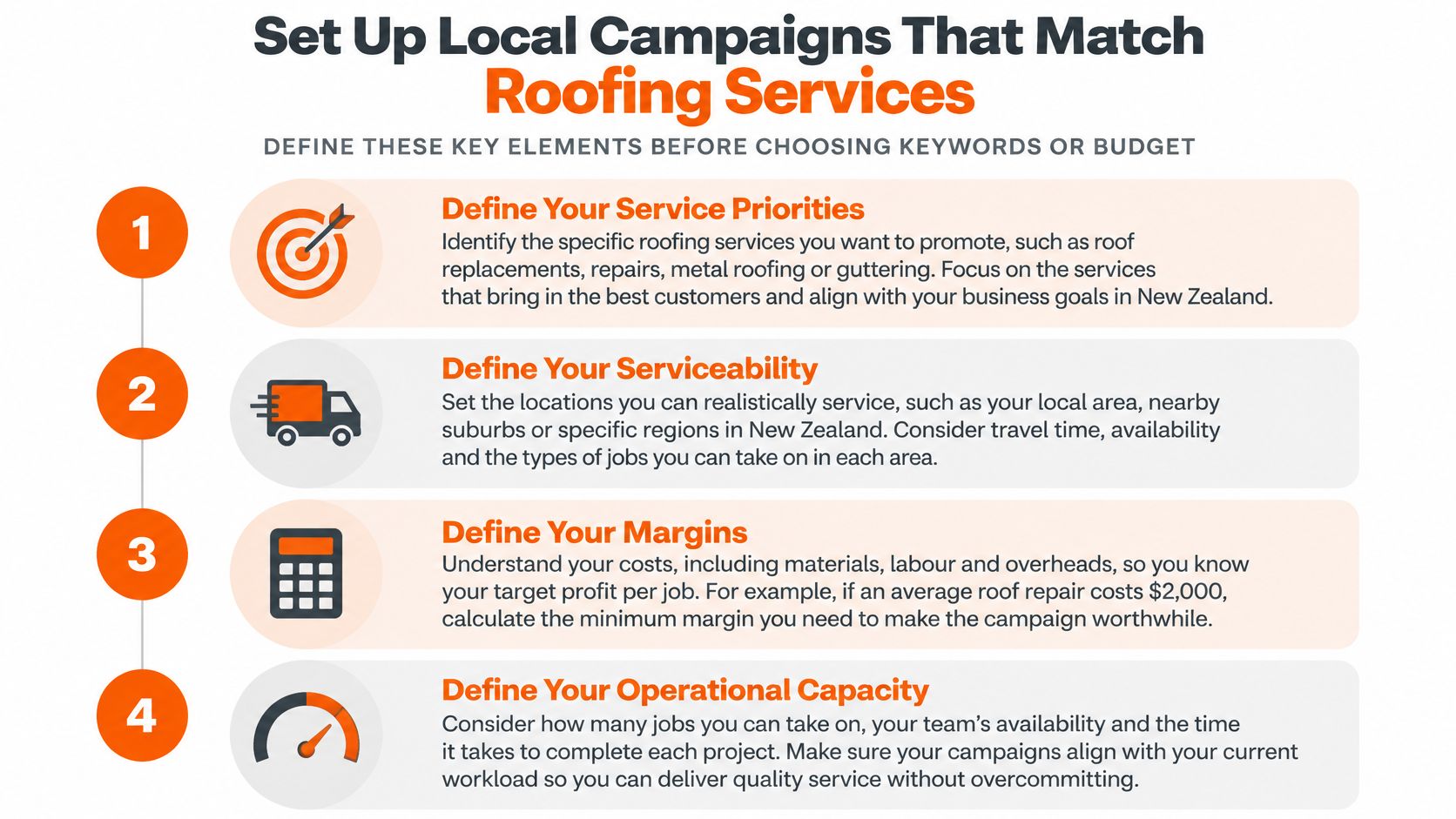
Before choosing keywords or deciding how much to spend, write down what the business can profitably quote and complete. A roofer with a strong replacement team but limited capacity for small repairs shouldn’t organise the account as if every job were equally valuable. Service priorities, travel, margins and the crew’s workload should shape the campaign structure.
Decide what to advertise and where
Start with a practical sequence:
- Set service priorities. Choose the work you want, such as reroofing, leak repair or commercial roofing. Keep services distinct if their customers, follow-up or economics differ.
- Define serviceability. List the suburbs and territories your team can cover. Exclude places that would create unworkable travel or scheduling.
- Consider job value and margin. A replacement enquiry may be more valuable than a small repair, but only your own commercial records can show how they compare.
- Check operational capacity. Ads should generate work the business can inspect and complete. If your team is already committed, widen the campaign only when you’re ready to handle more suitable enquiries.
Then match the location and service in the keyword, ad and landing page. For example, a Christchurch campaign might test phrases such as “roof repair Christchurch” or “reroofing Christchurch”. These are targeting examples, not promises of search volume, leads or sales. A matching page should identify the service, explain the coverage area and make it easy to call or request a quote.
Keep the account easy to inspect
Use names that tell you both the service and territory, such as “Repair | Christchurch” or “Commercial | Auckland”. Separate domestic and commercial intent where the offer or sales process differs. Build a negative keyword list for irrelevant searches, including employment, training, materials and do-it-yourself projects when those aren’t services you provide.
Prepare the service-specific landing page before launching. A general homepage may not give a person enough confidence that you handle their exact job or serve their suburb. If you need to check a business location’s Google Maps identifier when organising local listings, Bragly’s Place ID finder can help identify it. The account still needs a clear, consistent service area and useful page content to make local intent relevant.
Choose Bidding and Budget Controls
Bidding choices are trade-offs, not shortcuts. A tightly controlled Search campaign can make it easier to see which service and location attract the clicks, but it takes ongoing work to review search terms, adjust bids and remove irrelevant traffic. Automated bidding can respond to conversion signals, but it’s only as useful as the signals and boundaries you give it.
| Approach | Where it can fit | Main trade-off |
|---|---|---|
| Focused Search | High-intent services and defined areas | More control, with more hands-on review |
| Automated bidding | Campaigns with dependable conversion tracking | Faster optimisation, but weak conversion signals can steer spend towards low-value actions |
| Performance Max or remarketing | Broader reach or reconnecting with previous site visitors | More inventory and reach, with less certainty that every interaction reflects immediate roofing intent |
Let the work set the budget
Choose a budget around the jobs you can afford to quote and complete, not a generic cost-per-lead benchmark. A campaign that gets inexpensive forms for minor work may be a poor fit if the business needs replacement projects. In a smaller local market, blending territories and services can obscure which searches are useful and which are consuming the budget without producing suitable work.
The national search market’s size is context, not evidence that every local campaign will perform. Before expanding beyond focused Search, check whether calls and forms are being attributed correctly and whether qualified outcomes are making it back into campaign reporting. Broader campaigns can be worth testing, but they should have service, location and conversion controls.
If you’re forecasting what ad spend means for your business, understand the billing context too. This explanation of Google charging GST on AdWords in New Zealand covers a local cost consideration to factor into planning.
Decision rule: Begin with measurable, high-intent Search demand. Consider Performance Max, video or remarketing only when tracking can distinguish valuable roofing opportunities from low-quality activity and you have enough control to assess the result. Video advertising grew more quickly than search in the national market, but that doesn’t prove it will generate quote-ready roofing enquiries. Judge any expansion by the jobs it helps produce, not reach alone.
Use New Zealand Regional Keyword Examples
Auckland, Christchurch, Wellington, Hamilton and Tauranga shouldn’t be treated as interchangeable rows in one national campaign. A business operating across several territories can test each area against its own service availability, actual enquiries and completed work. That way, good performance in one location won’t hide poor-fit calls or wasted spend in another.
For example, a Christchurch roofer might build separate groups for local repair and reroofing searches, with pages that clearly confirm the services and coverage. Keyword Planner data reported for the exact phrase “roofing Christchurch” shows approximately 590 average monthly searches, with figures rounded by Google. That’s a directional demand signal, not a forecast of leads or revenue. (Canterbury search-demand information)
Use local examples as tests, not promises
An Auckland operator might focus on the suburbs their crews can reach and separate roof repair from replacement. A Wellington roofer may want different service groups or landing-page content if its team prioritises storm response and restoration. A company serving Hamilton or Tauranga can test relevant local phrases too, but it should confirm actual search terms and enquiries before moving budget based on assumptions.
A multi-service firm should also avoid treating every enquiry as equal. A domestic repair, a commercial roofing enquiry, a metal roofing project and a gutter job may differ in sales process, margin and capacity. If one group needs a site inspection and another can be assessed from an initial call, their landing pages and conversion tracking should reflect that distinction. Budget decisions can then follow evidence about suitable work, rather than the number of forms alone.
Give each territory its own feedback
Keep reporting clear enough to answer practical questions: Which service is attracting the enquiries you want? Are calls coming from areas you serve? Do replacement leads progress further than minor repair leads? When does a job become valuable enough to justify giving that campaign more budget?
Stats NZ’s building-consent release records 2,418 new dwellings consented in April 2025, with seasonally adjusted and trend figures also reported. That measures new dwelling consents, not roofing searches or contractor revenue, and it doesn’t describe demand from the existing housing stock. It’s a reason not to build the entire account around new construction: existing roofs may also need repair, replacement, maintenance or restoration. (Stats NZ building-consent data)
Measure Profitability Beyond Cost per Lead
The cheapest form submission can be the least useful result in the account. A caller might be outside your service area, looking for a supplier, or asking for work you don’t do. Another enquiry may concern a replacement job that takes longer to progress but fits the business much better. Reporting that counts both as identical conversions can teach bidding to chase volume rather than value.
Track the journey from first contact to completed job:
Enquiry → qualified opportunity → booked inspection → accepted quote → completed work and revenue
The point isn’t to complicate reporting. It’s to show where good leads come from and where unsuitable enquiries enter. Separate phone calls from forms, then assess them by service, suburb and outcome. A short accidental dial shouldn’t carry the same weight as a qualified call that leads to an inspection.
Make calls and forms useful signals
Mobile visitors need a clear way to call, while people who aren’t ready to speak may prefer a short quote form. Reporting should preserve that difference, not combine every action into one total. A call tracking setup can help connect phone enquiries with campaign activity, but the business still needs to classify what happened after the call. See this overview of call tracking software for Google Ads for one way to approach phone attribution.
Where feasible, connect the advertising account to the CRM so qualified calls, booked inspections, accepted quotes and completed work can inform campaign decisions. Avoid feeding every call into bidding as a successful lead. A supplier call, an out-of-area enquiry and a low-value repair request may need different treatment from a suitable replacement opportunity.
For a broader perspective on why lead costs vary with the nature of an enquiry, MakeAutomation’s SaaS lead generation cost insights offer useful context. The key for a roofer is to build local benchmarks from their own tracked outcomes, rather than applying a generic figure to every service and territory. National advertising spend can establish market scale, but it can’t tell you whether your account’s leads turn into profitable work.
Follow the job, not the form. If your reporting stops when a customer submits a quote request, you can’t see whether the campaign is producing work your team wants.
Build a Roofing Google Ads Operating Routine
An account gets easier to manage when the owner and agency review the same chain: service fit, location fit, enquiry quality and completed work. The owner knows which jobs the business wants, which suburbs are practical and whether the team can respond. The account manager can use that operational feedback to refine keywords, exclusions, ads, landing pages and conversion tracking.
Use a regular review to ask:
- Are searches relevant? Check search terms and add negatives for employment, training, materials, DIY or other mismatched intent.
- Are ads reaching serviceable areas? Review suburb and territory results against actual coverage.
- Do calls and forms represent suitable opportunities? Separate accidental, supplier and out-of-area contacts from qualified enquiries.
- Which enquiries progress? Compare services through booked inspections, accepted quotes and completed work.
- Do the ads and pages match the offer? Confirm that each advertised service and price claim is clear, supported and deliverable.
The Advertising Standards Authority says ads must be truthful, supported by evidence and able to meet reasonable demand. Price claims must be clear and accurate, and terms such as “lowest” or “cheapest” must be substantiated. (Advertising Standards Authority Advertising Standards Code) Before promoting a free quote, starting price or limited-time offer, clarify what it includes and make sure the team can fulfil the promise.
Start with a defined service area, a small set of priority services, matching landing pages and conversion tracking that distinguishes phone from form enquiries. Then review search quality and feed qualified outcomes back into campaign decisions. Don’t set expectations around an unverified lead volume, cost or timeline. Build the operating routine around evidence from your own market and the work your crews complete.
Bluelight works exclusively with roofing companies, managing Google Ads, roofing-specific landing pages and call and form tracking to connect enquiries with campaign activity. If you want to assess how that approach could fit your New Zealand service areas and job priorities, visit Bluelight.
Related service Google Ads for Roofers